










Final Table Takedown: Ian Pelz Wins Second-Largest Live Tournament Ever
Colorado Native Battles Through 24,629 Entries In WSOP Gladiator Event
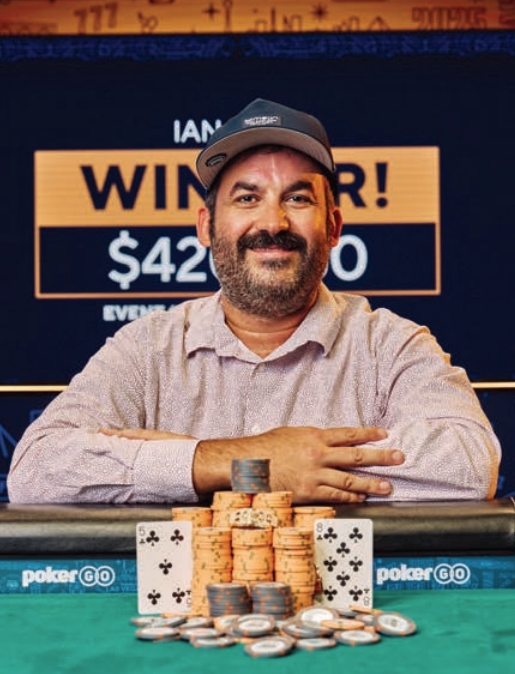 Ian Pelz started playing poker while in college at the University of Oregon during the poker boom, having graduated high school the same year that Chris Moneymaker won the WSOP main event. The Boulder, Colorado native started a career in agricultural commodities, trading and brokerage, while keeping his poker game sharp on the side.
In 2018, Pelz topped 642 entries in the $400 kickoff event at the Colorado Poker Championship, banking $47,454. The next year, he went deep in the WSOP main event, pocketing $211,945 after finishing 37th out of 8,569. Over the next few years, he would play the occasional tournament during his time off and find the winner’s circle, becoming a force in nearby Black Hawk, Colorado cardrooms.
In 2024, however, Pelz decided to take a sabbatical from his job and focus on poker. This summer he broke through, taking third in the $3,000 limit hold’em six-max event for $85,431, while winning the $300 Gladiators of Poker tournament, along with $420,680. The massive field of nearly 25,000 entries made it the second largest live poker tournament in history.
Pelz wasn’t supposed to play the low buy-in tournament, but figured he might as well after returning to the Horseshoe after a night of drinking to retrieve his car. “One hungover bullet” later, and Pelz had earned his first gold bracelet.
“I kind of just played my game and good things happened,” he said.
Card Player caught up with Pelz after his win to break down a couple of key hands he played en route to victory.
Event: WSOP $300 Gladiators of Poker
Buy-In: $300
Entrants: 24,629
Prize Pool: $6,058,734
First-Place Prize: $420,680
Craig Tapscott: When you sat down to play in this event, did you anticipate that there would be close to 25,000 entries? That’s crazy.
Ian Pelz: It’s a wild amount of players, but having made it deep in some other large fields I know that you can only concentrate on your table. I actually like the big fields since it speeds up some of the slower parts of the tournament (i.e. hand-for-hand play on the bubble).
Shout out to the WSOP for running an event of this size with such general competence. Their new app has made the experience much more seamless. If I had had to wait in line to register as opposed to clicking on my phone a couple of times, I might not even have played!
CT: You have to get lucky a few times to move through such a huge field and avoid getting unlucky when you’ve got the best of it. Please share some of the rollercoaster ups and downs you must have gone through to be the last player standing in such a huge field?
IP: I got very lucky a few times throughout the tournament. I got in an overpair versus overpair situation early on day 1 where I hit the 5% equity. I had an all-in preflop in the money day 1 where I had 8% equity going to the river. I also won a dominated all-in preflop situation with 11 left to build a maneuverable stack.
I won so many coinflips. I also lost some big pots, especially a chip lead pot on day 2 where I was a 65% favorite when the money went it. That took me down to just five big blinds with approximately 80 players left.
I have done some serious mental game work that focuses on processing the things that happen to you in poker both good and bad and allows you to recenter and move on to the next hand. Credit goes to that.
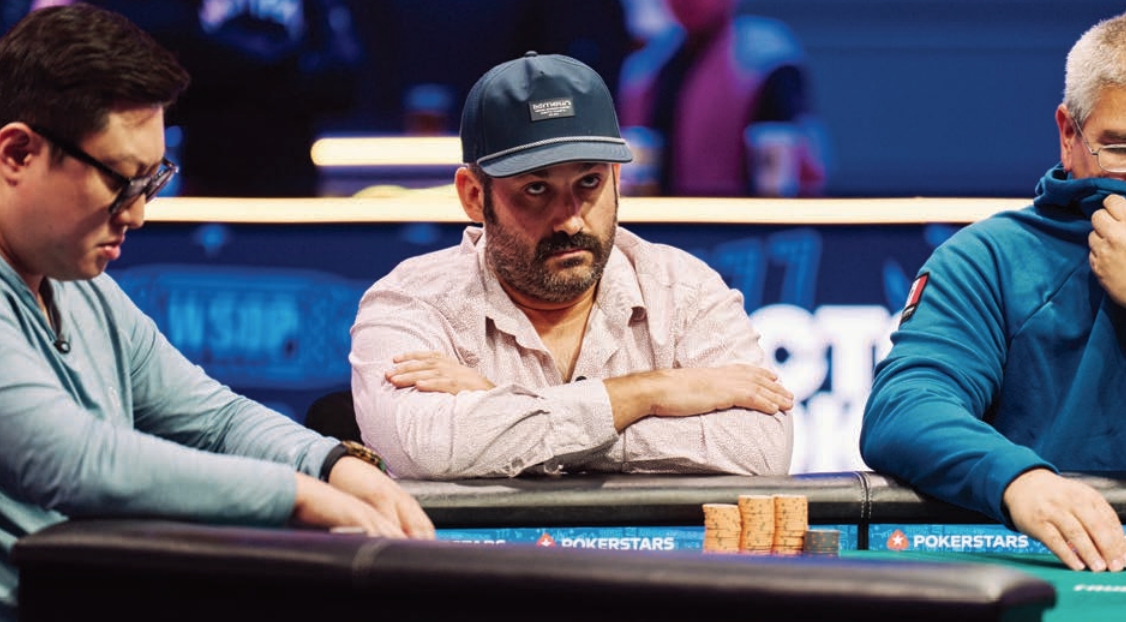
Hand No. 1
Stacks: Ian Pelz – 188,000,000 (31 BB) Villain – 124,000,000 (20 BB)
Blinds: 3,000,000-6,000,000 with a 6,000,000 big blind ante
Players remaining: 5
CT: ICM is so important at a final table. What were the stack sizes like going into this hand.
IP: I was second in chips with just over 31 big blinds, and the two short stacks were sitting on seven and six big blinds, respectively. This hand was against the button, who was third in chips with 21 big blinds.
CT: What was on your mind when it got down to five-handed?
IP: The first thing that needs to be considered is the overall tournament environment. We were in a crazy ICM environment where the pay jumps were larger than most of the players’ largest career scores. The next pay jump was equal to 96 buyins for the tournament. This was my fourth time playing on the WSOP feature table and my second WSOP final table, but it was a new and intense experience for everyone else.
The two short stacks in the blinds were doing everything they could do to outlast each other, and the button had immense ICM pressure because of their stacks. If he busted to me or the chip leader, it would be a disaster from a real money perspective. According to ICM, the button needed 17.6% higher equity to put the money in against me compared to a chip EV playing environment.
Once the chip leader folded first to act, I was in a position to exert this pressure on the opponents behind me. I could play a mixed strategy that included shoves because of how tight the button would have to call off, but versus weaker opponents I prefer to only min-raise when I enter the pot, counting on my ability to make good decisions facing resistance.
Pelz raised to 12,000,000 holding K♦7♠ from the cutoff.
IP: I pick up K-7 offsuit, a very reasonable hand to enter the pot with because of the ICM situation and the blocker effects of the king. If the big blind picked up a hand and shoved I would have to call, otherwise I didn’t have a tough decision.
Villain reraised to 24,000,000 from the button.
IP: The button unexpectedly three-bet small to four big blinds.
CT: That’s a very small reraise. Do you have any read on this player?
IP: An interesting thing about this lower buy-in tournament is that one piece of the puzzle is figuring out what the knowledge base of your opponents is. From prior conversations, I knew that the button understood the gravity of the pay jumps, and I think he understood the concept of the ICM pressure.
However, I also feel that he played ego-driven poker and that he didn’t want to let me take advantage of the situation. I had opened the prior hand from the button and taken down the blinds. So, game flow wise, he might have been suspicious and wanted to do something about it.
From observing the button’s tendencies over the last couple of days, when he had a strong hand preflop he preferred to use large sizes to protect his hand. This raise was not that, so I thought he was polarized to aces or a resteal.
CT: What did your gut tell you?
IP: I do mental game work with my longtime friend Jason Su (author of Poker With Presence), and one thing we work on is using our technical poker knowledge to trust our instincts.
My gut was telling me that the button didn’t have a hand that could call a shove for his tournament life when he was set to make nearly $100,000 by outlasting the two short stacks. If I doubled him up it would be very bad, but I would still have 10 big blinds to maneuver with and be third in chips. I decided that my read of my opponent was enough to justify trying to win the pot and make the tournament situation more advantageous, so…
Pelz moved all-in. Villain folded, and Pelz won the pot of 51,000,000.
IP: I found out the Villain had Q-10 offsuit, so I actually had the best hand. He folded and I increased my stack.
 Hand No. 2
 Hand No. 2
Stacks: Ian Pelz – 434,000,000 (43 BB) Sang Sim – 305,000,000 (30 BB)
Blinds: 5,000,000-10,000,000 with a 10,000,000 big blind ante
Players remaining: 2
IP: I was heads up for the bracelet. Like the first hand, I started thinking about the overall situation of this tournament.
I started this heads-up match at a 2.5:1 deficit but was able to increase my stack through sustained aggression (the cards were also going my way). I had just taken the chip lead, momentum was in my favor, and I could tell that my opponent was becoming very uncomfortable. He thought he was going to win at the beginning of the match but now was having major doubts.
With the big blind ante, I will never fold preflop from the button heads-up. I will play some polarized limps and raise most of my middling hands at this stack depth. I picked up 8♣5♣, which could be a limp or raise, but with the effectiveness of my aggression so far, I decided to min-raise to…
Pelz raised to 20,000,000 from the button. Sim reraised to 60,000,000, and Pelz called.
IP: My opponent raised to six big blinds. With position and a suited connector that is rarely dominated (unless he has an overpair), I chose to call.
From a game flow perspective and the dynamic described above, I also felt that this hand could win me the bracelet if it played out in my favor due to my opponent’s mental state.
FLOP: A♦8♠4♣
CT: Not a horrible flop for your hand.
IP: Not at all. I flopped middle pair and some backdoors. My opponent had a range advantage since he has a lot of A-x and I would four-bet some A-x preflop, so he could bet range for a small size, which he did…
Sim bet 15,000,000.
CT: What now?
IP: Versus this sizing, there are very few hands I would fold in position, probably only high cards with no backdoor flush draw. Due to my high continue rate and position, I would mostly play calls and see what develops. My hand was also not strong enough to put in all the money without further information.
Pelz called.
TURN: 10♣
IP: The turn gave me a flush draw along with my pair. The pot was 160,000,000 and my opponent’s stack was 220,000,000 creating an stack-to-pot (SPR) ratio of 1.375.
Sim checked.
CT: What did you make of his check? If he had an ace, do you think he would have checked in that spot?
IP: His A-x holdings should be strong enough to try to get all the money at this SPR, and the best way for him to do that was to bet the turn again rather than counting on me to bet.
When he checked, he was telling me that his hand had some sort of defect and there was a decent possibility I currently had the best hand. If I did have the best hand, he would likely have some overcards, so I benefit from protection.
CT: What were your other considerations when deciding whether to check or bet?
IP: The counterargument to betting is that I have a chance to realize my equity for free and play rivers in position. The worst outcome would be if I bet, my opponent check-raise jammed, and I had to fold.
I try to never let this happen as I like to plan ahead with my bets. So, my options were to check back or bet, setting up a river shove and committing if he goes all in. I decided I had the best hand enough and was willing to put all the money in, so…
Pelz bet 60,000,000.
IP: I bet six big blinds (37.5% pot), which left a very reasonable stack size behind to play rivers.
Sim called.
RIVER: 9♣
CT: What a card!
IP: The river completed my flush. My opponent decided to break game flow and shoved all-in.
Sim shoved.
Pelz called. Sim revealed Q♦J♦, and Pelz won the pot of 739,000,000 and the title.
IP: I quickly called, and he turned over a backdoored straight, which gave me the win.
Follow Pelz on Twitter/X @IanPelz.
- Photos by PokerGO