
Give us your opinion in the comments section below for your chance at winning a six-month Card Player magazine digital subscription.
Ask any group of poker players how you played your hand and they’ll come up with dozens of different opinions. That’s just the nature of the game.
Each week, Card Player will select a hand from the high-stakes, big buy-in poker world, break it down and show that there’s more than one way to get the job done.
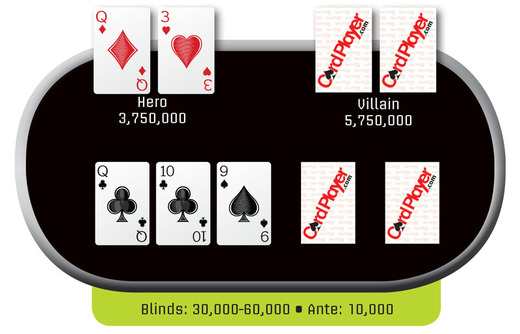
The Scenario
You are heads-up for a tournament title and are outchipped 3,750,000 to 5,750,000. With the blinds at 30,000-60,000 with a 10,000 ante, you have 62 big blinds in your stack.
On the button, you raise to 130,000 holding Q 3
3 . Your opponent calls and the flop comes down Q
 10 9
10 9 .
.
You bet 140,000 with top pair and your opponent check raises to 360,000. You reraise to 615,000 and your opponent moves all in. You have 3,005,000 remaining in your stack.
The Questions
Do you call or fold? What is your opponent representing with his all in push? What drawing hands would your opponent play this way, if any? What value hands would your opponent play this way? Is it possible that you are already drawing dead?
 What Actually Happened
Facing a decision for his tournament life in event no. 40, the $1,500 no-limit hold’em event at the 2013 World Series of Poker, Jared Hamby decided to make the call holding Q 3 on a flop of Q 10 9.
His opponent Peter Hengaskul, flipped over 10 9 for bottom two pair and Hamby was drawing to a better two pair or trips. The turn and river fell 2 2, counterfeiting Hengaskul and Hamby doubled up to 7,500,000.
Hengaskul was left with only 2,000,000 in chips and was eliminated shortly afterwards, earning $325,780. Hamby earned $525,272 and his first career bracelet.
What would you have done and why? Let us know in the comments section below and try not to be results oriented. The best answer will receive a six-month Card Player magazine digital subscription.