Give us your opinion in the comments section below for your chance at winning a six-month Card Player magazine digital subscription.
Ask any group of poker players how you played your hand and they’ll come up with dozens of different opinions. That’s just the nature of the game.
Each week, Card Player will select a hand from the high-stakes, big buy-in poker world, break it down and show that there’s more than one way to get the job done.
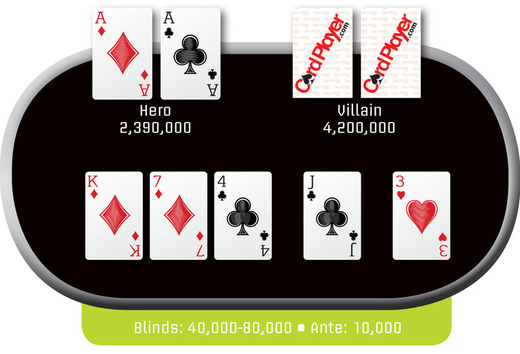
The Scenario
There are eight players remaining at the final table of a mid-sized poker tournament, dominated by local players and some out-of-town professionals. With blinds of 40,000-80,000 with a 10,000 ante and a stack of 2,390,000, you are in the middle of the pack and have plenty of big blinds to work with. There is a short stack sitting with just 11 big blinds, but for the most part, the rest of the table has a decent chip count.
The action folds around to the button, who is currently in second place with 4,200,000 in chips. He opens with a raise to 160,000. You look down at A A
A in the small blind and three-bet to 270,000.
The big blind folds and the button calls. The flop comes down K 7 4 and you continue with a bet of 215,000. Your opponent calls and the turn is the J.
You bet 305,000 and again, he calls. The river is the 3 and you bet 415,000. Your opponent thinks it over for 30 seconds before putting you all in. You have 1,185,000 remaining.
The Questions
Do you call or fold? What realistic hands are in your opponents range that have you beat? What hands are in your opponent’s bluffing range that you can beat? Do you regret your bet sizing on previous streets? Should you have opted instead to check call the river after getting call on both the flop and turn? What kind of hand do you think your opponent is putting you on based on your line?
 What Actually Happened
At the WSOP Circuit main event at Choctaw, Paul Phillips thought it over for close to a minute before calling all in with his pocket aces on a board reading K 7 4 J 3.
His opponent, Matt Kirby, quickly showed him 6 5 for a rivered straight. Phillips was eliminated in eighth place, earning $38,834. Kirby used his stack to navigate his way to a second-place finish, worth $192,751.
The eventual winner was Jeff Fielder, who banked $312,080 and his second WSOP Circuit gold ring.
What would you have done and why? Let us know in the comments section below and try not to be results oriented. The best answer will receive a six-month Card Player magazine digital subscription.