







Turn in Poker: Definition, How to Play It & Why It Matters
What Is Turn in Poker?
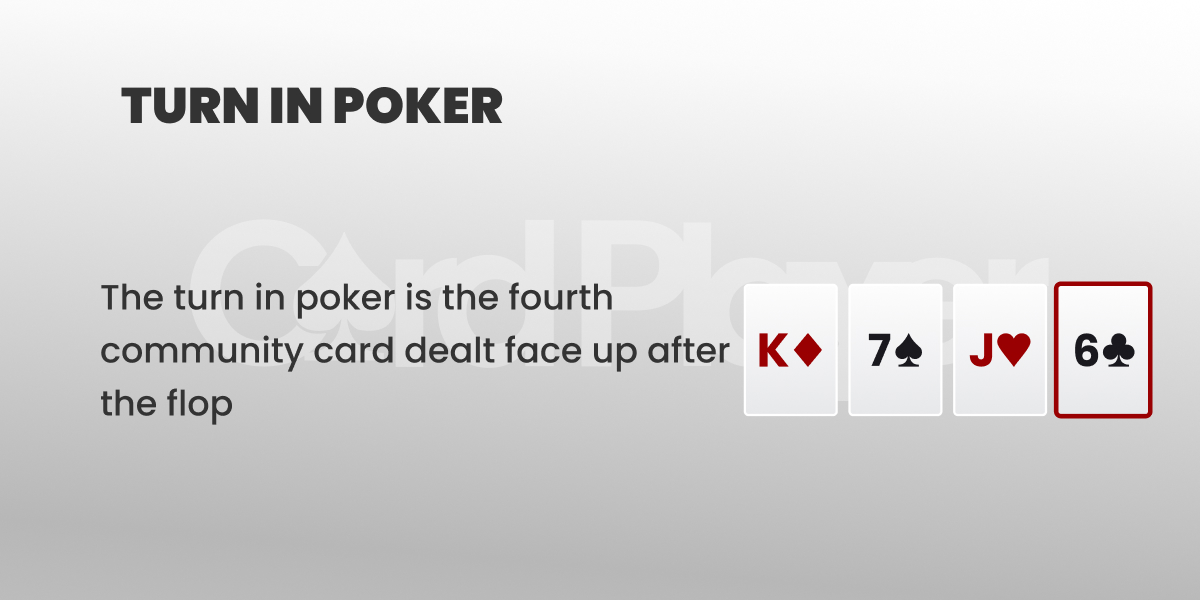
The turn in poker is the fourth community card, dealt after the flop and before the final community card, the river. It is also known as Fourth Street.
After the turn card is revealed, a third round of betting occurs. The turn card is strategically important because it significantly alters which player’s likely hands interact best with the board. Because of this, this betting street requires a strategic and methodical approach.
Turn in Poker: Key Points
- The turn is the fourth community card, dealt after the flop, followed by the third betting round.
- This betting round can significantly alter the board dynamic, including changing the best possible hand (the ‘nuts’).
- Because of the number of revealed community cards and the size of the pot at this point in the hand, the turn is often a key street.
In the next section, we explain where the turn fits in a poker hand, why it is important, give examples of common scenarios, and discuss basic turn strategy.
Where the Turn Fits in a Poker Hand
As we mentioned, the turn is the fourth community card, but understanding its role requires context of how it fits within the complete hand structure across all streets:
- Preflop: Players receive two private hole cards. The two players to the left of the dealer place forced bets known as the small and big blind. A round of betting begins with the player to the left of the big blind. Players can call, raise, or fold.
- Flop: All players who call the biggest bet made preflop get to see the flop. The dealer burns a card before dealing three face-up community cards. Another round of betting begins with the player to the left of the dealer. Again, players can check, bet, call, raise, or fold.
- Turn: If at least two players remain active after the flop round of betting, the hand proceeds to the turn. The dealer burns another card and deals a fourth community card. A third round of betting takes place, following the same process as the flop.
- River: If at least two players remain active after the third round of betting, the final community card is dealt after another card is burnt. Then the final round of betting takes place, following the same process as previous streets.
This pattern repeats with each new hand and is consistent across both online poker sites and live action.
In No-Limit Hold’em, players make their best five-card hand, which can be composed solely of community cards. In Pot-Limit Omaha, players also make their best five-card hand, but must use two of their four hole cards.
How the Turn Works (Step-by-Step)
Below, we explain betting on the turn, why it is an important street, and set out common scenarios.
Betting on the Turn
The first active player to the left of the dealer acts first and can check or bet.
Subsequent players can check, bet, raise, call, or fold, depending on the previous action. As the turn can considerably alter the strength of the range of potential hands available to each player, and only one more card and round of betting remain, any bets made at this point will make up for a larger percentage of the pot than those on the flop. In No-Limit games, there is no limit on the amount of any bet on any street.
In most fixed-limit structures, the maximum bet size doubles on the turn and the river.
Why the Turn Is Important in Poker
The turn is important because at this point in the hand, the pot is often inflated, and the potential hands each player may hold have narrowed after two rounds of betting.
Depending on the stack and bet sizes, continuing can leave a player pot-committed. Fourth Street can often alter the nuts and which player is more likely to hold it. It is often the point at which a player must decide whether they are seeking value, protection, or a pot control with a made hand, running a bluff with or without equity, or giving up on the hand.
A good line can set up a profitable river one. A bad line may leave you on the river with difficult bet sizes, pot-committed with weak hands, or without viable bluffs.
Common Turn Scenarios
- Completes a flush or straight: On a flop of A♣T♣2♦, the Turn brings the 8♣ (flush), or the J♦ (straight). This changes the best possible hand and may slow down the flop aggressor while opening up bluffing opportunities for opponents.
- Pairs the board: On a flop of A♣T♣2♦, the Turn brings the T♠. This can often kill the action.
- ‘Blank’ card: On a flop of A♣T♣2♦, the Turn brings the 6♠. Often, a green light for continued aggression from the flop aggressor.
- Changes the strongest possible hand: On a flop of T♦8♦3♣, the Turn brings the A♠. This changes the range advantage versus the big blind.
Example of the Turn in a Poker Hand
At blind level 100/200/200, Player A raises to 500 from the cutoff with K♣Q♠, and Player B defends the big blind with 7♦6♦.
- The flop comes K♦ 4♠ 3♣. Player A bets small to extract value, giving Player B a good price to call with a wide range of hands. Player B check-calls because he is getting decent odds with a drawing hand.
- The Turn brings the 9♦, significantly improving Player B’s position with a flush draw. Play B checks.
If Player A bets again, assuming a 50-75% pot size, there is almost no prospect of Player B folding because of the turn, and a check-raise becomes an attractive potential option for Player B.
Player B has a weak hand, with the potential to make a very strong hand on the river. Calling allows him to be certain to see the river, while a check-raise opens the possibility of getting better hands to fold, but reopens the action.
Turn Strategy Basics
Often, a sound basic strategy is to check or bet big.
This is because the potential hands each player may hold is reduced, and the stack-to-pot ratio is lower. On Fourth Street, it will often become clearer whether your purpose is to bet for value, to protect a made hand, to semi-bluff with strong draws, to get a better hand to fold, to pot control or get to showdown with medium strength hands, or indeed, to give up.
The first four purposes generally lean towards bigger bet sizes, potentially including overbets, whereas the final three are generally served by betting smaller or checking.
In Omaha, this street is more complex. With four hole cards, there are more combinations, redraws, shifts in equity, and nut-changing cards. Equities generally run significantly closer in this format.
Turn vs Flop & River
On the flop, the number of potential hands will generally be at its widest, while stack-to-pot ratios will be at their highest.
Possible hands narrow and the stack-to-pot ratio decreases as the hand progresses to the turn, reaching its peak at the river.
On the river, there is no longer any possibility of semi-bluffing, and any betting is generally for value or a bluff. Players may be more inclined to take medium strength hands to showdown.
FAQs
How many community cards are on the table after the turn?
There are four community cards on the table after the turn. The flop brings three cards, and the turn adds a fourth.
When is the turn card dealt during a hand?
The turn card is dealt after the flop betting round concludes. Once all players have acted on the flop and any bets are resolved, the dealer burns one card and then deals the fourth community card face-up. This begins the turn betting round.
Why is the turn also called Fourth Street?
The turn is called Fourth Street because it’s the fourth community card dealt to the board. This naming convention comes from stud poker games, where cards dealt in sequence were called “streets”.
How does betting work on the turn?
Turn betting follows the same structure as other rounds. In limit games, bet sizes typically double compared to preflop and flop. Action starts with the first active player left of the button, who can check or bet. Players can check, bet, call, raise, or fold when facing action.
Why is the turn considered a key decision point in poker?
A key decision point because the pot is often inflated and ranges have narrowed after two rounds of betting. It is often where players must decide their purpose in the hand.
Does the turn work the same way in Texas Hold’em and Omaha?
It is more complex in Omaha. With four hole cards per player, there are more combinations, redraws, and nut-changing cards.