







Gutshot in Poker: Definition, Odds, Strategy, and Examples
What Is a Gutshot in Poker?
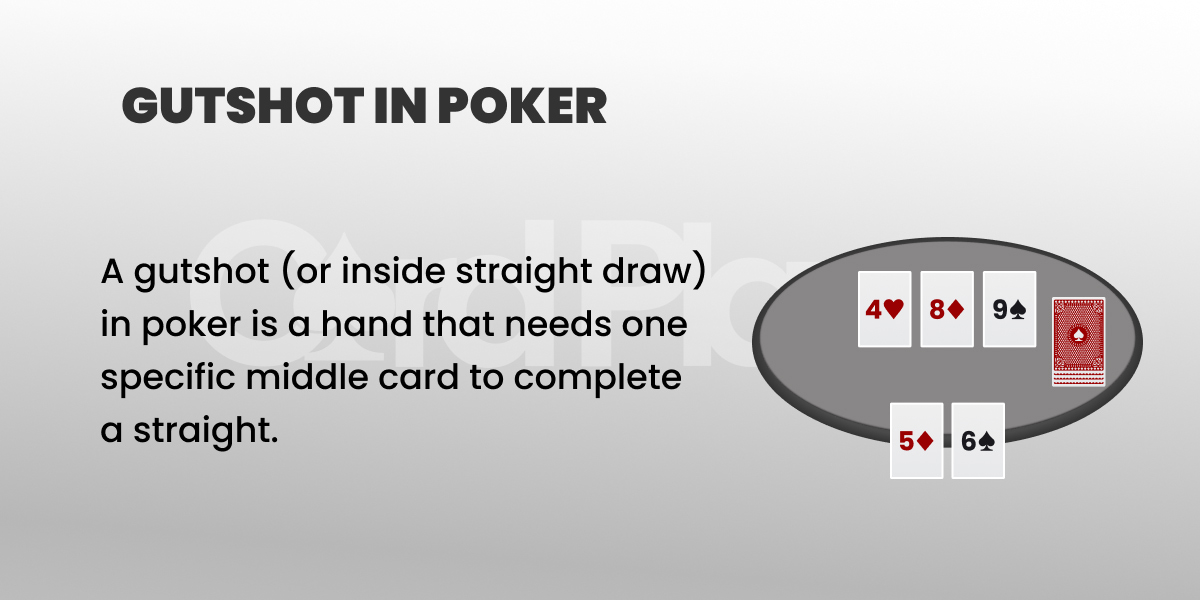
A gutshot in poker is a straight draw that requires a card of a specific rank to complete the straight.
This type of draw is often referred to as an inside straight because the missing card sits inside the sequence rather than on the outside. For example, holding 8-7 on a board of J-10-4 creates a gutshot straight draw because only a 9 gives you a straight. This contrasts with an open-ended draw, where two ranks of cards can complete your straight.
When new players begin to develop their poker strategy, this becomes a key difference to understand.
Gutshot in Poker: Key Points
- A gutshot in poker is an inside straight draw where you need one specific card rank to complete a straight.
- A gutshot straight draw has four outs because only the four cards of the missing rank can complete the straight.
- A gutshot straight draw usually requires stronger pot odds or implied odds than other draws because the chance of hitting it is lower
Gutshot vs. Open-Ended Straight Draw
Because there is only one rank that can increase the player’s hand strength, this draw offers half the number of outs that an open-ended straight draw offers.
Both draws have the possible outcome of making a straight; nevertheless, their methods of success differ. When the card you need fits somewhere in the middle of your hand, you have a gutshot straight. For example, if you hold Q-J and the board is 10-8-2, a 9 is what you need to make a straight.
Since there are four 9s in the deck, this particular draw puts four outs on the board.
An open-ended straight draw is possible if your cards give you a better opportunity to complete your draw with two different cards of different ranks on both ends. Once again, let’s use the same flop of 10-8-2, but this time we have a J-9 hand. Now we need a 7 or a Queen to make our straight.
Our open-ended straight draw has eight outs, twice as many as the gutshot draw.
Summing up, open-ended straight draws can be played more aggressively because of the high chances of making them. Gutshot draws, however, require consideration because the odds of completing them are lower.
Gutshot Odds and Probabilities
Because a gutshot straight draw has just four outs, it’s important to understand the basic math behind it. Poker probabilities help beginners avoid investing too much in a low-probability outcome.
When you see the flop with a gutshot draw in Texas Hold’em:
- The chance of hitting your gutshot straight on the turn is about 8.5%.
- The chance of hitting by the river, with two cards to come, is about 16.5%.
No matter what gutshot straight draw you have, these numbers stay the same.
Knowing that you only have a one in six chance of improving from the flop to the river can help you determine when to call and when to fold. Straight draw odds are very important here because they tell you if your call will be profitable in the long run.
Compare these probabilities to the pot odds being offered.
If the pot isn’t offering favorable odds, folding becomes the correct play. A gutshot straight draw becomes playable when the pot is large enough to justify the call, when implied odds are strong (meaning you expect to win additional chips if you hit), or when the situation allows for effective semi-bluffing.
Gutshot Strategy for Beginners
The first step to playing gutshots well, whether you’re playing online poker or in a casino, is to understand the board texture.
When you’re out of position, playing a gutshot becomes more difficult. Your opponent controls the betting action, which means they can dictate pot size and apply pressure. Since you currently have a weak hand that needs to improve, being out of position leaves you vulnerable to further bets that make continuing expensive.
When you’re in position, a gutshot straight draw can become a powerful semi-bluffing tool.
Position gives you control over the action, allowing you to apply pressure when your opponent shows weakness. This creates two ways to win: either you hit your gutshot, or your opponent folds to your bet.
This dual-path strategy makes gutshot draws much more playable in position.
Understanding Gutshot Hand Strength
New players should keep in mind that a gutshot draw does not count as a made hand in poker.
The strength of the final hand still depends on the board texture, even if the gutshot straight looks promising. Some gutshots make the lowest straight possible (referred to as the “vulnerable straight”). For instance, if you have 5-4 on a board of 8-7-3, you can draw a gutshot straight to a 6.
If the 6 comes, higher straights are still possible, and your straight may still lose.
In other gutshot straight situations, you can make the nut straight. If the K comes, holding A-Q on a board of J-10-4, you have a gutshot to the best possible straight. You can play this situation with more confidence because it’s stronger and, barring anything like a flush run-out, is a guaranteed winner.
Knowing how strong your gutshot hand is can help you avoid overplaying weak hands and teach you when your straight is truly strong.
How to Play a Gutshot Straight Draw
To play gutshots well, you need to know your opponent’s tendencies, pot odds, and implied odds.
One easy way for beginners to start is to play gutshot draws more aggressively when they are in position and more carefully when they are out of position. A gutshot straight draw almost never has the right odds when there are big bets on the table. In these situations, folding is usually the best thing to do unless the pot is big or the implied odds are high.
If you have fold equity, raising with a gutshot draw works.
Besides hitting your gutshot, semi-bluffing gives you another way to win the pot. A gutshot inside straight draw is a good way to semi-bluff against players who fold too often to aggression.
Common Mistakes with Gutshot Draws
Beginners often treat gutshot draws as if they are almost certain to improve their hand.
There’s a fallacy to this logic, and there are several mistakes that many new players need to avoid making.
Poor Judgment
The excitement of completing a hidden straight often clouds judgment. Calling too frequently is the most common mistake because the actual odds of hitting the inside straight are low.
Ignoring Position
A second common mistake is ignoring position. Calling with a gutshot when there are still players to act behind you leaves you vulnerable to further betting. If your opponent continues to apply pressure, realizing your draw becomes expensive.
Missing Implied Odds
A third mistake involves overestimating how much you’ll win when you hit your gutshot.
Just because you complete your gutshot straight doesn’t mean you’ll profit. If you make the lowest possible straight, your opponent may hold a higher one. You should exercise caution when the board texture allows for stronger straights, as hitting your draw could actually cost you more chips.
Real Examples of Gutshot in Poker Hands
Think about a hand where you have Q-J and the flop is 9-8-2.
You can only get the straight with a 10, which is a classic gutshot straight draw. If your opponent continuation bets (c-bets) and you are in position, whether to call or raise depends on how you read their range and how much money is in the pot.
A-5 on a flop of 7-4-3 is another example.
A 6 completes this gutshot draw. If the pot is small and someone bets big, it’s best to fold. But, if two or more players show weakness, betting the draw can work as a semi-bluff, especially if you’re in position.
Knowing how to handle a gutshot straight draw helps distinguish between emotional and strategic choices. New players should learn when to pursue these draws and when to fold, saving money by understanding odds, position, and hand strength.
FAQs
What does gutshot mean in poker?
In poker, a gutshot is an inside straight draw that needs a specific card rank to finish the straight.
What are the odds of getting a gutshot in poker?
The odds of hitting a gutshot from flop to turn are about 8.5%. The odds go up to about 16.5% from flop to river.
What’s the difference between a gutshot and an inside straight?
A gutshot straight draw is also called an inside straight draw.
How many outs does a gutshot straight draw have?
There are only four cards in the deck that can complete a gutshot straight draw, so it has four outs.
Should you chase a gutshot draw in poker?
Whether or not to chase a gutshot depends on the pot odds, your position, and the implied odds. Beginners should avoid calling big bets with weak gutshots.
What is the difference between an open-ended straight draw and a gutshot?
To finish the straight, a gutshot needs one specific rank. There are two different ranks that can complete an open-ended straight draw, and it has twice as many outs.