







Backdoor Draw in Poker: Definition, Strategy & Backdoor Draw Equity
What Is a Backdoor Draw in Poker?
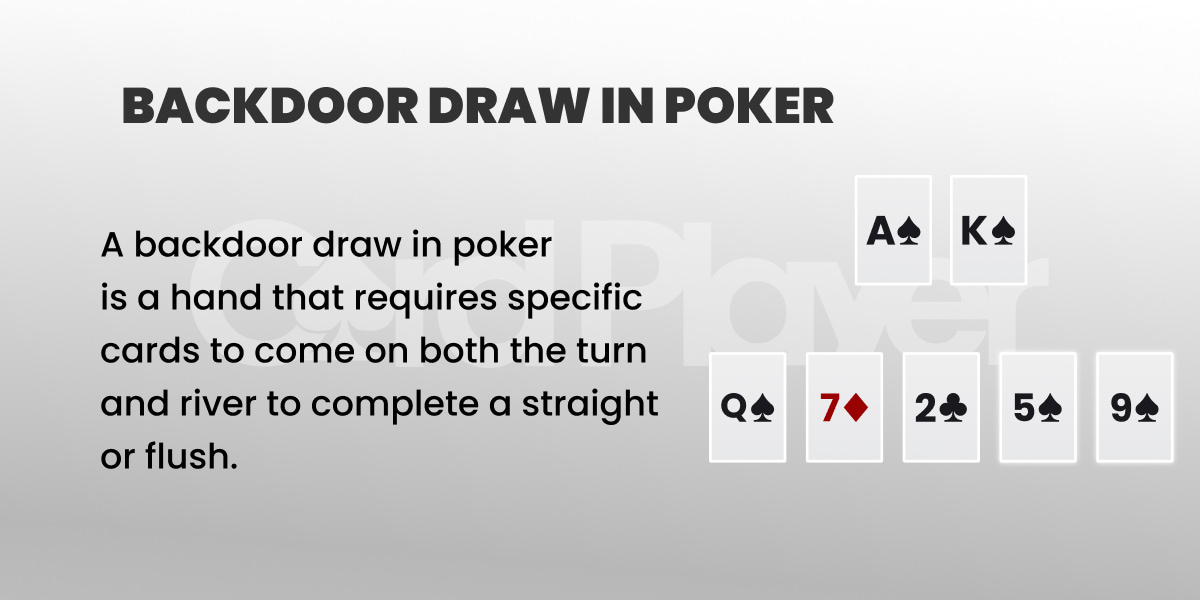
A backdoor draw in poker is a hand that needs two specific cards, one on the turn and one on the river, to become strong. Unlike a regular draw that needs only one card, a backdoor draw requires both remaining community cards to go your way, which is why it is also called a runner-runner draw.
Backdoor Draw in Poker: Key Points
- You need both the turn and the river to complete your hand because you’re two cards short after the flop.
- These hands are often called a runner-runner draw because you need two cards to “run” out in your favor back-to-back.
- While backdoor draw are hard to hit, they add a little bit of extra value to your hand.
Backdoor Draw vs. Draw
The main difference here is how many cards you still need to complete your hand.
- A “regular” draw is much stronger because you need one more card. For example, with four cards to a straight, you have roughly an 18% chance to hit it on the next card.
- A backdoor draw is much weaker because you’re starting with only three cards toward your goal. You must hit the right card on the turn just to have a chance on the river.
If you don’t hit the right card on the turn, your draw is dead. You can’t catch up anymore. This is why a regular draw is usually worth betting on, while a backdoor draw is more like a “bonus” feature of your hand.
Types of Backdoor Draws
There are two types of backdoor draws in poker.
Backdoor Flush Draw
The backdoor flush draw happens when you have two cards of the same suit in your hand, and only one card of that suit shows up on the flop. Since a flush requires five cards, and you only have three, you need both the turn and the river to be of the same suit to complete it.
This type of backdoor draw is effective because it’s well disguised. Since the flop doesn’t show an obvious flush threat, opponents often feel safe and don’t expect the flush to come together later.
Backdoor Straight Draw
The backdoor straight draw occurs when you need two very specific cards on the turn and river to complete a straight. For example, if you hold a 7 and an 8 and the flop comes K-2-9, you technically have the beginnings of a straight, but you’re far from completing it.
If the turn brings a 6 and the river brings a 5, you end up with a straight—but only because both cards arrived in the exact order you needed. This makes backdoor straights hard to spot and easy for opponents to underestimate until the hand is over.
Backdoor Draw Odds and Equity
Because you need two specific cards—one on the turn and one on the river—backdoor draws provide very little equity. A backdoor flush draw has roughly a 4% chance to complete from the flop, meaning you’ll only hit it once every 25 hands.
While backdoor flush draw odds are low, they aren’t zero. If you already have a made hand, like a pair, that extra equity can sometimes justify continuing in the hand.
Backdoor straight draws are even weaker, usually offering around 2% to 3% equity, depending on the exact card combinations involved.
Even with such small percentages, experienced players factor backdoor draws into their calculations in both online poker sites and live tournaments, looking for every possible edge.
Common Mistakes with Backdoor Draws
A lot of new players get into trouble because they think a backdoor draw is better than it really is. Here are the four most common mistakes with backdoor draws in poker.
- Chasing when the bet is too big. You should not pay a large sum to see the next card if all you have is a runner-runner draw. The math just doesn’t work out.
- Ignoring the cards on the table. Sometimes you might hit your backdoor flush, but the board also pairs up, giving someone else a full house. Always look at the whole picture.
- Overestimating your backdoor draw equity. Just because you have a 4% chance doesn’t mean you should play the hand like you’re the favorite to win.
- Forgetting to bluff. Sometimes, a backdoor draw is a good hand to bluff with because if you don’t hit your card on the turn, you can still try to represent a different hand, but this is a more advanced move.
The key is to treat backdoor draws as a small bonus to your existing hand strength, not as a reason to call by themselves.
FAQs
What is a backdoor draw in poker?
A backdoor draw is a hand that needs two specific cards on the turn and the river to become a finished hand, like a flush or a straight. You have three cards out of the needed five.
What does runner-runner mean in poker?
It means the same thing as a backdoor draw. It refers to needing two cards in a row (the “runners”) to come out of the deck to help you win.
What are the odds of hitting a backdoor flush draw?
The backdoor flush draw odds are usually about 4.2%. It’s not very likely, but it happens enough to be a factor in your strategy.
How much equity does a backdoor flush draw add?
It usually adds about 3% to 4% backdoor draw equity to your hand. This is helpful if you already have a pair or another way to win.
Should you chase backdoor draws?
You should not chase them if the cost to see the next card is high. However, if the bet is very small or you are checking, it’s a nice bonus.
What’s the difference between backdoor draw and regular draw?
A regular draw needs only one card to complete (like 4 cards to a flush), while a backdoor draw needs two cards (like 3 cards to a flush).
What is a double backdoor draw?
This is when you have a chance to hit both a backdoor straight and a backdoor flush at the
same time. This is a much stronger hand because you have more ways to win.
What are the odds of hitting a backdoor straight draw?
The odds are usually lower than a flush, often around 2% to 3%. It depends on whether the cards you need are “open” or if you need specific “inside” cards.