


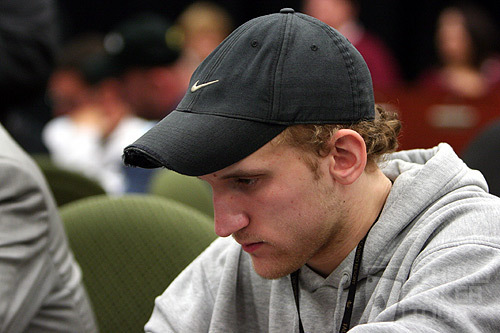
 Jason “JCarver” Somerville has been one of poker’s most consistent talents for the last three years. In 2007, during Card Player’s inaugural Online Player of the Year race, Somerville finished in 14th place and pocketed $458,360. The next year, despite taking more time off to play in live tournaments, Somerville still managed a 54th-place standing and earned an additional $357,573.
Somerville, who also plays online as Taknapotin, took some time out to talk to Card Player about strategy and his position as a poker instructor.
Julio Rodriguez: To start off, we’ve been seeing more and more of you at these big live tournaments. How has your transition gone so far?
Jason Somerville: It’s been an experience. I’m glad I have good friends like Vivek [Rajkumar], who has done really well. I give him a lot of credit for helping me become more confident in my live play, even though the results in the past six months haven’t been exactly where I want them to be. I cashed three times during the WSOP, but other than that it’s been a lot of small cashes here and there, nothing big. Still, I know it’s just variance and that my big live breakthrough is coming soon.
JR: What has been the biggest challenge in switching from online to live play?
JS: I think there’s a difference in terms of adjustments you have to make with the general style of play you encounter. For instance, people don’t bluff as much.
JR: How do you adjust for that particular situation?
JS: Well, you just have to be able to believe people more often. You need to be aware of those players who aren’t tricky and those who are. Having joined Poker VT recently and being able to work with Daniel Negreanu, who is obviously a sick live player, has helped me a ton in being able make adjustments.
JR: What are your responsibilities for Poker VT?
JS: I work as an instructor there, producing educational content, and I also help them out with their online forums.
JR: Are you the type of player who will put in a lot of volume and really grind it out?
JS: To be honest, I never was that type of player. I started out as a cash-game player and moved over to tournaments. Now, I just play whatever I feel like, in addition to the obvious Sunday tournaments.
JR: Speaking of Sundays, you seem to have a special ability to do well in those larger-than-normal fields.
JS: I do well in Sunday majors. My style translates particularly well to tournaments like the Full Tilt $750,000 guarantee, which I’ve gotten heads up in three times and won twice. A lot of it is definitely variance, meaning I’ve obviously run well to get to that point, but my style has a lot to do with it.
JR: Well, you can compare that to a tournament like the $200 rebuy…
JS: Which I never play, by the way.
JR: Do you feel like you play better against weaker competition?
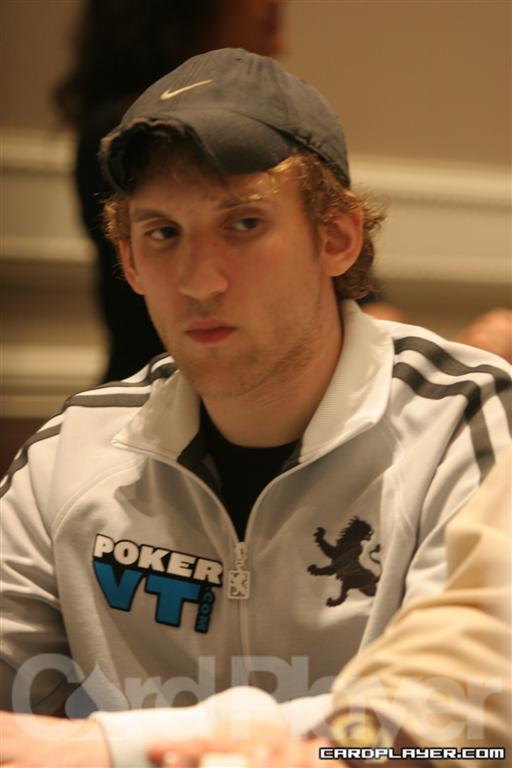 JS: I feel like I’m good at exploiting bad players, and due to my cash-game background, I feel like I’m good at manipulating even good players post-flop. In these tournaments, I can take control of the table and have it pretty much go my way, whereas in other more pro-heavy tournaments you have to fight to get the table to cooperate.
JR: Do you find yourself gunning for the weak spots at the table and going out of your way to play pots with them?
JS: I don’t really feel that way. I just concentrate on making the best decisions possible at every opportunity. My real edge in tournaments is that I’m pretty good at thinking through each situation and really getting down to the root of each problem, not so much in a mathematical sense, but more in the feel of the game.
JR: Is there any frustration in seeing your friends take down million dollar prizes every month while you are on the outside looking in?
JS: It’s a little frustrating, but truthfully I’m really happy for all of their success. Kevin “BeLOWaBOVe” Saul won at Bellagio last season, and this particular year has been ridiculous. Amit “amak316” Makhija and Luke “IWEARGOGGLES” Staudenmaier both made WPT final tables, and Vivek “psyduck” Rajkumar and Mike “sirwatts” Watson both won, as well.
JR: But certainly you’re not the only successful online player waiting his turn to take down one of these things.
JS: Right, I wouldn’t even use the word frustrating. I have a lot of faith in my game, especially online. I’m fairly confident that as I keep adjusting and adapting my game to the current situation that it’s just a matter of time. Hopefully it’s sooner rather than later, but that isn’t always up to me.
JR: Because of your Poker VT affiliation, have you adopted Daniel Negreanu’s heralded small-ball strategy at all?
JS: You know, it’s funny. Like most good online players, I used to laugh at some of the stuff he did. Daniel is obviously very good at what he does, but in most online players’ eyes, he has some obvious fundamental leaks in his game. Of course, that may or may not be true since a lot of it is based on misguided assumptions. But a lot of what he’s doing, the min-raises, the checking in position, it really works. I won a $150 buy-in tournament on Full Tilt just using that strategy, and I was amazed at how much easier my decisions were in certain spots. We don’t three-bet a lot, we call a lot, and we basically play loose-passive poker. Many will disagree with me, but it really does work well against most tournament fields. I mean, just look at his results, for example.
Another thing that worked out well for me what that my prior image was so aggressive. If you go back and look at my hand histories, you’ll see that I was consistently three-betting and four-betting wildly and making these ridiculous hero calls. I’m not saying I’m a super well-known player, but people reputations to go around and players adjust accordingly, so I’ve been able to take advantage of that.
The game in general has gotten more aggressive, as well. If you watch a tournament these days as opposed to two years ago, you’ll see way more players pushing the action than ever before. You have to open A-9 offsuit and call a shove more often than before just because that’s the current nature of the game. I think the loose-passive style of play is a good way to adjust right now.
JR: Do you think you could win with your old style of play right now?
JS: Of course, when you are a good player, you can pretty much utilize any style of play and be successful. I could go back to playing the old way and blow people off their hands with aggressive preflop play, but right now it’s all about minimizing my variance and getting maximum value when I’m ahead and little things like that. It highlights my strengths as a post-flop player, because you call a lot and don’t risk as much preflop while playing pots in position. I just think it’s probably the most +EV [positive expected value] way to play at the moment.
JR: There are players out there who have successfully transitioned from online players to live players, but is there still a sense of division between the two communities?
JS: I think there is a slow merge developing between both communities. More and more players are beginning to straddle that line where you’re not quite sure what to label them anymore. Then again, I talked to Chris Ferguson at Foxwoods and he couldn’t name a single online player off the top of his head. [Laughing] So, I guess that division still exists, but for the most part I know a lot of the younger live pros are making the effort to bridge the gap.
JR: [Laughing] So, 10 years from now do you see a Utopia of poker where a player like Kathy Liebert could sit down at an online table as an equal?
JS: [Laughing] I don’t know about that, simply because I think it’s harder to go from live to online than the other way around. You can build a winning game live that has huge gaps in the fundamentals. You see players do such terrible, weird things all the time like raising half of their stack and then folding to a shove. Things you’d never see a good online player do in a million years.
Having to go from live to online is going to be tough for those players who all of a sudden have to play hundreds of thousands of hands and can’t rely on those crutches that live play affords. A player like Kathy — who is excellent, by the way — is so good at reading her opponents that she or anyone else with those skills can sometimes get away with a mathematically incorrect decision here and there. They can make up for their lack of the basics by playing poker by feel, which is something that is very difficult to do online. If they can’t use those skills which they’ve become dependant on, then they’ll either have to catch up to the rest of us or fail.