


 Simultaneous Omaha and Hold’em doesn’t exactly roll off the tongue, thus it’s often more conveniently referred to by its acronym SOHE (pronounced: so Hee).
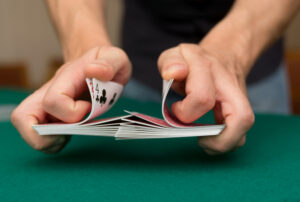
Everyone is dealt six cards, and on the first round of betting anyone contesting the pot must split their holding into a two-card Hold’em hand and a four-card Omaha Hand.
The split must be clear and obvious, and remain unchanged throughout the entire hand. Chips and/or card protectors may be used for the purpose of keeping the two different hands organized.
After the pre-flop action and splitting takes place, play proceeds in a normal fashion where at showdown the best Hold’em and Omaha hands chop the pot.
Some hands set themselves. For example, with A A
A J
J 10
10 8 7 you would want to play the two aces in Hold’em and the excellent double-suited rundown holding in Omaha.
When dealt six cards the probability of being dealt aces is around 6.1%, giving you at least one half of a very strong holding.
Since a pair of aces are so powerful in Hold’em they should often be kept intact, however, when dealt a hand such as A A K 9 8 7 it would probably be best to break them and organize as A K/ A 9 8 7. Many pots tends to go off multi-way, and this decision would result in two separate hands that play well against a large field.
You are also going to be dealt a pair of kings relatively often, where a large amount of the hands containing them would be highly playable, but it’s preferable to either hold an ace or have a decent Omaha holding. When not holding an ace ourselves, every opponent that may yet contest the pot has an approximate 7.4% chance of waking up with a pair of them and have you dominated in Hold’em. From early position with six players left to act, the probability is around 37% of ending up in this undesirable situation.
Since we must sometimes be concerned with a pair of kings, it should be clear that there’s nothing special about being dealt a pair of queens in a six-card game. A hand such as Q Q J 9 7 4 is a speculative hand, and probably only worth playing for a single bet in late position. One of the biggest traps in any split game are marginal two-way holdings as it’s easy to overrate their overall prospects, and they often offer reverse implied odds.
There are other holdings that may look marginal, but have the ability to make nut hands while sharing outs that can be used in both Hold’em and Omaha in which the right boards could provide decent scoop equity. Consider a hand such as A 10/ K J 6 3; while it’s quite weak in Omaha it can offer certain playing advantages.
When playing the A 10 combination in Hold’em, there are several cards that can arrive on the flop that would put you in the running to win both sides of the pot. These would be the four pairing hearts, and the other kings and jacks that may bring a Broadway straight draw. When picking up a nut draw in Hold’em, you then have a license to get aggressive which may limit the field and promote your chances of winning in Omaha.
Medium and small pairs aren’t much to write home about in either game, and occasionally we are dealt a holding such as A 8 8 7 7 6 that can make our head hurt as we try and sort through our various options. Which split would you prefer?
No. 1 – A 7 / 8 8 7 6
No. 2 – 8 8 / A 7 7 6
No. 3 – 8 7 / A 8 7 6
No. 4 – 8 6 / A 8 7 7
My guess is that all of the above probably result in a similar expectation, but option no. 3, which involves breaking both pairs, would probably be my preferred play. I’m not interested in flopping a medium set in Omaha, and boards containing sixes, fives, and/or fours might be quite helpful for both hands.
SOHE can run slow at times as there is often much to consider and review. Players first need to determine if their holding is worth a play and if so, shuffle the cards around in an attempt to optimally split. Then once the flop comes down it can take some time to ascertain your prospects for both sides.
If there happens to be a few thinking professors at your table not wanting to let any ounce of expected value escape from their grasp, it can become painfully slow. It’s always important to try and maintain an enjoyable atmosphere, and this means not sweating every little decision.
Another point to consider is that if someone really wants to cheat at SOHE by altering their split, they will probably have decent opportunities to do so. This usually isn’t a big concern for most players and the games they play in, but it’s something to keep in mind.
While there are a few potential drawbacks, SOHE is fun to play and the dynamic of having to split your hand and thus directly impacting your own fate is quite unlike any other form of poker. It’s also another flop game to add which is always beneficial in mixes that are often dominated by draw games.
In a vacuum, I’ll assign the game a rating of 6 out of 10, however, the game is highly lineup contingent. If you have a fun group that plays fast, it can be quite an enjoyable change of pace variant to work into the rotation. ♠
More From This Series
Introduction
Old School Dramaha
Super Sized Stud Hi-Lo
Badugi Dramahas
 Kevin Haney is a former actuary but left the corporate job to focus on his passions for poker and fitness. The certified personal trainer owned a gym in New Jersey, but has since moved to Las Vegas. He started playing the game back in 2003, and particularly enjoys taking new players interested in mixed games under his wing and quickly making them proficient in all variants. Learn more or just say hello with an email to haneyk612@gmail.com.