
Give us your opinion in the comments section below for your chance at winning a six-month Card Player magazine digital subscription.
Ask any group of poker players how you played your hand and they’ll come up with dozens of different opinions. That’s just the nature of the game.
Each week, Card Player will select a hand from the high-stakes, big buy-in poker world, break it down and show that there’s more than one way to get the job done.
The Scenario
There are three players remaining in a $5,000 buy-in live poker tournament. You are already guaranteed at least $237,719 for third place, second place will earn $329,860 and the winner will take home $536,858.
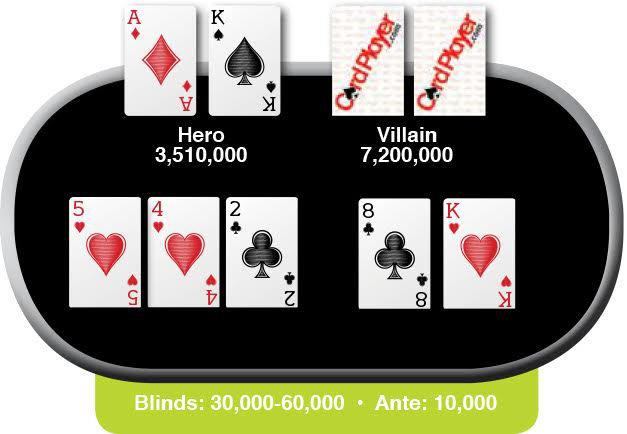
The blinds are 30,000-60,000 with a 10,000 ante, meaning your stack of 3,510,000 is worth 58 big blinds. The tournament’s chip leader has 7,200,000 and the short stack is sitting with 2,740,000.
The chip leader raises on the button to 120,000 and the small blind folds. You are in the big blind and look down at A K
K . You three-bet to 300,000 and your opponent calls.
The flop comes down 5 42
42 , giving you a gutshot wheel draw. You fire in a continuation bet of 350,000 and your opponent calls. The turn is the 8.
You bet 550,000 and your opponent calls. The river is the K and you check. Your opponent then moves all in, and has your remaining 2,300,000 easily covered.
The Questions
Do you call or fold? Given your line, what kind of range have your represented? Is he betting the river for value, or because the K is such a good scare card? Given your opponent’s line, what range of hands can he have? How much does the presence of another short stack influence your decision? What does ICM (Independent Chip Model) say about this situation? Do you regret not betting the river?
What Actually Happened
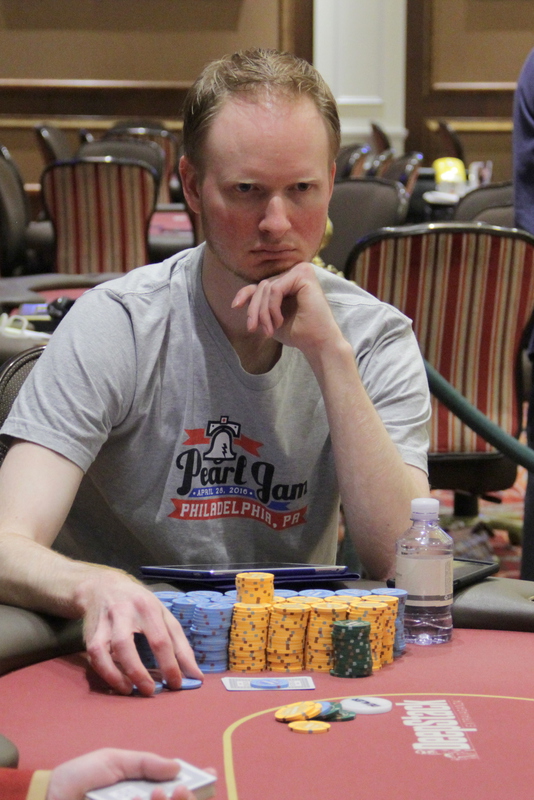 At the $5,000 buy-in 2016 Card Player Poker Tour Venetian main event, Jon Turner moved all in on a board reading 5428K and his opponent, Dan Heimilller, went into the tank.
Heimiller thought it over for about a minute before deciding to call with AK for top pair, top kicker, but Turner held A7 for the rivered nut flush.
Heimiller earned $237,719 for his third-place finish and Artem Metalidi took second for $329,860. Turner went on to win the tournament and the biggest score of his career for $536,858.
What would you have done and why? Let us know in the comments section below and try not to be results oriented. The best answer will receive a six-month Card Player magazine digital subscription.