
Give us your opinion in the comments section below for your chance at winning a six-month Card Player magazine digital subscription.
Ask any group of poker players how you played your hand and they’ll come up with dozens of different opinions. That’s just the nature of the game.
Each week, Card Player will select a hand from the high-stakes, big buy-in poker world, break it down and show that there’s more than one way to get the job done.
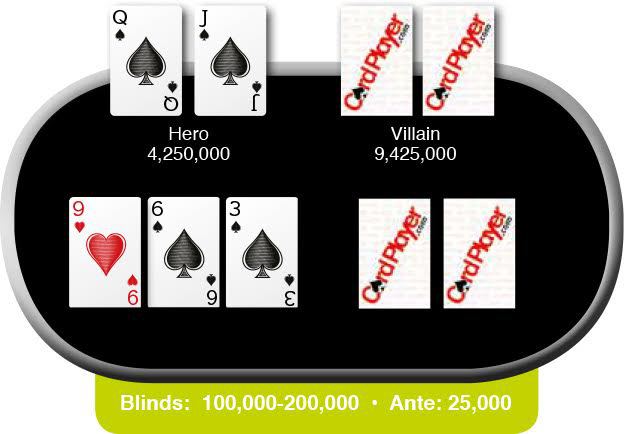
The Scenario
There are three players remaining in a major live poker tournament. The blinds are 100,000-200,000 with a 25,000 ante, and you are in third place with 4,250,000. Your opponents have 7,125,000 and 9,425,000, respectively.
You are already guaranteed a $153,078 payday. Second place earns $237,767 and first place takes home $354,001.
You look down at Q J on the button and decide to raise to 450,000. The small blind folds but the chip leader calls from the big blind. The flop comes down 9
 63 and your opponent checks.
You fire in a continuation bet of 450,000, and your opponent suddenly check raises to 1,100,000. You have a total of 3,225,000 left in your stack.
The Questions
Do you call, raise or fold? What’s a good reason for folding? If calling, what is your plan if you don’t hit a spade or one of your overcards on the turn? Can your overcards even be considered outs? If raising, how much? Do you have any fold equity? What is your opponent’s most likely range given his line?
What Actually Happened
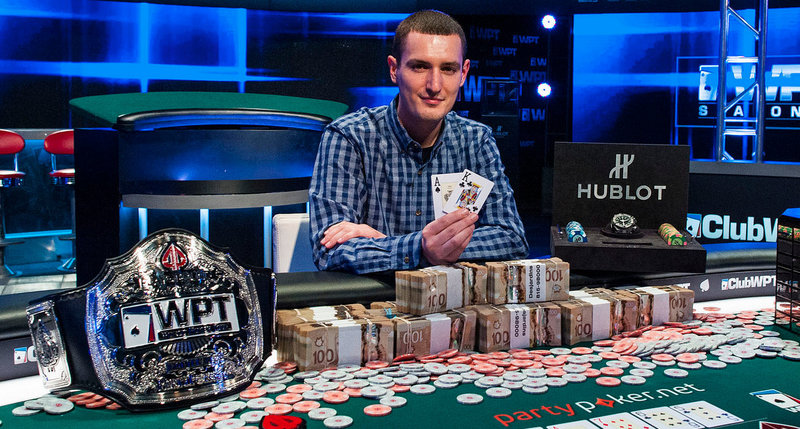 The the 2015 WPT Montreal main event, Darryll Fish decided to move all in with his QJ on a flop of 963.
His opponent, Jared Mahoney, instantly called with slow-played AA. The turn was the 5, giving Fish the flush and the 7 on the river confirmed his double up.
The pot was big enough to allow Fish to coast to a second-place finish for $237,767. Despite the setback, Mahoney rebounded to win the title and the $354,001 first-place prize.
What would you have done and why? Let us know in the comments section below and try not to be results oriented. The best answer will receive a six-month Card Player magazine digital subscription.