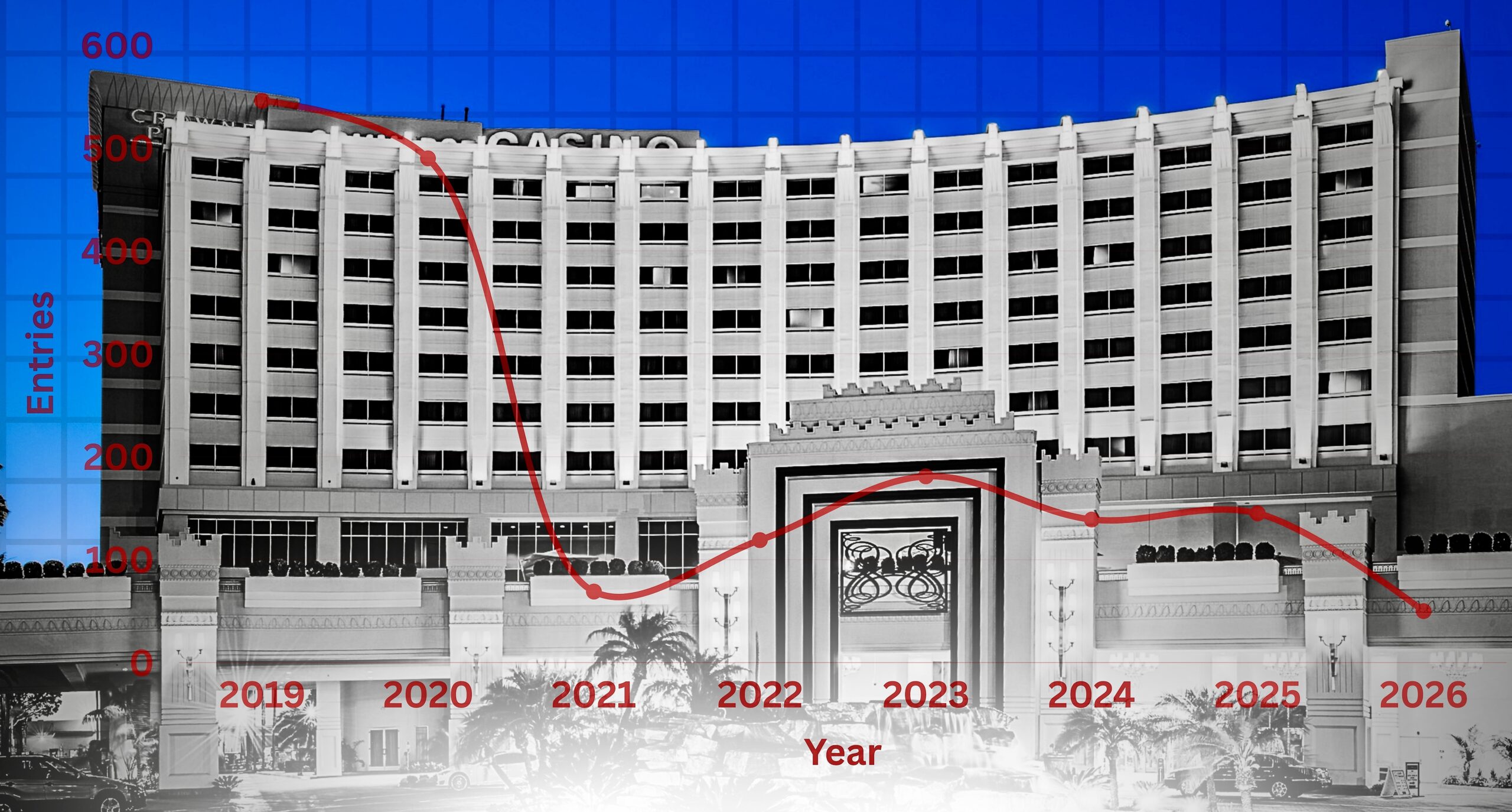
The Los Angeles Poker Classic once stood as a can’t-miss tournament poker destination for professionals and enthusiasts alike.
It appears those days are over.
In its heyday, the series spanned about six weeks at Los Angeles’ Commerce Casino with a wide range of tournament buy-ins and game variants, drawing incredible numbers across the board. Outside of Las Vegas during the World Series of Poker, there was no better place to find non-hold’em tournament action.
Now, the stop is still six weeks, but attendance is dropping. And dropping quickly.
The State Of The LAPC
The stop’s crown jewel for more than 15 years was its World Poker Tour-branded championship event, a culmination of six weeks’ worth of action. Massive satellite events boosted the numbers for a tournament that, for most of its existence, resisted the trend of re-entries while still producing huge fields.
In addition to the LAPC and its other signature series, the Commerce hosted a packed room of world-class cash game offerings year-round. It was everything a poker player could hope for in a tournament stop.
And yet, the state of the 2026 LAPC is a sad one. The series just reaped up on March 2 and is a shell of its former self. The championship event, a tournament in which Gus Hansen, Michael Mizrachi, Phil Ivey and many others won millions of dollars on WPT broadcasts, drew a grand total of 50 entries. And unlike those years, the 2026 version allowed re-entries.
In a report for PokerScout, Mo Nuwarrah detailed the causes of the series’ downward spiral. They’re numerous, intermingled, and complicated. The end of the WPT partnership, the fallout of the COVID shutdown, harsher tax concerns in California, a focus on cash games, and a multitude of alternate options are just a few of the reasons why the LAPC is on the brink of irrelevance.
While it speaks to the bleak state of poker in Southern California as a whole, for a series with such a rich history, this is, at the very least, an alarming trend.
LAPC Origins: Picking The Right Window
Commerce hosted the first LAPC in 1992. Organizers ran the series from late May through the end of June. During that era, the WSOP wrapped up by mid-May, making this window an attractive one for tournament poker.
That became a signature element of the LAPC. Organizers always picked a window that would be most beneficial for high-volume poker players. In the future, the series settled into its familiar spot in February and March.
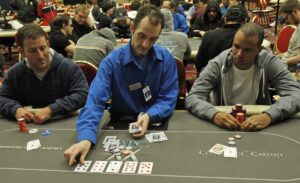
Phil Ivey (right) knocking out another player in the 2012 LAPC main event (photo courtesy of WPT/Joe Giron)
During the festival’s early years, tournament poker was in the midst of a transition. Outside of the WSOP and a handful of other stops, no-limit hold ’em was still finding its stride. While there was a $5,080 no-limit hold ’em championship event in the first year, and almost every year that followed, no-limit hold ’em tournaments represented just a fraction of the overall tournament offerings.
Seven-card stud, lowball variants, limit hold ’em, pot-limit Omaha and a variety of mixed game formats were well represented from the beginning. Big names came out to support the event from the beginning, with Phil Hellmuth, Johnny Chan, Freddy Deeb, Barbara Enright, and Ted Forrest capturing trophies in those early years.
Across its first decade, LAPC’s reputation was cemented as a premier tournament series. But the first sign of a significant leap came in 2002, the year before the WPT got involved.
Pioneers In Prize Pool Guarantees
In 2002, LAPC organizers slapped five tournaments with guaranteed prize pools. Two of those events carried seven-figure liabilities.
A $1,570 limit hold ’em event crushed its guarantee with 596 entries, while the $7,600 no-limit hold ’em championship just crested over the line, including rake, with 133 players.
The following year, the championship buy-in reached the now familiar $10,000 level. Gus Hansen beat a field of 136 players, securing his second WPT title during the tour’s debut season. The following year, Antonio Esfandiari outlasted a field of 382 and beat Vinnie Vinh heads-up to win the $1.4 million first-place prize.
Through the first 18 seasons of the WPT, the LAPC championship event awarded at least $1 million to the winner, while maintaining the longest continuous presence on the WPT schedule.
The Beginning Of The End
The 2020 LAPC ran from Feb. 29 through March 4. It was during the shadow of a dawning realization of just how serious an issue COVID was threatening to be worldwide. It drew 490 entrants, the smallest field size since Esfandiari’s victory. Within weeks, the live poker world shut down, and California was particularly slow in reopening its card rooms.
By October 2020, governing bodies allowed some ‘outdoor’ action, and it was under those circumstances that an abbreviated LAPC took place in 2021. Michael Liang won the main event, against a field of 69 entries, for a first-place prize of $175,300, after a heads-up deal with Adam Hendrix. It was the first LAPC without the WPT since 2002, and the partnership would ultimately not resume.
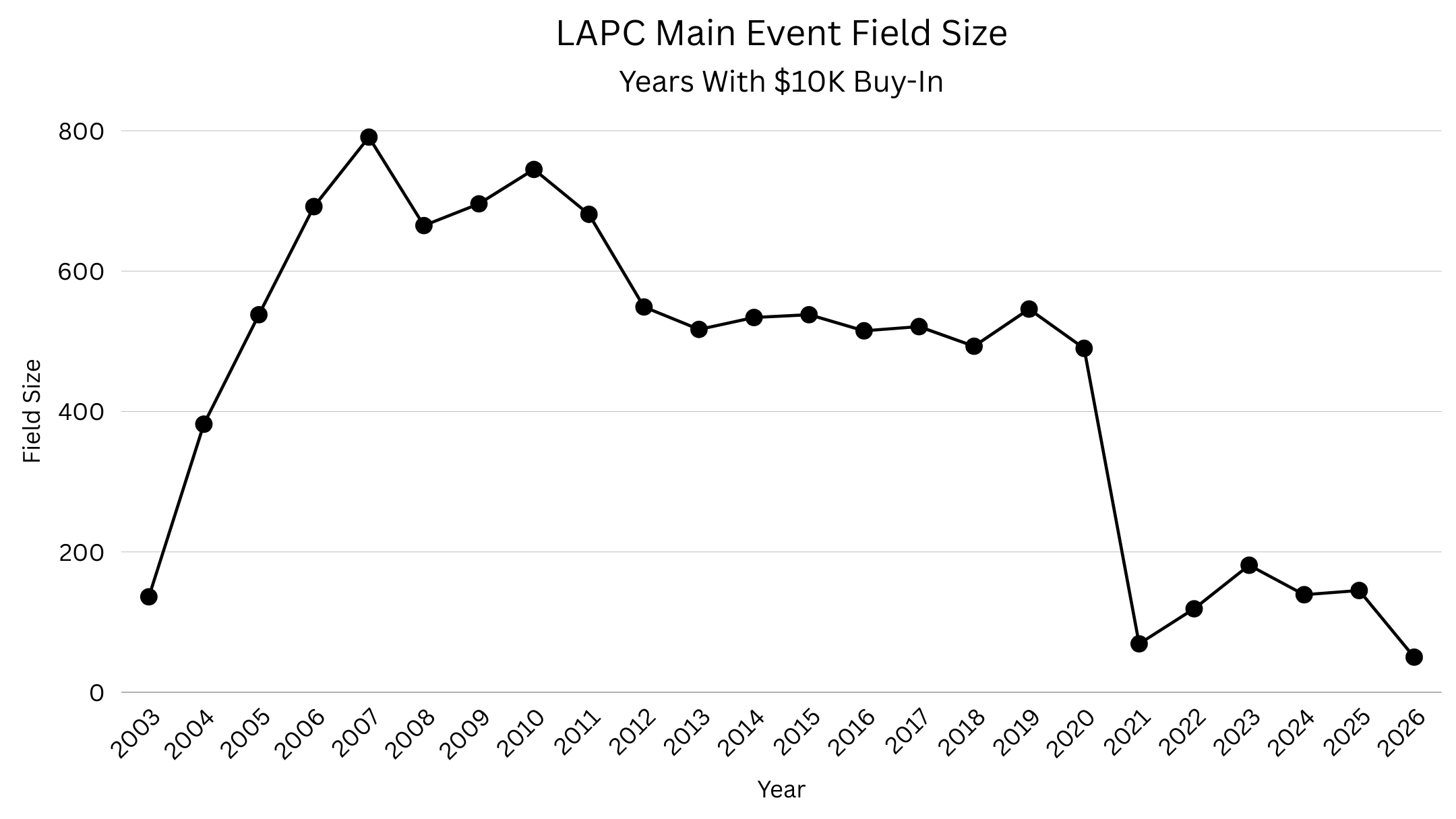
Over the ensuing five years, the field for the post-WPT era LAPC main event got as high as 181 entries, and then bottomed out at 50 in 2026. Beyond the main event turnout, which Nuwarrah’s piece delves into in detail, the overall festival saw similar steady declines in attendance.
Just looking at year-over-year trends, six of the 63 tournaments at the 2025 LAPC carried guarantees totalling $2,050,000. The 2026 LAPC featured 16 tournaments with guarantees, on a schedule of 65 total events, but 10 of those tournaments had smaller guarantees of just $50,000.
In total, the 2026 festival’s tournament guarantees only reached $1.9 million, over a considerably larger selection of tournaments.
Digging Deeper
Comparing a few signature events from 2025 and 2026, certain trends start to emerge.
| Event | 2025 Field Size | 2025 Buy-In | 2026 Field Size | 2026 Buy-In |
|---|---|---|---|---|
| No-Limit Hold'em Championship | 145 | $10,000 | 50 | $10,000 |
| Opening Event | 1,674 | $400 | 2,257 | $250 |
| Commerce Classic | 1,802 | $1,200 | 1,444 | $1,200 |
| HORSE | 57 | $600 | 123 | $600 (But With Four Starting Flights & $50,000 Guarantee) |
The drop in the main event field is the most stark decline in performance, but there are other troubling concerns to note. While the attendance for the opening event was up pretty significantly year over year, the buy-in was just 62% of the previous year and staff increased the number of starting flights. Even with a larger field, players were competing for a smaller prize pool.
Beyond the $10,000 main event, the series’ signature event is the $1,200 Commerce Classic. Despite an additional starting flight, the event experienced a 20% drop in total field size.
The only non-no limit hold ’em tournament with a guarantee at the 2026 series, a $600 HORSE, quadrupled the number of starting flights. However, the field size barely doubled.
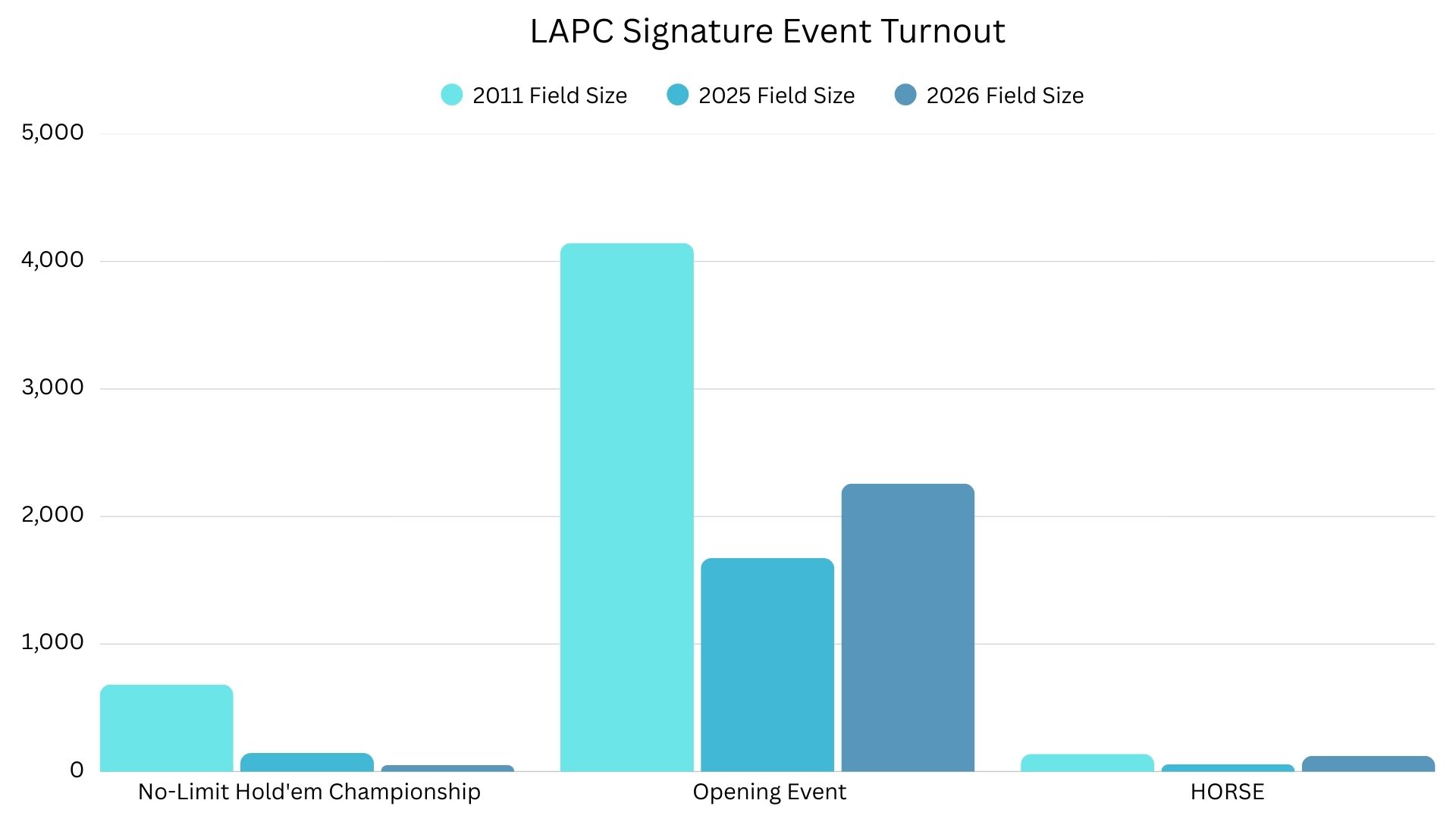
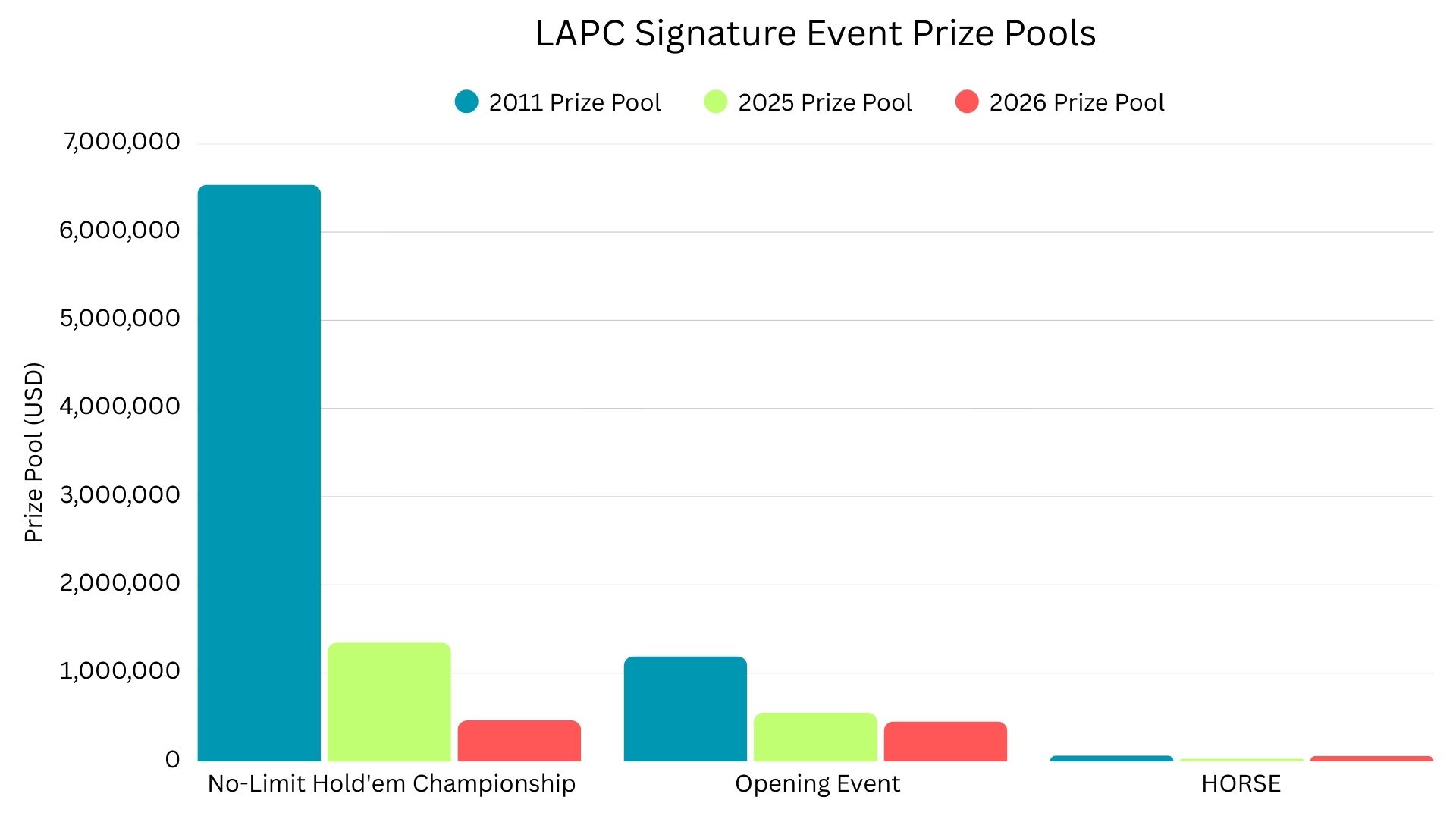
As bad as the year-over-year numbers look, it’s significantly worse if you go back 15 years, into the true heyday of the LAPC festival.
| Event | 2011 Buy-In | 2011 Field Size | 2011 Prize Pool | 2026 Buy-In | 2026 Field Size | 2026 Prize Pool |
|---|---|---|---|---|---|---|
| No-Limit Hold'em Championship | $10,000 | 681 | $6,537,600 | $10,000 | 50 | $465,000 |
| Opening Event | $335 | 4,179 | $1,191,015 | $250 | 2,257 | $451,400 (With 8 Starting Flights) |
| HORSE | $545 | 138 | $65,910 | $600 | 123 | $63,345 (With 4 Starting Flights & $50,000 Guarantee) |
The LAPC peaked as a WPT championship event in 2007 with 791 entrants. But the LAPC was still riding high in 2011, with 681 players creating a total prize pool of $6,537,600.
The opening event of the festival also exceeded expectations, drawing 4,179 entrants across four starting flights. That’s almost twice as many players in half as many opportunities, at a bigger buy-in level, than the 2026 opener.
The health of the mixed game tournaments was robust in 2011 as well. For a single-day event, 138 players turned out to play a $545 H.O.R.S.E. event.
What Comes Next?
There are some tough questions lingering for the once mighty Commerce Casino’s LAPC. With the WPT long out of the picture, a brief arrangement with the WSOP Circuit seemed to do wonders for tournament numbers.
But beyond the 2025 WSOP Tournament of Champions and its connected WSOP Circuit in May, and a return in November 2025, that relationship also seems to have soured.
Are Commerce’s tournament woes a microcosm of a larger regional trend?
As Nuwarrah explained, the tournament environment in general is significantly weaker throughout Southern California. The Parkwest Bicycle Casino (predominantly known as ‘The Bike’) is also getting hit hard with dwindling turnout.
Its upcoming annual Winnin’ o’ the Green festival, which starts the first week of March, may well be a strong indicator of whether the region’s recent woes extend far beyond Commerce.
Blackjack Rule Change Could Shape Future
All of this comes as California cardrooms face other problems. The state recently changed rules governing blackjack and other table games at these properties. Despite calling themselves a casino, Commerce is considered a cardroom under California law.
In the Golden State, Native American tribes have a monopoly on traditional casino games. It’s why Commerce Casino doesn’t have any slot machines.
However, cardrooms found loopholes to offer card-based table games like blackjack. But now the state has closed that loophole, and the cardrooms could face significant revenue declines soon. It creates skepticism about the long-term health of cardrooms in the state.
How will Southern California cardrooms react to the revenue loss? Will properties just eat the loss and operate mostly as a poker cash game hub? Or will they reinvest in poker tournaments in hopes of generating (or, in this case, regenerating) another source of revenue?
There have never been more options for poker throughout the United States and all over the world. But with the deep history and enthusiastic community of players in Southern California, watching tournament poker slip away in front of our eyes is a tough pill to swallow.