







Give us your opinion in the comments section below for your chance at winning a six-month Card Player magazine digital subscription.
Ask any group of poker players how you played your hand and they’ll come up with dozens of different opinions. That’s just the nature of the game.
Each week, Card Player will select a hand from the high-stakes, big buy-in poker world, break it down and show that there’s more than one way to get the job done.
The Scenario
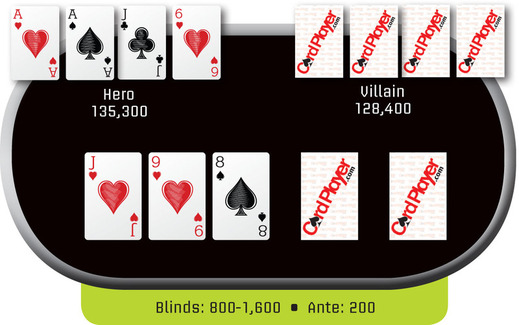
There are 20 players remaining in a pot-limit Omaha tournament and only 16 players will make the money. There are 4 tables remaining and you are playing five handed. The average chip count is currently 56,700. With blinds of 800-1,600 with a 200 ante and a stack of 135,300, you are the chip leader with 84 big blinds.
You look down at A A
A J
J 6 and decide to raise to 2,700. Your opponent, an aggressive poker pro with a big stack of 128,400, three-bets from the button to 9,900.
You decide to make a pot-sized raise to 31,500 and your opponent calls. The flop comes J98 and you check. Your opponent bets 24,000.
You have 103,600 remaining. Your opponent has 72,700 behind his flop bet. You have him covered in total by just 6,900.
The Questions
Do you call, raise or fold? If calling, what is your plan for non-jack, non-ace and non-heart turn cards? What is your plan for cards that improve your hand? If raising, how much? Do you re-pot all in for maximum fold equity? Do you even have any fold equity? How does the looming bubble weigh into your decision? What is your equity in the hand against a set? Against a straight? What was the reason for your initial flop check?
 What Actually Happened
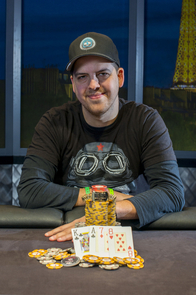
At the 2013 WSOP Europe €3,250 Mixed Max Pot-Limit Omaha event facing a bet of 24,000 on a flop of J98 and holding A AJ6, Raj Vohra opted to reraise all in against Ludovic Lacay.
Lacay instantly called all in for slightly less, tabling KQJ10 for the flopped straight with a redraw to a higher straight. The turn was the 9, giving Vohra more outs to a full house, but the 6 on the river shipped the massive pot to Lacay.
Vohra was left crippled and was eliminated soon after shy of the money. Lacay went on to finish runner-up, earning €64,800. The tournament was won by Noah Schwartz, who picked up his first gold WSOP bracelet and the first-place prize of €104,580.
What would you have done and why? Let us know in the comments section below and try not to be results oriented. The best answer will receive a six-month Card Player magazine digital subscription.