Give us your opinion in the comments section below for your chance at winning a six-month Card Player magazine digital subscription.
Ask any group of poker players how you played your hand and they’ll come up with dozens of different opinions. That’s just the nature of the game.
Each week, Card Player will select a hand from the high-stakes, big buy-in poker world, break it down and show that there’s more than one way to get the job done.
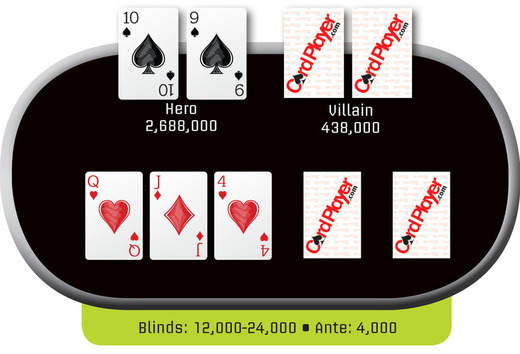
The Scenario
There are 10 players left in a major live tournament. With a stack of 2,688,000 and blinds of just 12,000-24,000 with a 4,000 ante, you are among the tournament’s chip leaders.
A young, aggressive player raises from middle position to 49,000 and you make the call from the hijack. The cutoff, sitting with 438,000, also calls, as does the big blind. The flop comes down Q J
J 4 and the action is checked to you. With an open-ended straight draw, you decide to bet 94,000.
The cutoff then moves all in behind you for a total of 385,000. The big blind and the original raiser both fold. There is 727,000 in the pot and it will cost you an additional 291,000 to call.
The Questions
Do you call or fold? What kind of hand does your opponent need to have in order to make your call profitable? Is there any concern that you may be up against a flush draw, killing some of your outs? Assuming you have eight clean outs, how often do you win this hand?
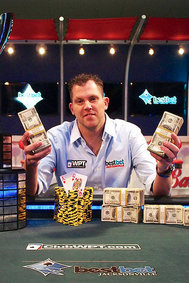 What Actually Happened
At the WPT Bestbet Open Main Event in Jacksonville, Florida, Michael Linster felt priced in with his 10 9 on a flop of Q J 4 and made the call against his all in opponent, Pete Chwala.
Chwala showed K Q and his top pair held when the board ran out 7 2. Chwala doubled up and went on to finish in fourth place for $79,619.
Linster rebounded from that pot to win the tournament, his first WPT title and the $321,521 first-place prize.
What would you have done and why? Let us know in the comments section below and try not to be results oriented. The best answer will receive a six-month Card Player magazine digital subscription.