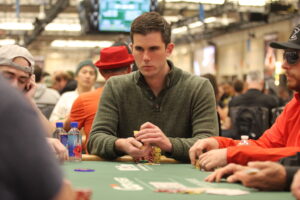
Give us your opinion in the comments section below for your chance at winning a six-month Card Player magazine digital subscription.
Ask any group of poker players how you played your hand and they’ll come up with dozens of different opinions. That’s just the nature of the game.
Each week, Card Player will select a hand from the high-stakes, big buy-in poker world, break it down and show that there’s more than one way to get the job done.
The Scenario
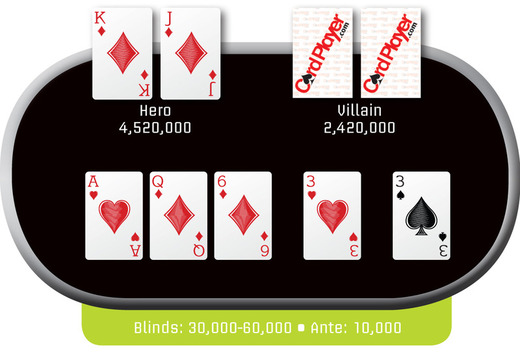
You are sitting five-handed in a marquee tournament with a slight chip lead and a stack of 75 big blinds. There is only one player in the danger zone, the big blind who holds 10 big blinds.
The second shortest stack at the table, one of the less active members of the final table with 40 big blinds, raises on the button to 135,000 with blinds at 30,000-60,000.
You look down at K J from the small blind and make the call. The short stack in the big blind folds. The flop comes down A
 Q 6, giving you a straight draw and the second nut-flush draw.
You decided to lead for 150,000 and your opponent calls. The turn is the 3, putting a potential heart flush and additional straight draws on board. You bet 230,000 and once again, your opponent calls.
The river is the 3 , missing your hand completely. Your opponent has 1.905 million remaining and you have him well covered.
The Questions
Do you check or bet? If betting, how much? Are you betting for value with king high or as a bluff? What kinds of hands can your opponent be holding given his line? If your opponent is drawing as well, wouldn’t your hand win at showdown? What kinds of hands can you get your opponent to fold? If your opponent bets after you check, what do you do?
 What Actually Happened
At the World Poker Tour Five Diamond World Poker Classic, Antonio Esfandiari opted to check the river on a board reading A Q 6 3 3.
His opponent, Thomas Winters, checked behind, showing K J for a busted straight and flush draw. Esfandiari showed K J for the same busted draw and the two players chopped the pot.
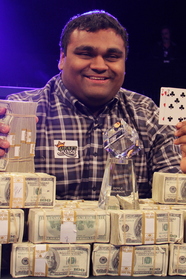
Esfandiari wound up finishing in fourth place, earning $329,339. Winters took third, banking $483,031. The eventual winner was Ravi Raghavan, who took home a first-place prize of $1,268,571.
What would you have done and why? Let us know in the comments section below and try not to be results oriented. The best answer will receive a six-month Card Player magazine digital subscription.