
Give us your opinion in the comments section below for your chance at winning a six-month Card Player magazine digital subscription.
Ask any group of poker players how you played your hand and they’ll come up with dozens of different opinions. That’s just the nature of the game.
Each week, Card Player will select a hand from the high-stakes, big buy-in poker world, break it down and show that there’s more than one way to get the job done.
The Scenario
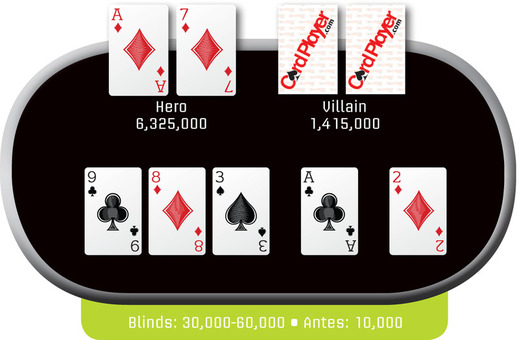
You are the chip leader at the final table of a major tournament. With seven players remaining, you have over 100 big blinds. There are two short stacks with roughly 20 big blinds, but nobody is in any immediate danger.
A player with 23 big blinds raises in the cutoff and you defend your big blind with A 7.
7.
The flop comes down 9 8 3
8 3 and you check. Your opponent also checks and the A hits the turn.
You check again, and your opponent bets 165,000. You call and the river is the 2.
Again, you check, but this time, your opponent moves all in for his last 1,095,000.
The Questions
Do you call or do you fold? What hands can you beat at this point? What does your opponent’s flop check and turn bet say about his hand?
The Argument For Calling
The turn helped you, so it is less likely that it also helped your opponent. With top pair, no kicker, you are basically trying to beat a bluff. Your opponent could be just trying to represent an ace or could even have a busted straight or flush draw. If you call and lose, you’ll still have over 80 big blinds and the chip lead.
The Argument For Folding
Your opponent checked back the flop because he caught a big piece of it and didn’t want to scare you away. After testing your hand on the turn, now he is gunning for full value. Though calling wouldn’t cripple your stack, it would still take away a nice buffer that you have built for yourself from the rest of the pack.
What Actually Happened
 At the WinStar River Poker Series main event, Andy Robinson went into the tank for nearly two minutes before finally making the call with A 7 for top pair.
His opponent, Matt Newcombe, turned over A 8 for turned two pair. The double up allowed Newcombe to coast to a third place finish for $195,160.
Robinson rebounded, but ultimately finished second to Aaron Massey, earning $334,030. Massey picked up the lion’s share of the prize pool for $651,559.
What would you have done and why? Let us know in the comments section below and try not to be results oriented. The best answer will receive a six-month Card Player magazine digital subscription.