







Give us your opinion in the comments section below for your chance at winning a six-month Card Player magazine digital subscription.
Ask any group of poker players how you played your hand and they’ll come up with dozens of different opinions. That’s just the nature of the game.
Each week, Card Player will select a hand from the high-stakes, big buy-in poker world, break it down and show that there’s more than one way to get the job done.
The Scenario
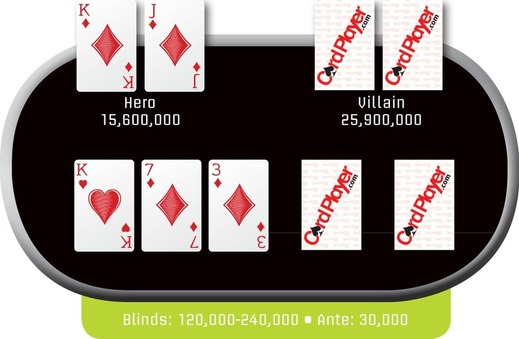
You have navigated your way through a monster field in the World Series of Poker main event. There are just 12 players remaining and with 15.6 million, you are in good shape to make the final table and become a member of the October Nine.
With the blinds at 120,000-240,000 with a 30,000 ante, a player with above average chips raises to 500,000 in the cutoff and gets called by the button and the small blind, who has you well covered.
Sitting in the big blind with K J, you come along as well to see a four-way flop of K
 7 3. The small blind checks, you check, the original raiser checks and the button fires in 1.45 million.
The small blind then raises to 3.4 million. You have just over 15 million remaining in your stack, which is just enough to cover the button. The small blind has you out chipped by about 10 million.
The Questions
Do you call, raise or fold? If raising, how much? If calling, what is your plan for the turn? What kind of hands can the button and the small blind be holding?
The Argument For Raising
You’ve flopped top pair and the second nut flush draw, so in all likelihood, you have at least 12 outs if your opponent is holding a king with a better kicker. By raising to an amount that commits the rest of your stack, let’s say around 6.5 million, it sends a clear message of strength to your opponents and may get them to lay down better kings. Even if your opponent holds the nut flush draw and decides to call, you are still ahead with your pair and hold blocker cards, making you a strong favorite.
The Argument For Calling
You may have a pair and a flush draw, but how many outs do you really have? Your opponent in the small blind showed significant strength by check-raising the button’s bet, meaning there is a chance that your pair of kings is irrelevant. Furthermore, by calling and keeping the pot smaller, there is a chance the button folds, allowing you to play the rest of the hand in position against the one player at the table who can bust you.
 What Actually Happened
After Jesse Sylvia check-raised from the small blind to 3.4 million, Scott Abrams then reraised to 7 million. Russell Thomas and Steven Gee both folded back to Sylvia, who moved all in.
Abrams immediately called with his K J, but was in rough shape against Sylvia’s set of sevens. The turn and river fell Q 6 and Abrams was eliminated in 12th place, good for $590,442.
Sylvia took the massive pot, making him the overwhelming chip leader heading into October’s WSOP main event final table, where he will start with 43.875 million, about a fourth of the total chips in play.
What would you have done and why? Let us know in the comments section below and try not to be results oriented. The best answer will receive a six-month Card Player magazine digital subscription.