





Give us your opinion in the comments section below for your chance at winning a six-month Card Player magazine digital subscription.
Ask any group of poker players how you played your hand and they’ll come up with dozens of different opinions. That’s just the nature of the game.
Each week, Card Player will select a hand from the high-stakes, big buy-in poker world, break it down and show that there’s more than one way to get the job done.
The Scenario
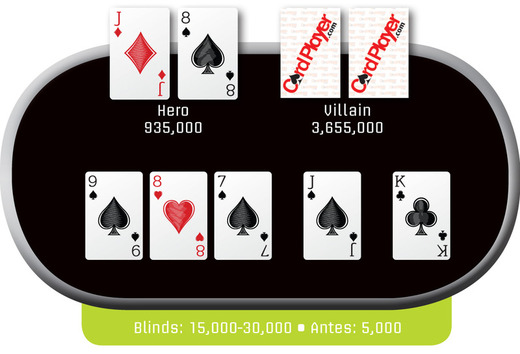
You are sitting in fourth place out of six at a major tournament final table, but at least you have position on the chip leader, who has all but one player covered three times over. Though you are short stacked with just 31 big blinds, two other players have less with 23 and 12 blinds, respectively.
Though you’ve only played three orbits, you are perceived to be the most active player at the table thus far. Though you really haven’t gotten out of line, your opponents haven’t seen you show down many hands.
The action folds around to the chip leader in the small blind, who makes just over the minimum raise to 65,000 and you defend in the big blind with J 8
8 . The flop comes 9 8
 7 and your opponent continues with a bet of 80,000.
You call, and the turn card is the J, giving you two pair and a flush draw. Your opponent doesn’t slow down, and bets 160,000. You call and the river is the K .
.
Your opponent moves all in. You have 625,000 remaining in your stack.
The Questions
Do you call off the rest of your stack, or fold? What kind of hand is your opponent representing by raising preflop and betting all three streets? Is it possible that you are being bullied by the overwhelming chip leader or are you simply beat by a better hand, perhaps a straight or flush? What does your line say about your hand? Would a flop or turn raise have been a better option?
The Argument For Calling
If you fold, you’ll be left with just 21 big blinds and forced to play behind an active chip leader who will be opening a wide range in front of you. In order to claw your way back into the tournament, you’ll have to come up with a decent hand to three-bet shove with and there’s no guarantee that you’ll get it. If you call and win, you’ll have 1.89 million and will be an immediate threat for the win.
Your opponent has seemingly shown strength by raising preflop and betting all three streets, but take a look at the river bet. He is betting 625,000 into a pot of 640,000, effectively going for home run value. His river bet is nearly four times his turn bet, which should raise some flags. Given your passive line, in his eyes, you are more likely to be holding a weak, one-pair type of hand, if not a missed draw. If he was holding a straight or a flush, wouldn’t he bet smaller to ensure he got paid light?
The Argument For Folding
Yes, 21 big blinds isn’t a lot of chips, but it’s not exactly a death sentence. In fact, you won’t even be the shortest stack remaining in the tournament. There is still plenty of play left and you have enough maneuverability in your stack to stage a comeback. Folding also ensures that you can move up one to two spots on the money ladder, which begins to escalate quickly at this point in the tournament.
Your line has been passive to this point, so while it is possible that you are being bullied, it is also possible that you could be holding a straight or a flush yourself and are trapping. For your opponent to jam the river, he’d either need to be holding a straight or flush himself, or be extremely confident in his read on your hand. Why would he risk his dominating chip lead on a pure bluff?
 What Actually Happened
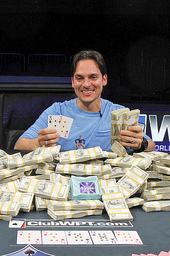
Six-handed at the World Poker Tour Jacksonville BestBet Open, on a board reading 9 8 7 J K, Shawn Cunix moved all in and Darren Elias went into the tank.
After nearly a minute of thought, Elias folded J 8 and Cunix raked in the pot, neglecting to show his 7 3.
Elias went on to fight his way back to a third-place finish and a $147,850 payday. Cunix eventually defeated James Calderaro heads-up to claim his first WPT title and the $400,600 first-place prize.
What would you have done and why? Let us know in the comments section below and try not to be results oriented. The best answer will receive a six-month Card Player magazine digital subscription.