







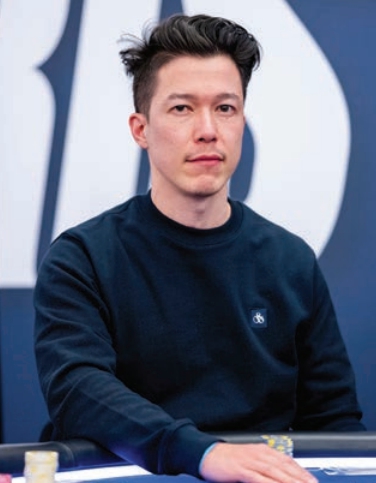
Thomas Muhlocker
Even the best players in the world make mistakes. Join Sam Greenwood as he breaks down and analyzes hands played from the high roller circuit on his Punt Of The Day Substack.
Paris. The City of Light! I arrived just after Valentine’s Day, and it felt like a movie. The hotel and casino were connected to a mall with a very good grocery store, so I only ended up going outside twice during the two weeks I was there.
My first two POTDs were about putting too much money in the pot with a bad hand. This time, I mixed it up and put too much money in the pot with a good hand. At least my mistakes are balanced!
Since this hand happened two years ago, I had to estimate stack sizes and exact bet sizes, but don’t worry — the mistakes I made were robust enough that they’re still mistakes at both 20 and 100 big blinds.
Event: 2023 EPT Paris €25,000 High Roller
The Hand
Registration has just closed in this single-day tournament, and I’m sitting on 135,000 up from my original 100,000 starting stack. The blinds are 2,000-5,000 with a 5,000 big blind ante.
It folds around to Thomas Muhlocker who raises to 10,000 off of a 125,000 stack in the cutoff. I defend 7♦3♦ in the big blind.
Flop: 10♠7♥3♣ (Pot: 27,000)
I check, and Thomas checks behind.
Turn: 5♥ (Pot: 27,000)
I bet 30,000, and Thomas calls.
River: Q♦ (Pot: 87,000)
I shove for Thomas’s last 85,000, and he folds.
What Was I Thinking?
I have a suited hand that pure defends preflop, and 10-high boards never get leads from the big blind. Even though this hand took place two years ago, I can easily remember what I was thinking at the time.
‘I have two pair, and he checked the flop, so I’m going to keep betting until I’m all-in.’
A good heuristic in all forms of no-limit hold’em is that if you are in the big blind and the preflop raiser checks back the flop, you play aggressively on most turns, especially with good hands. The preflop raiser often has a middle-of-range hand that can bluff catch, but isn’t necessarily interested in value betting. So, you force them to put money in the pot.
It’s not hard to find bluffs as the big blind, either. I have a wide array of flush draws, two-card straight draws, and one-card straight draws that can semi-bluff on the turn. The Q♦ river is not great for my range, as overcards usually aren’t good for the big blind. But with only a pot-sized bet left to play for, I’m still allowed to continue value betting two pair-plus and happily shove for value.
What Did I Get Wrong?
I aced the difficult preflop and flop nodes with my expert play. On the turn, I got the shape of my strategy correct in that I bet a lot and my most common sizes are on the larger end.
The errors I made were in hand selection. Thomas’s flop check-back range does have a lot of middle of range hands. (One of the more common middle of range hands that checks back the flop and calls a turn bet is a 7-x. Another lower-frequency hand, but still present, hand is 3-x. When I have 7-3 I’m blocking around 5% of his turn calling range.)
I thought I would be betting the turn for value, but also protection. What I failed to realize was that my hand needs very little protection. Sure, there are bad rivers for my hand, such as a 4, 5, 6, 10, or a heart. That’s almost half the deck.
But hands that aren’t drawing dead vs. two pair rarely fold the turn. There is value in charging those hands, but checking two pair is more likely to let a hand that is drawing dead catch up or bluff than it is to let a hand that would fold to a bet suck out on me, because he has a lot more unpaired no-draw hands like A-K high or K♦6♦.
Types Of Errors I Made
- Defaulting to a lazy play
- Underestimating how much equity I had
Grade
Shoveling money in the pot with a hand that is good enough to stack off can never be that costly a mistake and is often a strong exploit vs loose-passive players. It’s not a costly play, but slow-playing flopped bottom two is an easy mechanic to internalize, and one I could have figured out if I were playing my A-game.
I’ll give this one a B-.
 Sam Greenwood is one of the winningest tournament poker players ever and is third on Canada’s all-time money list, having cashed for $42 million and counting in high roller events all over the world. The former stock trader-turned-champion has played millions of poker hands and is breaking them down street by street on his Punt Of The Day Substack. You can reach out to the Run It Once coach on Twitter/X for private coaching @SamGreenwoodRIO.
- Photo by PokerStars – Eloy Cabacas