







Pot-Limit Omaha Tournament Strategy With Daniel Negreanu, Josh Arieh, Ben Lamb, Jesse Lonis, And Joey Ingram

Looking for pot-limit Omaha tournament tips? This group of poker pros includes some of the winningest PLO tournament players of all time, combining for more than $13 million in cashes, as well as five bracelets in the discipline.
Card Player: What is your advice for cash game players just dipping their toes into PLO tournament events?
Daniel Negreanu: While playing PLO tournaments, you have to really make a mental note of the stack sizes, especially early on when everyone is deep.
My best advice is to play a little more cautiously preflop in some spots. You don’t want to telegraph your hand when you reraise preflop with aces, especially when there are a lot of chips behind. That’s mainly because you’re giving away a lot.
When it’s later in the tournament, and you only have 25 to 30 big blinds, it’s fine. You know, you just get it in there. But it’s best to be a little trickier when deep stacked; that’s kind of important.
A lot of players will say things like, ‘Oh man, I took a terrible beat. I had a hundred big blinds and two aces in PLO, and I lost to a guy with Q-9-6-4.’
I have to add, ‘who was 44 percent.’ You know what I mean? You have to understand when you’re getting it in preflop, you’re never getting it in better than two to one. It’s a post-flop game. I always tell players to focus on making good decisions post-flop.
Card Player: Can you share some PLO bubble strategies that beginners may not be aware of?
Daniel Negreanu: The thing about PLO, especially around the bubbles, is that the equities run so close. Every hand is pretty close in equity, which allows the chip leader to open up any four cards. And most of the time when he’s doing that, he’s just fine.
What it does is force the short stacks to say things like, ‘My God, I can’t get it in really good.’ But if I have 12 big blinds, and there are guys with three and four big blinds at a final table or a bubble, ICM, all those variables factor in.
[Medium stacks] have to play extremely conservatively, because you have the dynamic where the chip leader can open up super wide, and the short stacks are handcuffed.The strategy is quite simple in that regard, right? If you keep that in mind when you’re the big stack and can take advantage of the dynamic, you want to be the hammer, not the anvil on the bubbles.
Card Player: Any pointers for new players?
Josh Arieh: One of the basic pointers for PLO tournaments is to understand the stage of the tournament that you’re in at any given moment. And also, to know that the blinds that you have are worth way more than you realize.
For example, when you’re at 10 or 15 blinds, you can still maneuver and do things at the table. Don’t be afraid to limp. It’s not like it is in no-limit. If you’re not raising coming in the pot during a no-limit tournament, you’re losing money, whereas in PLO, you can limp.
One thing I’ve noticed is that many players overvalue aces in PLO. Aces are valuable, but tough to play. Be cautious and avoid becoming too attached to them.
Card Player: What’s one of the fastest ways to expand your PLO knowledge?
Ben Lamb: I spent a lot of time years ago discussing the game with my friend Chance Kornuth. We spent a lot of time under the same roof and learning the game together. At that time, there were no solvers or training software. We both watched videos and read books.
One of the best ways to learn the game is by discussing why I made a particular decision at any point during a hand. I learned a lot during that period, especially with someone as sharp as Chance. That’s still the best advice. Find someone you can discuss the game with.
Card Player: What are some of the leaks you see players have the most often?
Ben Lamb: People still tend to overplay aces a bit, but anyone who has studied has primarily addressed that issue by now.
I think no-limit players coming to PLO overvalue many hands more than they should, not just aces. They overvalue a hand like two weak pair, or they have a shot at a nine-high flush, things like that. They have a little bit of everything in their hand, but nothing is really very good.
In tournaments, I think many beginning players tend not to realize how much tighter you need to play when you’re short-stacked. And inversely, and more importantly, how much looser you can play when you have chips.
When you have a big stack, you need to put pressure on people and try to maintain that large stack. That’s changed a bit over the last few years with the ante being added, though. It’s a change for the better because now you have to battle for your blinds a bit more. I don’t think people are doing that as much as they should, depending on their stack size.
Card Player: What advice do you share with players just dipping their toes into PLO MTTs?
Jesse Lonis: I believe many PLO players come from a cash game PLO background. Because of that experience, they don’t realize you can’t just sit there and play quality hands and play solid poker as you mostly can during a cash game. In PLO tournaments, your goal is to get every single chip.
During certain stages of the tournament, it is essential to open more hands than people are accustomed to doing. Because during their whole PLO experiences in cash games, they’re used to only playing a certain range.
Players need to understand and be able to open any four cards, as there are numerous bubbles in PLO tournaments, not just the money bubble.
Every stage is kind of a bubble. You’ve got to learn when to be aggressive and when to sit back. There are also times when you really have to overfold hands, even when you normally wouldn’t. It’s an entirely different game than cash, and you have to be able to adjust to that.
Card Player: What are some of the major leaks you see pretty often during tournaments?
Jesse Lonis: I don’t think players adjust enough at the right times; also, you can be the complete opposite of standard play, depending on the stage of the tournament.
I always suggest to players to have fun during a PLO tournament. Also, be aware that final tables are such an ICM battle. That’s something players need to learn.
Card Player: Biggest difference between cash game PLO and tournaments?
Jesse Lonis: That’s where all the money is made when you get to the end. That’s when you have to know how to play small ball at certain times and give yourself a chance to ladder. It all depends on your stack size.
If you’re in the middle of the field, you want to wait for the short stacks to bust before you play most any type of hand.
If you have a big stack, you have to be able to realize when there’s a very short stack where you can open almost any hand. I don’t think people do that enough, from my experience.
Card Player: What advice do you have for those who want to take a shot at PLO tournaments?
 Joe Ingram: One of the biggest adjustments when transitioning from PLO cash to tournaments is learning to fold beautiful hands that you’d never let go of in a cash game.
Once stacks start shrinking, especially in that 10 to 40 big blind range, you can’t just pot every hand. Whether to pot, limp, or min-raise becomes a much bigger consideration. That’s been a weakness of mine in the past, so I’ve spent a lot of time refining my opening ranges at shorter stack sizes.
Card Player: What are you primarily focusing on during the early stages of a PLO tournament?
Joe Ingram: Hands that realize equity immediately become a lot more valuable as stacks get shorter. The pretty rundowns that look great deep just don’t perform well short-stacked and can get you in trouble.
Early on, you’ll usually find a lot of weaker players at the table, so I focus on getting into pots with them and building a stack when I have position and an edge.
Another key thing I’ve learned is to avoid over-defending marginal hands in the big blind. That’s one of the classic traps that gets people in trouble.
Once you get deep, understanding ICM becomes critical. A lot of cash game players have no clue how it works, but it drastically affects how wide you can open, when to be the aggressor, and how tight you need to defend. Mastering that transition can be the difference between bubbling a final table and making a real run.
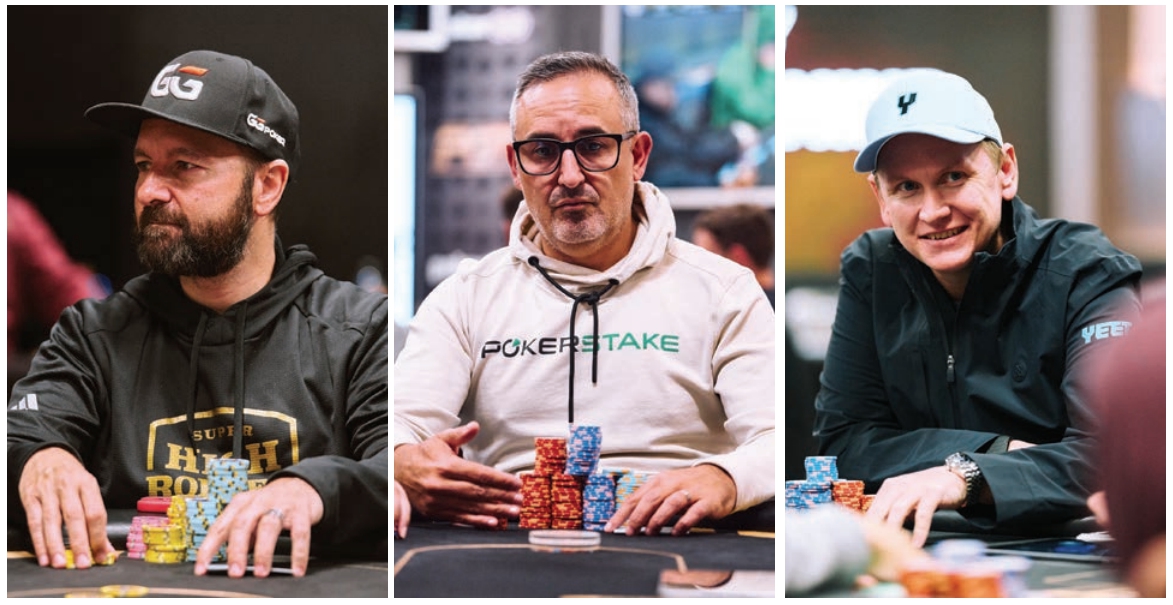
Daniel Negreanu had a dream run to capture the 2024 WSOP Poker Players Championship and a seventh bracelet. The GGPoker ambassador has $55 million in tournament earnings, more than $2 million of which has come in PLO. Watch the two-time WSOP POY’s vlogs on YouTube or follow on Twitter/X @RealKidPoker.
Josh Arieh is a proud member of Team Lucky and owner of the staking site PokerStake, previously known as PocketFives. The six-time WSOP bracelet winner and 2021 WSOP Player of the Year has $3 million in PLO cashes and $14 million overall. Follow the Atlanta pro on Twitter/X @JoshuaArieh.
Ben Lamb has made two WSOP main event final tables, and was the 2011 WSOP Player of the Year. The high-stakes cash game regular and co-founder of Yeet crypto casino has $4.1 million in PLO tournament earnings, with $17 million cashed in total. Follow the Tulsa native on Twitter/X @BenbaLamb.
Jesse Lonis is on fire, having dominated the recent Triton Montenegro series to climb to the top of the overall Player of the Year race. The New York native has already racked up $21 million in cashes, with $3.8 million of that coming in PLO tournaments. He also won the $50,000 PLO high roller at the WSOP in 2023. Follow on Twitter/X @JesseLonis.
Joey Ingram is a popular poker content creator and media personality. Although the Chicago native doesn’t have the tournament results of the other players listed here, he’s a long-time PLO cash game player. The Venetian Poker Room and GTO Wizard ambassador can be found on YouTube or Twitter/X @Joeingram1.
- Photos by PokerGO, WPT, Card Player