







Game $3-$6 heads-up no-limit hold’em
Opponent Aggressive medium-stakes regular
Stacks $1,623.50 (ours); $1,042.50 (his)
Our Cards K 5
5
Our Position Big blind
In a recent training video that I made for Card Player Pro, I reviewed a $3-$6 heads-up no-limit hold’em match played by a Card Player Pro member. I felt that one hand in particular exemplified an important heads-up concept: keeping track of your opponent’s hand range. If you know what hands your opponent can or cannot have in certain situations, you can avoid becoming a “Payoff Wizard” and paying off big river bets.
In this hand, our opponent opened the pot for $18, and we called with the K 5.
Given the flow of the match thus far, I don’t think folding the K 5 is an option preflop. Our opponent had been playing very aggressively, and K-5 suited is too strong to throw away against a player like him. Sometimes I’d reraise, but I think flat-calling is fine, as well.
The flop came 5 4 2 — giving us top pair.
We checked, and our opponent bet $25 into a $36 pot. We check-raised to $76.
I like this play a lot. This thin check-raise for value is something you’re not going to see from most players. Normally, people won’t check-raise with a weak top pair, for fear that they’re turning their hand into a bluff. However, if you’re not capable of check-raising with a single pair for value here, the only value hands that you represent with a check-raise are 2-2, 5-5, 4-4, 5-4 suited, and A-3. Being able to add hands like top pair to your range here is great for balance, and forces your opponent to keep guessing about your hand.
Our opponent flat-called our check-raise, and we saw the turn.
The turn brought the J, adding a second flush draw. We bet $144 into a pot of $188.
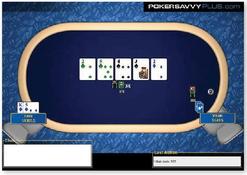
Again, I like this bet a lot. This bet offers protection when we have the best hand, but more importantly, it sets us up for a big river bluff on certain cards.
On a club or a 6 river, we can profitably shove all in and force our opponent to fold anything that isn’t a straight or a flush. So, this turn bet is effectively a “two-way” bet: It protects our hand on the turn if we are ahead, but also enables us to set up a big river bluff should the situation arise.
After some thought, our opponent called the bet.
The river brought the 2.
This, unfortunately, is one of the worst rivers in the deck for us — not because I think it improved him in any way, but because he’s very unlikely to fold a hand that’s better than ours at this point.
Both flush draws missed, the straight draws missed, and if we had 5-4 suited, our two pair is now counterfeited by higher two pairs. Bluffing is no longer an option.
So, we checked, and our opponent bet $355.
On certain rivers, I think there is merit in check-calling this bet. This simply isn’t one of them. On the 2, our opponent’s value-betting range becomes much wider than it would on any other river. Hands like 6-6 to 10-10 will likely value-bet. Any jack will value-bet, and, of course, Q-Q+ will value-bet. Given how wide this range is, even if he bluffs with most of his missed draws, we still can’t profitably call this bet.
Had the river been, for example, the Q — I think calling is much better. Hands like 6-6 to 10-10 will no longer bet, and even a jack may not bet. So, when he does bet, it’s much less likely that we’re beat. On the 2, however, he just bets too many hands that beat us. This river is a pretty clear check-fold.
Our hero, unfortunately, lost track of his opponent’s value range on the river, and lost a pretty big pot when he called and his opponent flipped up the Q Q.
While I think the flop and turn in this hand were played quite well, our hero lost sight of his opponent’s range on the river. Keep in mind the hands that your opponent is capable of betting in certain spots, and your tough decisions should become much easier.