







Game: PokerStars Nightly Hundred Grand no-limit hold’em tournament
Blinds: 4,000-8,000
Opponent: Unknown early-position raiser
Stacks: 174,000 (me) vs. 300,000
My Cards: 2 2
2
My Position: Small blind
 I recently found myself at the final table of the PokerStars Nightly Hundred Grand no-limit hold’em tournament, a $150 freezeout event. I was in seventh place with a little over 20 big blinds and the 2 2 in the small blind. Ninth place paid slightly over $2,000, with first place a handsome $28,000. Once the action reached me, a player in early position had raised to 19,000 and another player had called the raise. The decision was upon me, and I opted to call the raise and try to flop a set. In almost any other case, calling with pocket deuces with only about 20 big blinds left is not something I would preach doing; however, as we’ll see in this column, sometimes you must analyze a hand outside of a pure “mathematical vacuum,” and justify your decisions with reasoning that is not based on “poker math.”
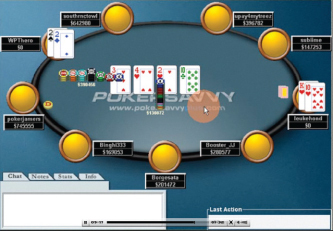 Let’s consider the factors present in this hand. After the early-position raise and subsequent call, I have to call 15,000 of my 174,128 stack. I am being offered just shy of 4-1 odds on the call, assuming that the big blind doesn’t call, as well. Knowing that I need 7-1 immediate odds to call, I am not getting the correct price to make a call here to try to flop a set. However, I must consider several other factors occurring in this hand, outside of the pure mathematics, when making my decision; specifically, the pay scales.
In this tournament, ninth place paid $2,200, eighth paid $3,500, seventh paid $5,000, and sixth paid $6,600. These payouts increased steadily to a $28,721 first-place prize. In looking at these payouts and the chip stacks of my opponents, I can assume that had I passed up this 2 2 opportunity and played tight, I could have moved up two spots in the money. However, there’s more at stake than just a few money spots; I’m trying to take first place! The 15,000 I am committing to call with 2-2 goes beyond the odds of flopping a set; it improves my chance at a top-three tournament finish. If I assume that flopping a set will win me a big pot against either of these opponents, and that I will increase my chip stack by, on average, 100,000 if I do (I’m not risking just the original 19,000 on a call), I’m giving myself a legitimate chance to win $28,721! While it is not 100 percent certain that I’ll win a huge pot if I do make a big hand, the possible reward outweighs the risk in this spot — even though the math odds don’t support my decision. I’m taking a big risk in calling, but in this case it’s time to gamble — take a flop and hope for that deuce.
The jump from 20 big blinds to 40 is enormous in terms of flexibility and strategy approaches that you can take at a final table. While you always need to keep an eye on the poker odds and strive to make profitable decisions, you can’t overlook some of the tangible factors off the table — such as the payout structure, field strength, and blinds levels. On some rare occasions, you simply need to throw the poker math out the door and make the decisions that give you the best opportunity to be the last man standing. Good luck at the tables.
To watch Justin Rollo comment on and play this hand, point your browser to Card Player Pro, the complete online poker training site, at www.CardPlayer.com/link/jurollo-8.
Bertrand Grospellier Vol. 22, No. 8
-
Capture the Flag — Justin Smith
-
Mind Over Poker
-
The Scoop — Scott Seiver
by The Scoop
-
Hand 2 Hand Combat — Corwin Cole
-
Card Player Pro
by Justin Rollo
-
Generation Next — Faraz Jaka
-
Generation Next — Faraz Jaka
-
Railbird Roundtable — Dutch Boyd
-
Final-Table Takedown — Steven Burkholder
-
Player of the Year
-
Inside Straight — News