







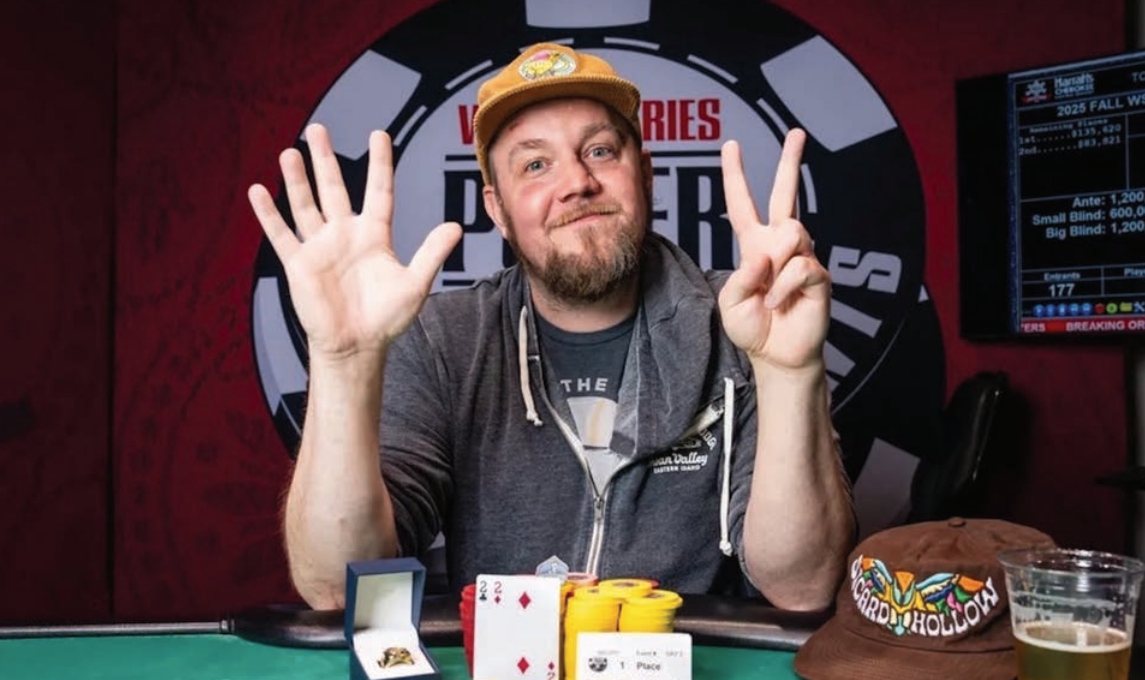
Marshall White started playing poker while in college at Appalachian State, where he double majored in Philosophy and Spanish. The poker boom was in full effect on his campus, and White was better than most at separating others from their beer money in his weekly home game.
He dabbled online, and started moving up in stakes. By junior year, he was making enough from poker to pay his rent. By senior year, poker was putting significant cash into his pocket, enough that he decided to turn pro after graduation.
The former river rafting guide has found considerable success on the World Series of Poker Circuit, racking up seven rings in total, including two high roller titles. His biggest cash remains the $330,841 he banked for taking down a World Poker Tour side event at Borgata back in 2017.
In late November, White overcame a massive field of 3,526 players at Harrah’s Cherokee in North Carolina, taking down the $400 buy-in WSOP Circuit kickoff event for a $135,620 payday. That’s a massive 33,805% return on investment!
Card Player caught up with White to talk about his latest victory and to break down two key hands he played en route to the title.
Craig Tapscott: What does it feel like to now have seven WSOP Circuit rings?
Marshall White: I’m not chasing trophies or accolades, but poker tournaments are hard to win. So, it’s cool to have them as a little token of the time I’ve put in the game and found at least a modicum of success.
CT: How do you determine what events you’re going to play during the year?
MW: I do play full-time, and I travel mainly within the southeast, playing low- and mid-stakes tournaments, with a couple of trips to Vegas each year.
I look for good-value tournaments. I also check where friends will be, because I put a lot of value in enjoying myself and having a good time while I’m not playing poker. At most of these stops, if I’m not in a poker tournament, there’s a good chance you’ll find a big group of us playing a game like Codenames in the lobby.
I enjoy and appreciate the flexibility of the job. When the travel gets to be too much, I’m happy to stay home and play online as well.
Series: WSOP Circuit Cherokee
Event: $400 No-Limit Hold’em
Entrants: 3,526
Prize Pool: $1,163,580
First-Place Prize: $135,620
CT: This was a huge field. With a lot of reentries. How do you usually approach the first levels of play in a marathon event?
MW: It’s very much a minefield you have to navigate through and get very lucky to come out on top.
I will take more gambles earlier on, especially in earlier flights and while registration is open, to try and position myself with a stack with more maneuverability later on. There is a lot of value in having a big stack on day 2 to leverage, having more tools at your disposal to continue accumulating chips.
But I didn’t find a bag on the first three flights, so on the fourth and final flight, I was putting more value on making it through. I bagged a below-average stack, but got a full double on the second hand of day two and continued building from there. I think I had about a 3x the average stack by the first break.
Anything can happen on day 2, but you’ve got to be there for it.
Hand No. 1
Stacks: Marshall White – 8,000,000 (66 BB) Villain – 3,800,000 (20 BB)
Blinds: 60,000-120,000 with a 120,000 big blind ante
Players Remaining: 16
MW: This was the last hand before the dinner break on day 2, with two tables left. I had been quite active previous to this hand, doing a lot of chipping up without showdown.
The action folded to me on the button…
White raised from the button to 250,000 holding Q♠10♠. The villain in the big blind called.
CT: Did you have any reads on the player in the blind at this time?
MW: Not really. I had definitely been the most active player at the table and was winning a lot of uncontested pots. But I got a vibe from the big blind that he was ready to put his foot down and fight back.
FLOP: 8♦8♠7♥
Villain led out for 350,000.
CT: What hands would donk bet in this spot?
MW: He could be leading a lot of things. Perhaps a seven, eight, straight draws, or random bluffs.
With two overs and some backdoor potential, position to navigate future streets, being ahead of all straight draws, and also just not necessarily believing the big blind’s lead, I decided to call.
CT: From your extensive experience, what are most recreational players doing when they lead out in a scenario like this one?
MW: The lead here can be hard to decipher. Better players will be balanced, but I’ve found that most recs are typically pretty weak here. Very rarely do they hold an eight.
I think a lot of the time, they just hope I missed and will fold, and that’s the extent of their plan.
White called.
TURN: K♦
Villain checked.
MW: The turn brought backdoor diamonds, and he checked quickly.
The king was better for my range than his, and I considered betting with plans to barrel the river to pressure a seven.
But I think the times he does have a seven, he is likely to get sticky with it on a lot of rivers. And because I was still ahead of all straight draws, I think I just had the best hand a lot of the time and didn’t want to face a potential check-raise.
Getting to showdown seems preferable to trying to get him to fold a seven.
White checked.
RIVER: 4♣
Villain bet 1,100,000.
MW: He went with a big bet just north of a million into about 1,400,000. He also said something along the lines of, “whatever this is” as he made the bet with two fistfuls of stacks.
CT: Kind of a weird way to put the bet out. What was running through your head at the time?
MW: Most of the straight draws missed, with 5-6 being the only one that got there. And although it’s not great to have a ten in my hand as a bluff catcher here, I still just wasn’t buying what he was selling.
His line didn’t really add up, and his body language was screaming weakness. His river bet seemed nervously ham-fisted.
White called, and Villain turns over J♣3♣. White won the pot of 3,580,000.
MW: He showed up with a complete airball. I went to dinner break towards the top of the chip counts, and I was feeling good about making a great read.
CT: What are some of the things you’re looking for or questions you’re asking yourself in a spot like this?
MW: I’m looking at the hand as a whole. I’m thinking about what makes sense and using each individual data point to get there.
I thought it was unlikely he would go bet/check/bet with an eight. His value hands to take this line seemed to be 5-6 or a random king, most likely.
The physical tells told me he didn’t want a call. I didn’t like having a ten in my hand, but ultimately, when they show up with a hand like J-3, I have to remind myself that in these sorts of fields, blockers are not as relevant as one might think.
Hand No. 2
Stacks: Marshall White – 40,000,000 (50 BB) Villain – 25,000,000 (31 BB)
Blinds: 400,000-800,000 with an 800,000 big blind ante
Players remaining: 3
Villain raised to 1,800,000 from the button, and the small blind folded.
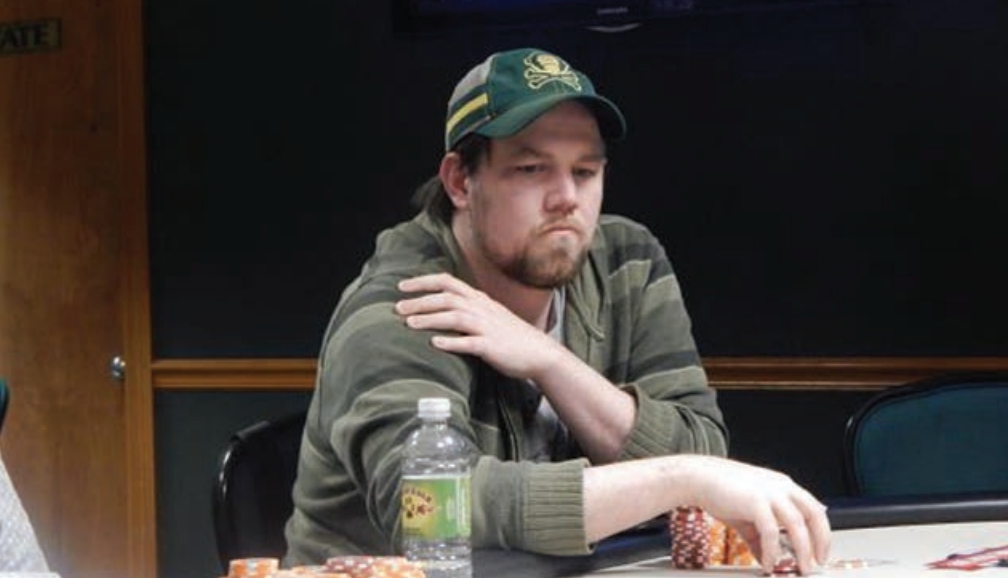
MW: I was holding pocket tens in the big blind. Obviously, a very strong hand three-handed, playing just over 30 big blinds effective. I was happy to three-bet and get this in.
White raised to 6,500,000, and the villain called.
FLOP: K♦K♥J♥
MW: It was obviously not the best flop. I thought his peels were going to be a lot of Broadway combos.
White checked, and Villain checked behind.
TURN: 5♠
White checked, and Villain bet 3,500,000.
MW: I thought we had a pretty easy call, despite the board texture. I knew I was often going to face a tough river decision, but I was happy to call and assess at that point.
RIVER: 3♦
White checked, and Villain moved all-in.
CT: You asked for a tough decision, and your wish came true.
MW: Yes. As was expected, we were now faced with a tough river spot. Tens didn’t feel great to have because they block some of the hands I wanted him to show up with. But we do not have the 10h, which is at least slightly relevant to unblock missed flush draws.
CT: Did you pick up any reads?
MW: I had been playing with this guy for a while by then, and had picked up a couple of tells. But similar to the first hand, I just felt like he was weak.
I tanked for a bit but ultimately trusted my read and called.
White called. The villain turned over 9♣7♦, and White won the pot of 50,400,000.
CT: Great call.
MW: Thanks. That hand gave me a 3:2 chip lead going into heads-up play and helped propel me to victory.
CT: You made two amazing hero calls. That had to feel good.
MW: I think both of these hands were important because I trusted my reads on both of them and found big calls even with arguably bad bluff catcher candidates. But in these massive field, small buy-in tournaments, you face a lot of player types, and it’s important to notice tendencies, develop reads, and trust yourself.
And as evidenced by these two hands, often when I’m trying to construct ranges of opponents, they will show up with something completely off the wall that you didn’t even consider. You have to take that randomness into account.
- Photos by WSOP and Palm Beach Kennel Club