







Knowing how to play Caribbean Stud poker is just the beginning. This guide walks you through everything from table setup and betting rounds to key strategy tips, plus a bit of background on how this poker variant gained popularity in casinos worldwide.
How to Play Caribbean Stud Poker: Key Points
- Caribbean Stud Poker is played against the dealer, not other players.
- Both you and the dealer receive five cards, but only one of the dealer’s cards is shown.
- The dealer needs at least Ace-King high to qualify.
- If the dealer does not qualify, your ante bet pays even money, and your raise bet is returned (a push).
- Raise pays according to a payout table.
In This Guide
What Is Caribbean Stud Poker?
Caribbean Stud Poker is a casino table game where you play against the house, not other poker players. It’s based on Five Card Stud but works more like blackjack or baccarat in practice.
For some players, the opportunity to beat the casino while playing poker is the game’s main appeal. Though for most, it’s just a more interesting alternative to traditional table games.
Caribbean Stud tables are often:
- Faster-paced.
- Less crowded.
- Offer bigger rewards than many other games.
History of Caribbean Stud Poker
It’s often claimed that legendary poker player and author David Sklansky created the first version of Caribbean Stud Poker. That’s disputed, but we know the King International Casino in Aruba was heavily responsible for promoting Caribbean Stud during the 1980s, which is why it’s named after that game.
Well-known developer ShuffleMaster created the first Caribbean Stud Poker online casino game, a title that inspired dozens of copycat titles. However, the first mainstream live-dealer Caribbean Stud poker online release is often credited to Evolution in 2015.
The only notable differences between today’s online variants are minor tweaks to the paytable and the addition of a few side bets. Whether you’re playing online poker for real money or live poker, this is a great game to check out.
How to Play Caribbean Stud Poker
Caribbean Stud Poker is a solo pursuit where you take on the house instead of other players. Just like in traditional poker, the goal is to make the best possible five-card hand. Stronger hands not only improve your chances of beating the dealer but also lead to bigger payouts.
Each round gives you two betting opportunities:
- The Ante Bet: Placed before any cards are dealt.
- The Call Bet: Placed after you see your cards.
If you don’t like your cards, you can simply fold them. This immediately ends your participation in the game, so you don’t have to waste chips on a second bet.
Caribbean Stud Poker Rules
The deck in this game features a standard setup: one 52-card deck, no jokers, with cards shuffled between rounds.
The rules are the same whether you’re trying Caribbean Stud Poker online or playing at a land-based casino. Let’s run through an example hand to illustrate how it all works.
Ante Bet and Initial Setup
- Each table sets its own minimum and maximum ante, so check the limits before playing.
- Once everyone’s placed their ante, the dealer will distribute the cards.
Dealing the Cards
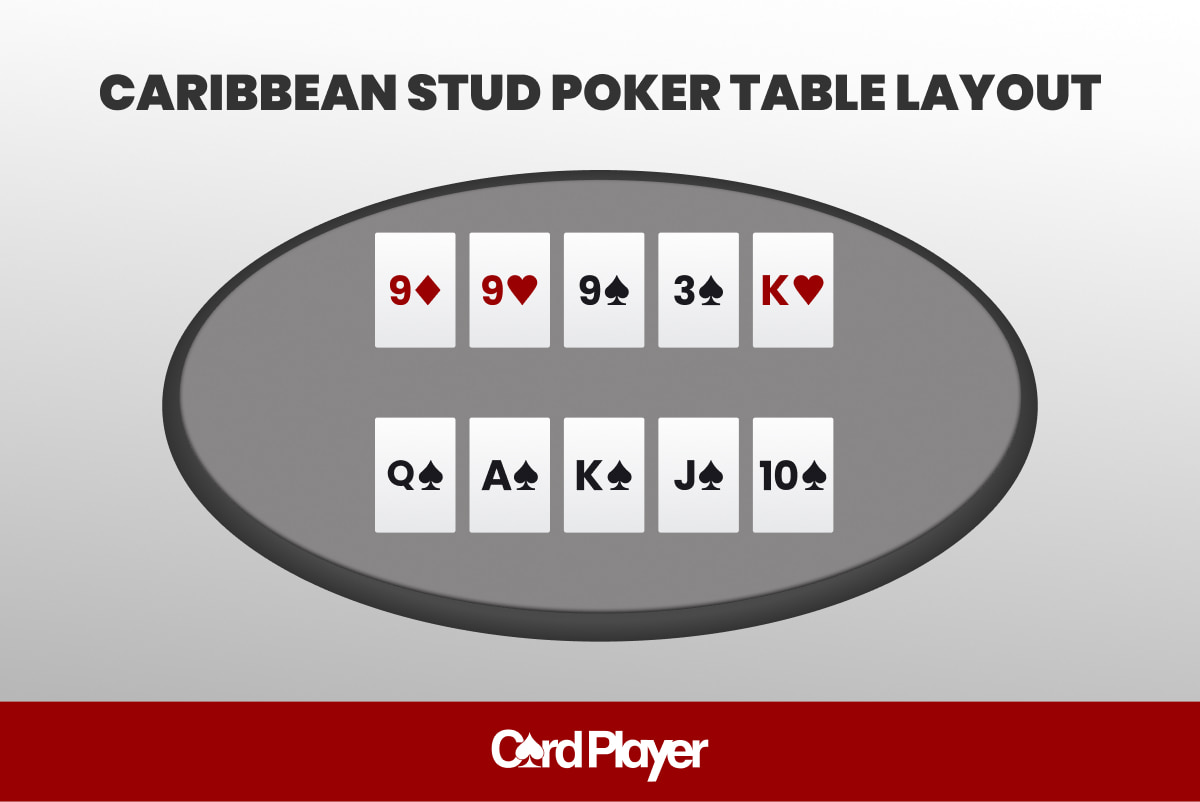
- Each player receives five cards face down.
- The dealer also gets five cards with one upcard exposed and four face down.
At this point, players assess the strength of their hands before deciding whether to continue playing.
Decision: Fold or Bet
After looking at your hand, you have two options:
- Bet (raise): If you like your hand and think you might have a chance of winning, you may elect to continue playing. This requires a second bet of exactly 2x the ante. For example, if you choose to ante $10, your bet will cost $20, meaning a total wager of $30.
- Fold: If your hand looks weak, you can fold. Although you’ll surrender the ante, you won’t lose any more money with a bad hand.
How do you know whether or not it’s a good idea to bet? We’ll come to that later, when we discuss the optimal Caribbean Stud Poker strategy.
Dealer Qualification
For the dealer’s hand to qualify, it must be Ace-King or better:
- If the dealer does not qualify, the ante pays even money, and the raise pushes.
- If the dealer qualifies, their hand is compared against each player’s hand.
Qualification is essential, as it determines which bets come into play and how they are settled.
Bet Settlement
When you make an ante bet (the initial wager), it pays even money – that means if you bet $10, you win $10.
The second bet (the “raise”) works differently:
- If the dealer doesn’t “qualify” (usually meaning their hand isn’t strong enough), your raise is returned to you – it’s a push.
- If the dealer qualifies, their hand is compared to yours.
Here’s what happens in each case:
- Your hand is stronger: You win even money on the ante, plus a payout on your raise. The exact payout depends on the paytable. For example, a royal flush might pay 100 to 1.
- The dealer’s hand is stronger: You lose both the ante and the raise.
- You tie with the dealer: It’s a push, and both your ante and raise are returned.
Caribbean Stud Poker House Edge
The Caribbean Stud house edge is 5.224% when using the standard paytable above and following an optimal poker strategy – which we’ll reveal shortly. This figure, often referred to as the ‘house edge,’ represents the casino’s long-term advantage on the ante bet.
A different metric, the ‘element of risk,’ is approximately 2.56%, which calculates the expected loss relative to the total amount wagered (ante plus raise).
Side Bets
Progressive jackpot side bets typically cost a fixed $1 and often pay 100% of the pool for a royal flush and around 10% for a straight flush (structures vary by casino).
Some Caribbean Stud Poker tables, particularly those found online, offer side bets. These aren’t compulsory, but many players enjoy them.
Here are the two main Caribbean Stud side bets:
Caribbean Stud Poker Hand Rankings
How do you know which hand is better when playing Caribbean Stud Poker? The variant uses the same hand rankings as Texas Hold’em, the most popular version of poker.
An Ace may also play low in a straight (A-2-3-4-5).
| Rank | Poker Hand | Description | Example |
|---|---|---|---|
| 1 | Royal Flush | A, K, Q, J, 10 of the same suit | A♦️ K♦️ Q♦️ J♦️ 10♦️ |
| 2 | Straight Flush | Five cards in sequence; same suit | 9♥️ 8♥️ 7♥️ 6♥️ 5♥️ |
| 3 | Four of a Kind | Four cards of the same rank | K♣️ K♦️ K♥️ K♠️ 3♣️ |
| 4 | Full House | Three of a kind and a pair | Q♠️ Q♣️ Q♥️ 8♠️ 8♦️ |
| 5 | Flush | Five cards of the same suit (not in sequence) | 2♣️ 6♣️ 8♣️ 10♣️ K♣️ |
| 6 | Straight | Five cards in sequence, different suits | 10♦️ 9♣️ 8♠️ 7♥️ 6♣️ |
| 7 | Three-of-a-Kind | Three cards of the same rank | 7♠️ 7♦️ 7♣️ Q♦️ 2♥️ |
| 8 | Two Pair | Two different pairs | A♠️ A♦️ 9♣️ 9♠️ 5♣️ |
| 9 | One Pair | Two cards of the same rank | 4♠️ 4♣️ K♥️ 9♦️ 2♠️ |
| 10 | High Card | If no player has a pair or better, the highest-ranking card wins | A♣️ 10♠️ 8♦️ 6♥️ 4♠️ |
Caribbean Stud Poker Payouts
Let’s take a look at some typical payouts you might encounter when playing Caribbean Stud Poker:
| Hand | Payout |
|---|---|
| Royal Flush | 100 to 1 |
| Straight Flush | 50 to 1 |
| Four of a Kind | 20 to 1 |
| Full House | 7 to 1 |
| Flush | 5 to 1 |
| Straight | 4 to 1 |
| Three of a Kind | 3 to 1 |
| Two Pair | 2 to 1 |
| Pair/High Card | 1 to 1 |
Caribbean Stud Poker Strategy
Now that you know the rules, let’s look at how to play Caribbean Stud Poker the right way. The good news is that the strategy for this game is straightforward, since you only have a couple of decisions to make each hand:
- Raise with any pair or better.
- Fold with less than Ace-King high.
- With Ace-King, consider raising when the dealer’s upcard is Ace or King, or when you hold A-K-Q or A-K-J and one of your other cards matches the dealer’s upcard.
Following these rules does not guarantee wins, but they give you the strongest mathematical edge when deciding whether to raise or fold. For safer play, always keep responsible gambling guidelines in mind.
Below are some expert tips to help guide your decisions at the table.
Stick to Ace-King or Better
The golden rule of Caribbean Stud Poker is to fold anything ranked lower than Ace-King.
Don’t forget that the dealer needs Ace-King in order to qualify. By playing anything worse than that, you can’t win more than an even money payout on your ante when the dealer fails to qualify. If the dealer does qualify, you’re guaranteed to lose.
You can play these hands if you want, of course. You might even win. However, it has been mathematically proven to be a losing strategy in the long term.
Assess the Paytable
The next most important thing is to check the paytable before taking a seat.
Although the fundamental rules of Caribbean Stud Poker don’t change from casino to casino, the odds sometimes do. Why would you willingly play at a site paying 6 to 1 for a full house if a rival is offering 7 to 1?
Avoid the Side Bets
Finally, as fun as they can be, it’s not a great idea to play the Caribbean Stud poker side bets.
These wagers are designed to increase your enjoyment, but also your spending. They often have a very high house edge, meaning you’ll just burn through your bankroll much quicker than usual.
Caribbean Stud Poker is easy to learn, offers payouts up to 100 to 1, and – when you follow optimal strategy – carries a house edge of about 5.22% (with an element of risk around 2.56%). To get the most from the game, just remember a few rules: avoid side bets, only play strong hands, and set firm limits before you start.