One of the most common mixed game variants is Badugi.
The Rules
Played in a similar manner to triple draw, Badugi is often spread in mixed rotations, or is an element of other split-pot games such as Badeucey and Badacey. When Badugi is played alone, it is a one-winner game where the best hand wins the entire pot.
Each player is dealt four cards, and the object of the game is to make the lowest four-card, unpaired, offsuit hand possible. As such, the best possible hand is 4-3-2-A rainbow, reading the largest number first. So, a hand of A♣3♥7♦9♠ would be called a nine badugi.
If a hand contains a pair or a suited card, the higher card is removed to knock it down to a three-card hand. Therefore, a hand like 2♣4♦5♦6♠ would be considered a ‘three-card six’ where the three cards comprising the hand would be the 2♣, 4♦, and 6♠. Of course, any four card beats a three-card hand, and any three-card hand beats a two-card hand, and so on. When two hands tie, it goes to the next highest card, so if one hand was 3♣4♦6♠7♠ and up against 2♣4♠6♦J♦, the first hand would play 6-4-3 and lose to the second hand playing 6-4-2.
The Action
With the rules out of the way, that brings me to a hand that came up in a $40-$80 game at Bellagio. We were playing late and four-handed, so the action was aggressive. My opponent was a brilliant player with over $6 million in tournament cashes, to go along with a bracelet in mixed triple draw, and he opened for a raise first to act.
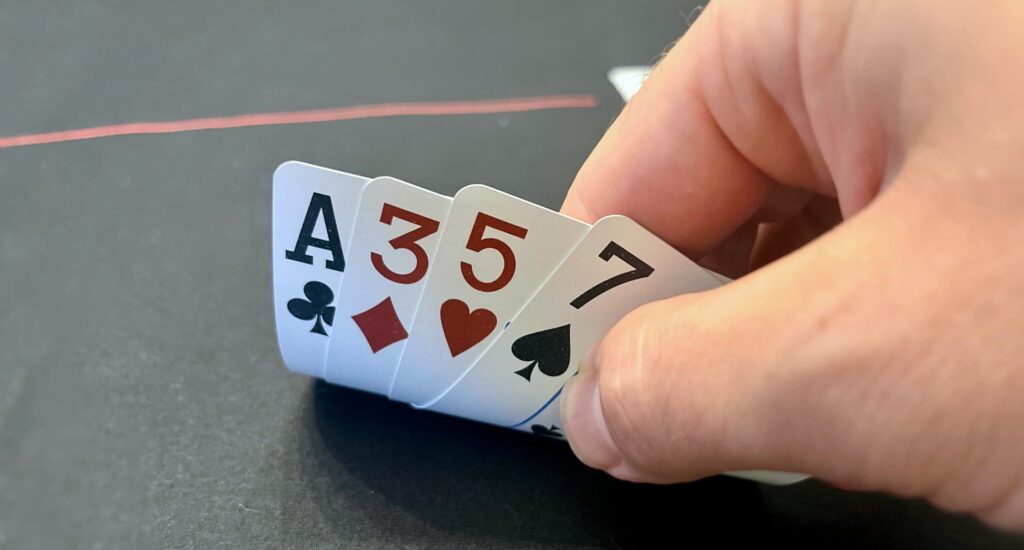
I looked down at a glorious holding on the button of A♣3♦5♥7♠ for a made seven Badugi. Slow playing doesn’t offer much merit in triple draw since it will already look strong when someone stands pat right away, so three-betting is typically the best choice. Additionally, three-betting would not allow the blinds to draw cheaply.
I elected to three-bet, the big blind called, and the raiser called, and we took the first draw three ways with $120 from each player plus $20 from the small blind for a total of $380. The small blind drew two, raiser drew one, and I of course patted behind.
I assessed the blind’s range as strong two-card draw (either A-2, A-3, or 2-3), and I gave the raiser credit for drawing live (his worst possible holding here when raising under-the-gun would be a three-card five or six, which would give him up to four outs against me three times).
Both opponents checked, I bet $40, and they called growing the pot to $500. They each drew one on the second pull, and I patted again. They both checked again, I bet $80, and they both called making the pot $740.
On the last draw, the blind again drew one, the raiser drew one, and I patted. Now during the final betting round, the first player checked, and the original raiser led into me for $80, leaving a tough decision.
With the pot now at $820, folding a strong hand is out of the question. The only choice I have is to raise or call. The first thing I considered is if my opponent does have a better hand than me, he must have at least a 7-5 perfect which will almost always warrant a three-bet when I raise, so I will be risking losing two more bets when I am beat to win one more when I am good, effectively laying him 2:1 when I choose to raise. As such, I need to be correct over 66% of the time for this raise to be profitable.
Additionally, the other opponent could have potentially hit a monster card on the end and be planning to check-raise, so there is some chance that I could be getting three-bet from there, or possibly just called by a hand like a better seven, or even paid off on two bets if he made an eight or a nine.
Another factor is that all my opponent knows from my play of the hand is that I am repping some type of dealt made hand, and the average made Badugi dealt to a player is a queen. As such, my opponent here could be betting a wide variety of hands, so his range isn’t heavily weighted to super strong holdings.
After much consideration, I put in the raise and the first opponent quickly folded. With the $160 I added, the pot grew to $980 which the lone opponent left had to call only $80 in hopes to win. He grimaced when the action came to him, and he clearly didn’t like his hand at this point. After much deliberation and getting pot odds of over 12:1 on his money, he folded 9-5-4-2 rainbow face up for a fantastic laydown. I told him that was an amazing fold as I courteously tabled my seven.
The next thought I had was that the play he made does exhibit some exploitability, as if I had made the same move bluffing the river with a face card in my hand while laying 12:1 pot odds, the move could have gotten through successfully winning a big amount of money. Badugi is a nuanced game and it can present some exciting and challenging decisions, as this hand illustrates.
 Mark Mazmanian has been a mixed-game specialist for more than two decades playing in games all over the country. The Las Vegas resident can be reached on Instagram @maztastic1 or by email to markmaz17@hotmail.com.