Give us your opinion in the comments section below for your chance at winning a six-month Card Player magazine digital subscription.
Ask any group of poker players how you played your hand and they’ll come up with dozens of different opinions. That’s just the nature of the game.
Each week, Card Player will select a hand from the high-stakes, big buy-in poker world, break it down and show that there’s more than one way to get the job done.
The Scenario
It is day 1 of a major live poker tournament filled with some of the best players in the world. There are 40 players left from a small starting field of 64, and only the final eight will make the money.
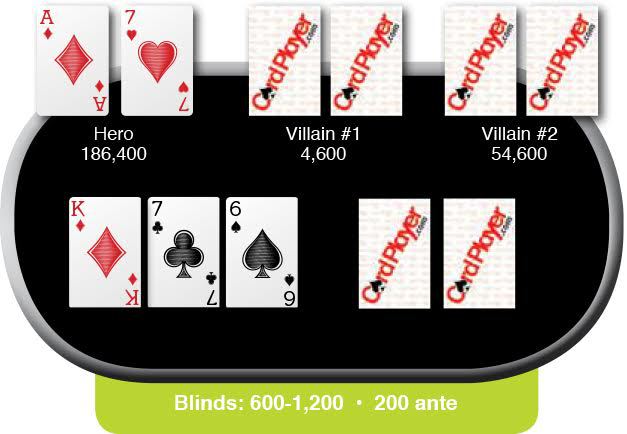
Each player began the day with 50,000 in chips, and you have done quite well for yourself so far and are among the chip leaders with 186,400. The blinds are 600-1,200 with 200 ante, giving you more than 155 big blinds to work with. You are known for being an extremely aggressive player.
It folds to you in the cutoff and you look down at A 7
7 . You decide to raise to 2,400 and the small blind, who has a stack of 54,600, makes the call. The big blind is extremely short stacked with 4,600, and he tanks before moving all in.
The raise is just enough to re-open the betting, so even though you aren’t very confident about your hand, you decide to isolate and reraise to 7,400. Your hope is that the small blind’s dead money will give you the right odds against the all-in player.
Unfortunately, the small blind does not cooperate and he calls, creating a 6,000 side pot to go along with the 14,800 in the main pot. The flop comes down K7 6
6 , giving you middle pair. The small blind checks.
The Questions
Do you check or bet? If betting, how much? Is there enough in the side pot to entice you to bet right now, or should you be checking this hand to a showdown in the hopes that either you or the small blind will knock out the all-in player? If checking, what is your plan for the turn? What if your opponent checks the turn? What if he bets?
What Actually Happened
 At the WPT Tournament of Champions, Jason Brin was all in before a flop reading K76. Taylor Paur checked and Michael Mizrachi bet 6,000. Paur folded and Mizrachi took the side pot while simultaneously revealing A7 for middle pair.
Brin reluctantly showed 22 and needed help to stay alive, but the turn and river fell QJ, sending him to the rail.
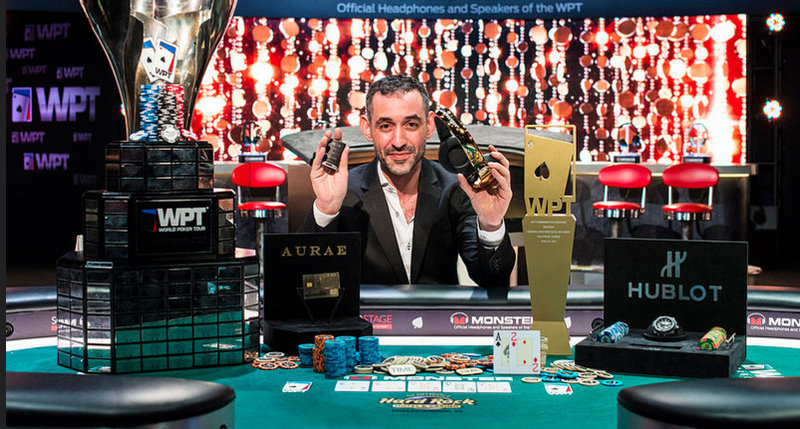
Mizrachi went on to finish in third place, earning $140,450. The eventual winner was Farid Yachou, who picked up his second WPT title and the $381,600 first-place prize.
What would you have done and why? Let us know in the comments section below and try not to be results oriented. The best answer will receive a six-month Card Player magazine digital subscription.