






Give us your opinion in the comments section below for your chance at winning a six-month Card Player magazine digital subscription.
Ask any group of poker players how you played your hand and they’ll come up with dozens of different opinions. That’s just the nature of the game.
Each week, Card Player will select a hand from the high-stakes, big buy-in poker world, break it down and show that there’s more than one way to get the job done.
The Scenario
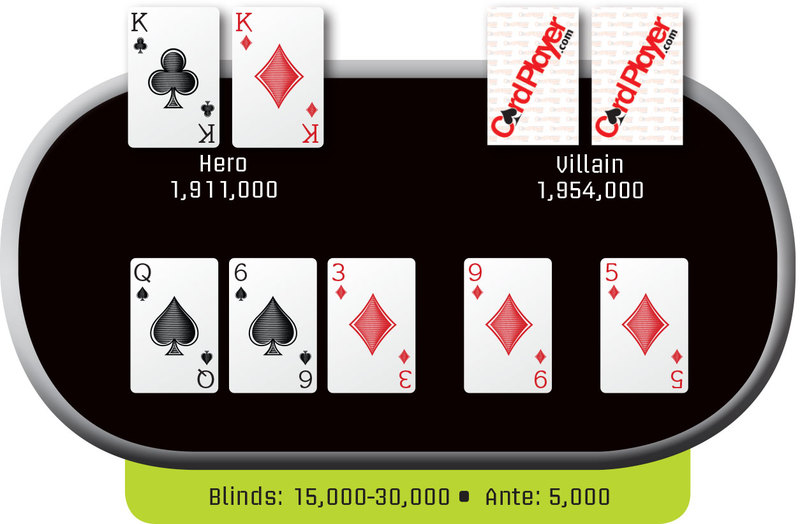
There are nine players remaining in a WSOP event and with 1,911,000, you are in second place by a slim margin. With blinds of 15,000-30,000 with a 5,000 ante, you have 63 big blinds. There are three short-stacked players with less than 15 big blinds.
You look down at K K
K in early position and raise to 75,000. The chip leader, a player with 1,954,000, calls immediately behind you. The blinds fold and the flop comes down Q
 63.
63.
You bet 125,000 and your opponent calls. The turn is the 9 and you bet 225,000. Again, your opponent calls. The river is the 5.
The Questions
Do you check or bet? If checking, what is your plan should your opponent bet? Will you call or check raise? If betting, how much? What kinds of worse hands will your opponent call a value bet with? If your opponent has a busted draw of some kind, should you check and hope he bluffs?
 What Actually Happened
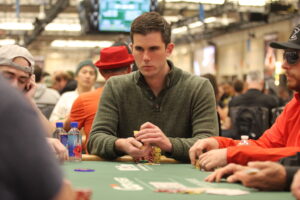
In the WSOP $3,000 no-limit hold’em event and sitting with pocket kings on a board of Q6395, Sean Dempsey checked and his opponent, Ryan Laplante, bet 664,000.
Dempsey quickly called and saw that his kings were ahead of Laplante’s A Q. Dempsey took the pot and a big lead in the tournament.
Laplante went on to finish in fifth place, banking $113,796. Dempsey won the event, earning his first gold bracelet and the $548,460 first-place prize.
What would you have done and why? Let us know in the comments section below and try not to be results oriented. The best answer will receive a six-month Card Player magazine digital subscription.