





Give us your opinion in the comments section below for your chance at winning a six-month Card Player magazine digital subscription.
Ask any group of poker players how you played your hand and they’ll come up with dozens of different opinions. That’s just the nature of the game.
Each week, Card Player will select a hand from the high-stakes, big buy-in poker world, break it down and show that there’s more than one way to get the job done.
The Scenario
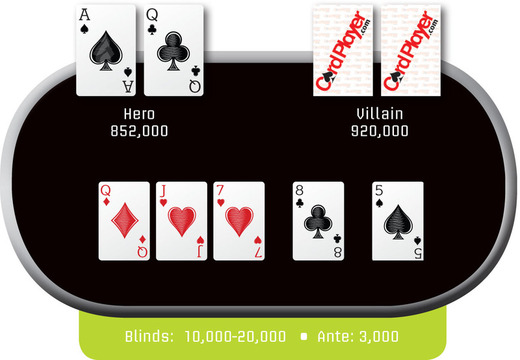
There are 14 players left in a major high-stakes tournament and only eight players will make the money. With 852,000 in chips and blinds of 10,000-20,000 with a 3,000 ante, you are sitting with over 42 big blinds, which is good enough to put you in the middle of the pack.
You look down at A Q
Q and raise to 40,000 from under the gun and are called by two aggressive players on the button and in the big blind. The flop comes down Q
 J
J 7 and the big blind checks.
You continuation bet 90,000 and the button, who has you slightly covered, calls. The big blind folds and the turn is the 8. You check and your opponent bets 150,000. You call and the river is the 5.
You check once again, and your opponent bets 500,000, leaving himself with just 140,000 behind. You have only 569,000 remaining.
The Questions
Do you call, fold or raise all in? If calling, what hands do you expect to see from your opponent that you can beat? If folding, what hands do you expect to see from your opponent that have you beat? What does your opponent’s river bet size say about his hand? Why would he leave you with just over 3 big blinds? Would he bet so much of his stack on a bluff? Assuming your opponent isn’t giving off any discernible reads, how do you make your decision?
 What Actually Happened
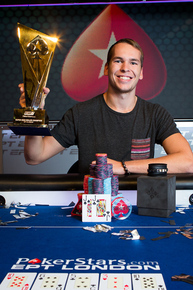
At the 2013 EPT London £50,000 buy-in Super High Roller event, Tim Adams was facing a bet for the majority of his stack while holding A Q on a board reading Q J 7 8 5.
After some time in the tank, he opted to call the bet. His opponent, Patrik Antonius, turned over K 10 for a busted open-ended straight draw. Adams won the pot and increased his stack to 1,700,000.
Antonius rebounded to sneak into the money, finishing eighth for £109,455. Adams finished sixth for £175,200. The eventual winner was 23-year-old German pro Martin Finger, who banked £821,000 and his second major tournament title on the EPT.
What would you have done and why? Let us know in the comments section below and try not to be results oriented. The best answer will receive a six-month Card Player magazine digital subscription.
*Winner photo courtesy of Neil Stoddart and PokerStars.