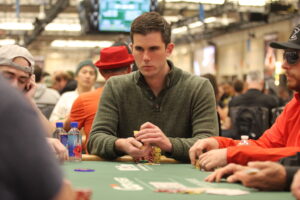
Give us your opinion in the comments section below for your chance at winning a six-month Card Player magazine digital subscription.
Ask any group of poker players how you played your hand and they’ll come up with dozens of different opinions. That’s just the nature of the game.
Each week, Card Player will select a hand from the high-stakes, big buy-in poker world, break it down and show that there’s more than one way to get the job done.
The Scenario
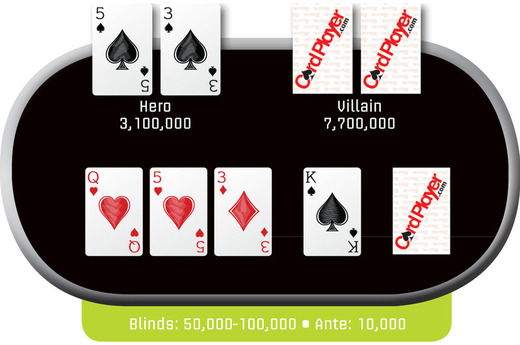
You are four-handed in a major tournament and with 3.1 million in chips (31 big blinds) you are virtually tied for second place. The chip leader is a young, aggressive player with 7.7 million (77 big blinds). The short stack, on your immediate left, is a capable amateur player who has been playing very tight and only has 800,000 (8 big blinds) left in his stack.
The short stack is first to act and folds, opting to wait for a better spot. The chip leader then raises to 200,000 on the button and the small blind folds. You look down at 5 3 and decide to defend your big blind.
The flop comes down Q 5 3
5 3 , giving you bottom two pair and you go for the check raise. Unfortunately, your opponent checks behind, and the K hits the turn.
You have 2.9 million chips remaining and a pot of 490,000 in front of you.
The Questions
Do you check or bet? If betting, how much? If checking, what is your plan if your opponent bets? What if your opponent checks behind? With bottom two pair, what kind of value are you looking to get out of this hand and what’s the best way to do it? Your opponent raised preflop, but did not make a continuation bet on this board. What does that say about his hand, if anything?
 What Actually Happened
At the 2013, PokerStars Caribbean Adventure $100,000 Super High Roller, David Sands opted to check back on a flop of Q 5 3 despite holding Q 10 for top pair.
Scott Seiver, holding 5 3 for bottom two pair, checked again when the K hit the turn and then fired in a bet of 300,000 when the 2 came on the river. Sands snap-called and then congratulated himself after seeing he lost the minimum.
Seiver would eventually get even, however, and rebound to take the title along with the $2,003,480 first-place prize. Sands was forced to settled for a runner-up finish and $1,259,320.
What would you have done and why? Let us know in the comments section below and try not to be results oriented. The best answer will receive a six-month Card Player magazine digital subscription.