
Give us your opinion in the comments section below for your chance at winning a six-month Card Player magazine digital subscription.
Ask any group of poker players how you played your hand and they’ll come up with dozens of different opinions. That’s just the nature of the game.
Each week, Card Player will select a hand from the high-stakes, big buy-in poker world, break it down and show that there’s more than one way to get the job done.
The Scenario
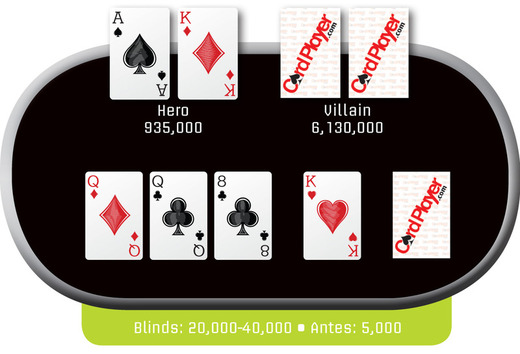
You are sitting as the short stack at a four-handed final table. Though you still have x big blinds, your opponents are all deep and unafraid to aggressively use their superior chip stacks.
On the button, you pick up A K
K and raise to 80,000. The chip leader makes the call from the big blind and the flop comes down Q Q
 8. Your opponent checks and you check behind.
The turn is the K and your opponent bets 140,000. You have 850,000 total remaining in your stack.
The Questions
Do you call or raise? If calling, what is your plan for the river? If raising, how much? What range of hands is your opponent representing and what action could you take to narrow that range?
The Argument For Calling
At this point in the hand, your opponent is only betting made hands that are either way ahead or way behind. Because you are in position and have the benefit of acting last, you can reevaluate your hand on the river after your opponent has made their decision. By just calling on the turn, you keep the pot small when you are behind and allow your opponent to bet again on the river, either for value or as a bluff, when you are ahead.
The Argument For Raising
Though the K gives you top pair, top kicker, it also has the potential to give your opponent a large number of draws. Because you didn’t continuation bet on the flop, you can’t rule out a club flush draw. Additionally, your opponent could be taking a stab with a number of straight draws including A-J, A-10, J-10, J-9 or 10-9. Raising allows you to protect your hand and charge your opponent for drawing.
 What Actually Happened
At the final table of the EPT Grand Final €100,000 buy-in Super High Roller on a board reading Q Q 8 K, Justin Bonomo bet 140,000 and Patrik Antonius decided to just call with his A K.
The river was the 9 and Bonomo bet 380,000. After about a minute of thought, Antonius moved all in and Bonomo quickly called, showing J-10 for a rivered straight.
Antonius was eliminated in fourth place, earning €443,000. Bonomo went on to win the tournament, pocketing €1,640,000 for the largest score of his career.
What would you have done and why? Let us know in the comments section below and try not to be results oriented. The best answer will receive a six-month Card Player magazine digital subscription.