Give us your opinion in the comments section below for your chance at winning a six-month Card Player magazine digital subscription.
Ask any group of poker players how you played your hand and they’ll come up with dozens of different opinions. That’s just the nature of the game.
Each week, Card Player will select a hand from the high-stakes, big buy-in poker world, break it down and show that there’s more than one way to get the job done.
The Scenario
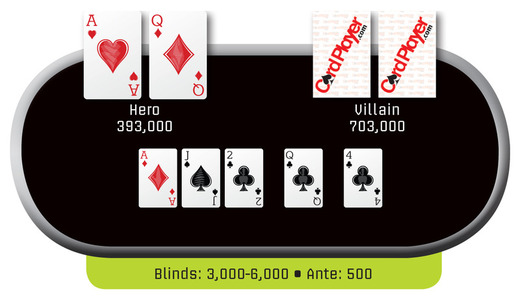
You have just made the money in a major tournament and are sitting in the middle of the pack with 54 players remaining. You are dealt A Q
Q on the button and decide to open to 15,000.
The small blind, one of the bigger stacks remaining in the tournament, three-bets to 38,000 and the big blind folds. You make the call and see a flop of A J 2
2 .
.
The small blind continues for 31,000 and you call. The turn is the Q and the small blind bets once again, this time 65,000. You call and the 4 hits the river.
The small blind doesn’t slow down and fires in 133,000. You have 258,500 in chips remaining.
The Questions
What do you do with your remaining chips? Do you call, shove or even possibly fold? What type of hand is your opponent three-betting preflop and betting all three streets with?
The Argument For Shoving
You’ve severely under-represented your hand to your opponent, who will have trouble putting you on a hand better than one pair. As it stands, you beat any hand with an ace it in, which will make up a good portion of your opponent’s preflop three-betting range.
Furthermore, because you only have an additional 120,500 left in your stack behind your opponent’s river bet, you may even get a crying call from a hand like A-K or A-10 and are certainly getting called by hands like A-J and Q-J. You’ve been gun shy so far throughout the hand, so you might as well go for maximum value while you still have the chance.
The Argument For Calling
You may have been trying to trap an aggressive opponent, which is fine, but the time for raising was on the turn. Now that your opportunity has come and gone, it’s best to take the cautious approach and just call this river bet. Your opponent could have any number of backdoor club combinations, a set of aces, queens or jacks or even a hand like K-10, which fired a continuation bet on the flop with a gutshot and got there on the turn.
Although you’d hate to just call and be shown A-J, you certainly don’t want to be out of the tournament either. If you call and lose, you’ll still be left with 120,500, or 20 big blinds. That’s more than enough chips to maneuver with.
The Argument For Folding
Perhaps our readers can make a better case than we can, but your opponent has shown a significant amount of strength by three-betting preflop and then betting all three streets on a board in which he has to know you hit in some way.
The likelihood of him bluffing is significantly decreased by his river bet, the only question is whether or not he is value betting a worse hand than yours. Yes, A-J, Q-J and maybe even A-K are worse hands, but everything else in his range, assuming he isn’t bluffing, is beating you. Save your last 258,500, which is still 43 big blinds, and keep grinding.
What Actually Happened
Sitting in the money at the EPT Campione main event, Massimiliano Bellucci was facing a bet of 133,000 holding A Q on a board reading A J 2 Q 4.
After some thought, he moved all in for his last 258,500 and his opponent, Koen De Visscher made the call, tabling K 10 for a turned straight.
Bellucci was eliminated in 54th place, earning €9,000. De Visscher went on to make the final table.
What would you have done and why? Let us know in the comments section below and try not to be results oriented. The best answer will receive a six-month Card Player magazine digital subscription.