
Give us your opinion in the comments section below for your chance at winning a six-month Card Player magazine digital subscription.
Ask any group of poker players how you played your hand and they’ll come up with dozens of different opinions. That’s just the nature of the game.
Each week, Card Player will select a hand from the high-stakes, big buy-in poker world, break it down and show that there’s more than one way to get the job done.
The Scenario
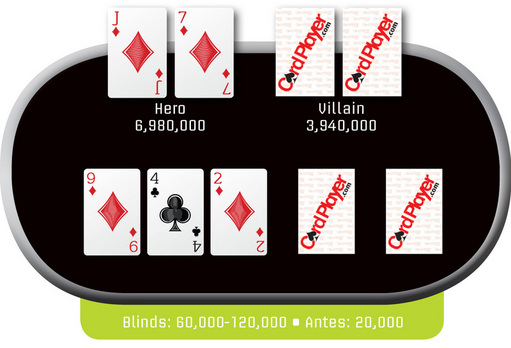
You are heads-up for a major tournament title and currently hold slightly less than a 2-1 chip lead over a solid player who has won the majority of the pots over the last hour. In fact, if it wasn’t for the decent size pot you recently won, the stacks would be about even.
With about 58 big blinds, you min-raise to 240,000 on the button holding J 7. Your opponent calls and the two of you see a flop of 9 4
 2.
2.
You decide to continuation bet 300,000 and your opponent check-raises to 900,000. Your opponent has 2,780,000 behind and you are sitting with 6,420,000. So far in this hand, you’ve only invested 560,000.
The Questions
What do you do with your flush draw? Should you just call and see a turn card? Should you move all-in over the top of his check-raise? How well does your hand play against his range?
The Argument For Calling
Assuming that your opponent has some sort of made hand, such as a nine or better, you are now looking at what is likely to be 12 clean outs to win the pot. According to the Card Player Poker Odds Calculator, that puts your chances at winning somewhere in the neighborhood of 45 percent, barring any shared cards or redraws. Since we know that almost all nines or better are calling a shove, it makes little sense to take what is guaranteed to be the worst of it.
Now, if your opponent happens to have a worse diamond draw, or say, an open-ended straight draw, then there’s even more of an argument for calling, since it would tempt him to continue on most turns despite being way behind.
The Argument For Shoving
Your opponent has put in 1,160,000 of his stack, which represents less than 1/3 of his total chips. Though he would undoubtedly be short stacked if he folded to a shove, his 23 big blinds are more than enough to mount a comeback. For that reason, there is some fold equity left in the hand.
Furthermore, there’s no guarantee that you’d be paid off if you hit a diamond, since it’s a card that your opponent would likely be scared of. Shoving on the flop guarantees that you’d be called by most, if not all worse drawing hands and gets medium-strength hands, such as pocket fives through eights, to fold a majority of the time.
What Actually Happened
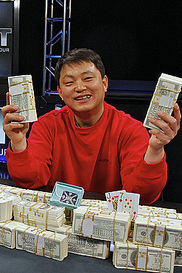 Heads-up at the WPT Bay 101 Shooting Star main event, Moon Kim min-raised to 240,000 and Ubaid Habib made the call. The flop fell 9 4 2 and Habib checked.
Kim bet 300,000, Habib check-raised to 900,000 and then Kim moved all in. Habib thought it over for a couple minutes before calling all-in for his tournament life with Q 9 for top pair.
Kim showed J 7 for a flush draw with an overcard and connected when the turn and river came A 8. Habib was eliminated in second place and earned $570,200, while Kim took home the title and the first-place prize of $960,900.
What would you have done and why? Let us know in the comments section below and try not to be results oriented. The best answer will receive a six-month Card Player magazine digital subscription.