
Give us your opinion in the comments section below for your chance at winning a Card Player prize pack.
Ask any group of poker players how you played your hand and they’ll come up with dozens of different opinions. That’s just the nature of the game.
Each week, Card Player will select a hand from the high-stakes, big buy-in poker world, break it down and show that there’s more than one way to get the job done.
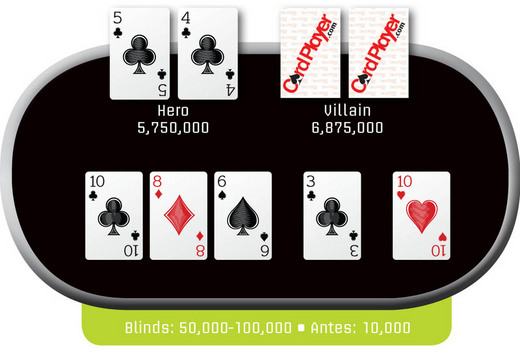
The Scenario
You are three-handed for a major tournament title and are currently second in chips. There is an aggressive, but shorter stacked pro on your right and the chip leader on your left. Your opponent in this hand is technically an amateur, but has played well enough to this point. His only real leak seems to be a tendency to defend his big blind too often with marginal holdings.
The button folds and you look down at 5 4 in the small blind. You decide to raise to 280,000, or just under 3 big blinds. Your opponent decides to call behind you and the two of you see a flop of 10 8
 6
6 .
.
You continuation bet 360,000 with your gutshot straight draw and your opponent quickly calls. The turn is the 3, giving you an open-ended straight draw and a flush draw.
You bet 640,000 and once again, your opponent calls. The river is the 10 which misses your hand completely.
You have 4,460,000 remaining in your stack and your opponent has 5,585,000. You are known for being a methodical, yet tricky player who is capable of showing down a wide range of hands.
The Questions
Do you check or bet? If you decide to bet, how much? What range of hands is your opponent holding in this particular situation?
The Argument For Checking
Your opponent has been defending his blinds liberally throughout the tournament, so it’s tough to pinpoint exactly what type of hand he’s holding when he calls preflop. You decided to continuation bet and were called, which rules out most ace high hands and K-Q or K-J, as well as most small pairs such as pocket fives, fours, threes and deuces.
On the turn, you picked up enough outs to fire another bullet, but your opponent still came along for another call, which should set off some alarms in your head. The river is a particularly ugly board pairing ten, which makes it extremely difficult to for you to continue. Why? Here’s why.
It’s not that the ten will always hit your opponent, (though sometimes it will) it’s that it prevents you from telling a believable story with the line you’ve taken up until now. Yes, your opponent could have a few combinations of busted draws, but your river bluff attempt would get picked off by pretty much every other hand with even a little bit of showdown value. In other words, if your opponent thought his pocket nines, any eight, pocket sevens or any six was good on the turn, then he’s certainly going to think it’s good on the river as well.
In order to make sense, a river bluff would probably be in the neighborhood of 1 million, which if called would leave you as the table’s short stack. Checking and giving up still allows you to control the other good player at the table, who has less chips and a positional disadvantage.
The Argument For Betting (Bluffing)
Let’s keep in mind that at no point during this hand has your opponent gone out of his way to show strength. In fact, he’s done quite the opposite by making quick calls of your flop and turn bet. Anyone who has played live before knows that quick calls are rarely made by those who have monster hands.
Now let’s take a look at the hands which would fold to a river bet (bluff). If your opponent happened to be holding any number of straight draw combinations that include Q-J, J-9, Q-9, 7-5 or 7-4, then he’d certainly lay his hand down to a bet, given the fact that he has zero showdown value.
Even a bluff as small as the amount you bet on the turn would get the above hands to fold. The pot has swelled to nearly 2.6 million by this point, so assuming you bet around 650,000, you’d only have to be successful 1 out of every 4 tries in order for it to be a profitable play.
That being said, even if your bluff is picked off, you’d still be left with a minimum of 3.6 million, which at 36 big blinds, is more than enough to maneuver with given the relatively slow moving structure.
What Actually Happened
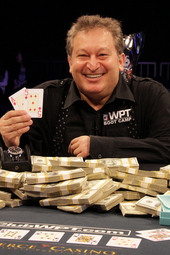 Three-handed at the World Poker Tour L.A. Poker Classic, Dan “djk123” Kelly folded his button and David “Doc Sands” Sands raised to 280,000 from the small blind. Sean Jazayeri defended in the big blind and the flop came down 10 8 6.
Sands fired 280,000 and Jazayeri called. The turn was the 3 and Sands bet 640,000. Jazayeri called once again and the river was the 10.
Sands checked and Jazayeri reluctantly checked behind, showing J 9 for a busted open-ended straight draw. Sands mucked and Jazayeri took the pot.
Kelly went on to finish third for $521,770, Sands finished runner-up for $806,370 and Jazayeri won it all for $1,370,240 and his first WPT title.
What would you have done and why? Let us know in the comments section below and try not to be results oriented. The best answer will win a Card Player prize pack.