







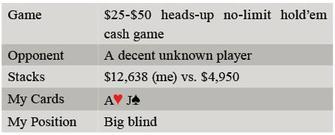
When you play high-stakes poker, you need to have several poker plays in your repertoire that most casual players don’t often use. One such play is turning a “made hand” (a hand with strong showdown value) into a bluff, to push your opponent off an even better hand. This column will look at turning a made hand into a bluff in a high-stakes match I played against an online opponent in $5,000 no-limit heads-up play.
This hand took place about 45 minutes into the match. My initial impression of my opponent was that he was decent, but probably not a huge winner in $5,000 heads-up play. He played a bit too straightforwardly, and was relatively easy to read overall. Most importantly, I felt that he played a bit too weakly and a bit too passively, and wasn’t really capable of thinking outside the box.
In the hand in question, my opponent opened from the button to $150, and I decided to flat-call with the A J
J . Both flatting [flat-calling] and reraising here are fine; this time, I opted to flat-call.
The flop came A 9 8, giving me top pair. I checked, my opponent bet $200, and I again decided to flat-call. I think check-raising also would be a good play, and one that I would mix in from time to time — but this time, I decided to call.
The turn was the 7 . I checked, and my opponent checked behind.
The river added the offsuit 7, giving me two pair — aces and sevens with a jack kicker.
At this point, I figured to have the best hand nearly always. This particular opponent would almost never have checked behind on the turn with a big hand (two pair, a set, and so on) — so my decision was to pick a bet size that could possibly get called by a weaker hand, such as a pair of eights or nines.
I bet $525, hoping to get called by a weaker ace or a weaker pair because he put me on a missed flush draw or missed straight draw.
Instead, he raised to $1,500.
Although he was rather straightforward, I expect him to bluff-raise in this spot some percentage of the time. My hand looks fairly weak; the best hand I’ll really ever have here with my line is one pair — so I think I can call his raise and show a small profit over the long run.
However, if he didn’t have a bluff, I asked myself what I really thought his raising range would be like on this river. Since he wasn’t the type to check back a very strong hand, I really expected his range of hands to be restricted to a bluff or, specifically, three sevens. And while I think calling his raise is probably a break-even play, I think that if I shove, I can get him to fold three sevens.

Now, several key factors have to be in place for this play to work. First, I have to be reasonably sure that he wouldn’t slow-play the turn by checking a straight, a set, or a hand like 8-7 or 9-7. Second, I have to be reasonably sure that he can read hands. Low-stakes players will often call my river push with three sevens because they have a “strong” hand in an absolute sense.
However, since my opponent’s hand looks a lot like three sevens — and he knows that I know his hand looks like three sevens — when I shove all in, he probably doesn’t think I’m shoving with a worse hand, ever. Finally, I have to be sure that he won’t make a river call out of spite — but I think this is counterbalanced by the fact that I can very credibly represent a straight or a full house, and I don’t expect him to think I’d bluff.
So, I shoved all in, and my opponent thought for a few moments and folded.
While I don’t often show my bluffs, I decided to show my opponent A-J, and he typed in chat that he had indeed folded the 7 6, for three sevens.

For most players when facing a raise, the decision is binary: Do I fold or do I call? However, being able to think of the third option — turning your hand into a bluff and shoving — can really expand your game. Best of luck at the tables.
To watch Evan Roberts comment on and play this hand, point your browser to Card Player Pro, the complete online poker training site, at www.CardPlayer.com/link/eroberts-5.