







Omaha vs Texas Hold’em: Key Differences Explained
Today, we look at the differences between the two biggest games in poker, Omaha vs Texas Holdem. This comparison has shaped modern poker strategy discussions for years.
If you’ve ever wondered whether to give Omaha Poker a shot or just want to understand why it plays so differently, this guide on Texas Hold’em vs. Omaha Poker strategy will show you exactly what sets the games apart.
Omaha vs Texas Hold’em: Key Points
- In Omaha, you are dealt four hole cards instead of two.
- You must use exactly two hole cards and three community cards to make your hand.
- Texas Hold’em is usually no-limit; Omaha is typically pot-limit (PLO).
- These differences fundamentally change preflop and postflop strategy.
Omaha vs Texas Hold’em — What’s the Difference?
When players search for Omaha vs Texas Holdem, they’re usually trying to understand which format fits their style and bankroll.
The fundamental difference between Omaha Poker and Texas Hold’em starts with the hole cards. Players are dealt four instead of two. This simple change transforms everything, from starting hand selection to postflop play.
Adding two cards creates a whole new game, which is currently the second-most-popular in the world. There are other differences between Texas Hold’em and Omaha, too.
The 4 Main Differences
To clearly understand the difference between Texas Holdem and Omaha, we need to break down structure, betting, and hand composition.
- Number of hole cards: In Texas Hold’em, players are dealt two hole cards. In Omaha, each player is dealt four hole cards.
- Card usage rule: In Omaha Poker, players must use exactly two hole cards and three board cards, whereas in Texas Hold’em, players can use any combination of hole and board cards.
- Betting structure: Texas Hold’em usually uses a no-limit betting structure, whereas Omaha is usually pot-limit, meaning bets and raises are restricted to the size of the current pot.
- Hand strength & equity dynamics: With more ways to hit the board, hand strengths and equities run closer together in Omaha, making edges slimmer and variance higher.
Quick Rules Comparison Table
| Feature | Omaha | Texas Hold’em |
| Hole Cards | Four | Two |
| Hand Composition | Must use exactly two hole cards and three community cards. | Any combination of hole cards and community cards. |
| Starting Hand Combinations | Much more complex, 16,432 unique combos. | Simpler, fewer combinations. |
| Typical Winning Hands | Usually very strong, such as nut straights, flushes, and full houses | Hands like top pair or bottom set often win at showdown. |
| Game Variance | Higher variance. | Moderate variance. |
| Bluffing Frequency | Less effective, semi-bluffing encouraged. | More effective. |
| Drawing Hands | Very common, big wraps or combos can be ahead of made hands. | Combo draws are less frequent, and most draws are behind made hands |
| Learning Curve | Steeper, more complex. | Easier for beginners, more resources. |
| Common Format | Pot-Limit Omaha (PLO) | No-Limit Hold’em (NLHE) |
Starting Hand Complexity
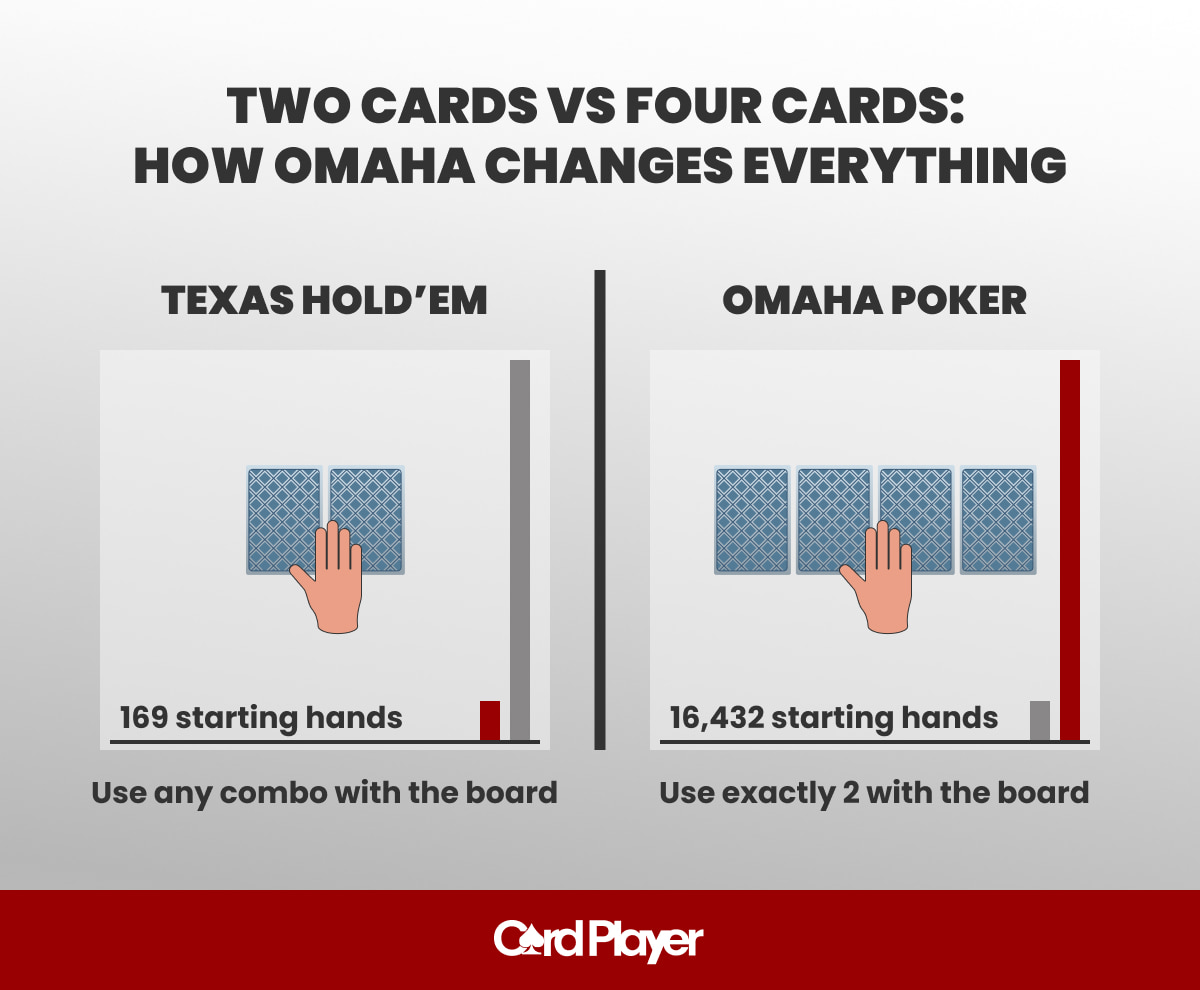
In Texas Hold’em, there are 169 unique starting hands. Adding two hole cards in Omaha Poker increases the number of distinct starting hands to 16,432. This stark difference makes Omaha Poker a game that is much more complex, both preflop and postflop.
Preflop Hand Values in Texas Hold’em
No Limit Texas Hold’em is driven by premium hands, such as AA, KK, QQ, and AK, which crush weaker ranges and can be played aggressively preflop in any position.
Great preflop hands also retain their value on most flops in Texas Hold’em.
Hand reading is simpler in Texas Hold’em because there are fewer possible combinations, and it’s easier to visualize and categorize hands. Simple preflop charts with ranges can cover many common situations, making learning a basic tight preflop Texas Hold’em strategy fairly easy.
What Makes a Strong Preflop Omaha Poker Hand
Here are the qualities of strong Omaha Poker starting hands:
- Big pairs: Solid hands that are often ahead and can make high sets.
- Suitedness: Preferably double-suited, for example, A♠K♣T♠9♣, giving you the chance to hit two different flushes along with other hands.
- Connectedness: Hands that have lots of outs to make straights, like J♣10♣9♠8♠.
- High cards: To make strong pairs, three of a kind, the top end of straights, and high flushes.
- No danglers: We don’t want any unhelpful cards (like in J♣10♣9♠4♦). All four cards should work together.
Typically, we want our hand to have all of these qualities, not just one or two.
Another important concept in Omaha Poker preflop is nut potential. Since straights, flushes, and even full houses appear so often in Omaha Poker, we want to make sure we have the best version of these hands.
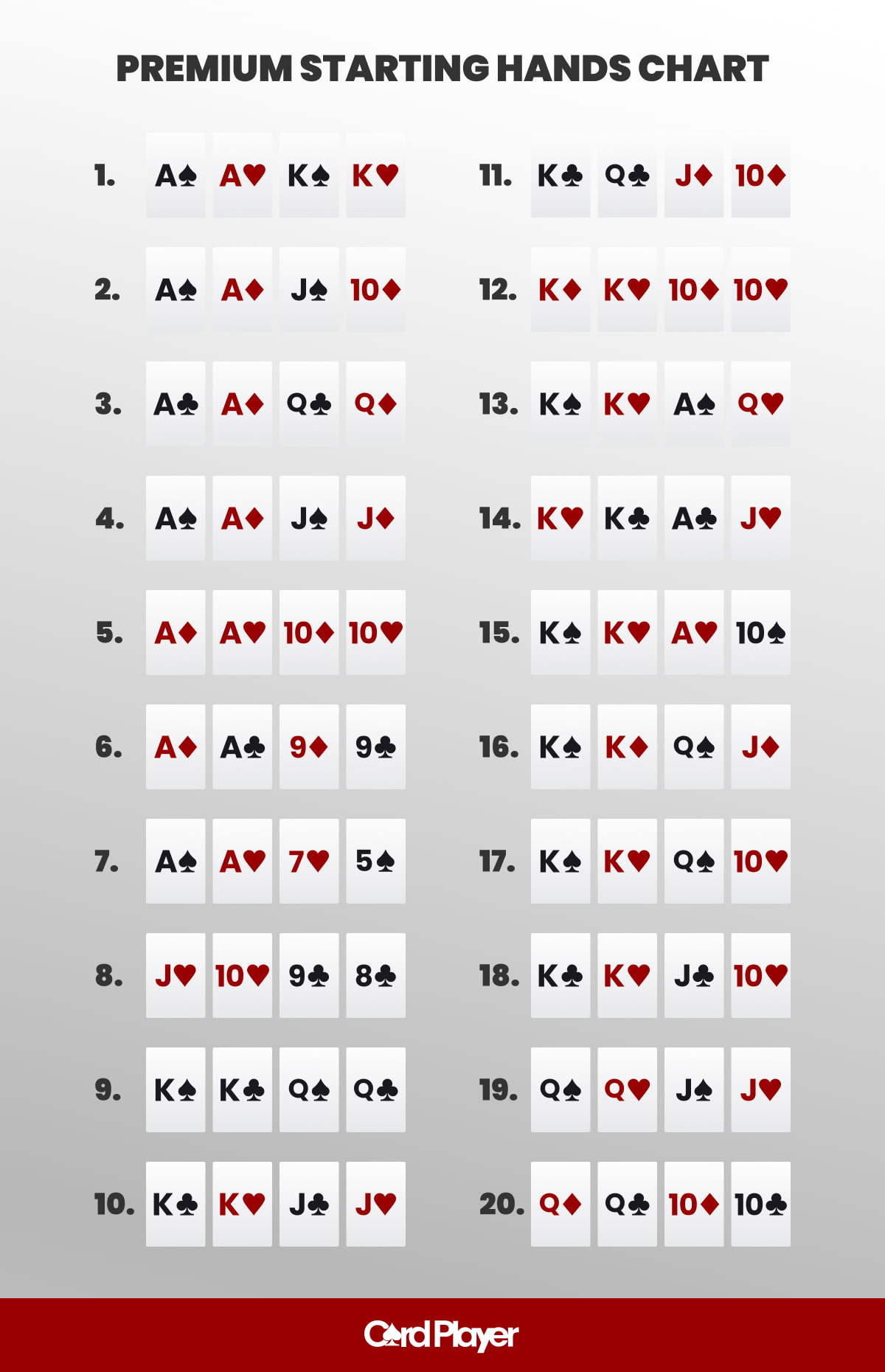
Here are the top ten best starting hands in Omaha poker:
Why Aces Play Differently
In Texas Hold’em, premium pairs like AA and KK are the undisputed rulers of starting hands. Pocket aces have around 82% equity against a random hand, meaning you’re crushing your opponent’s range when you pick up a strong hand.
In Omaha poker, the best starting hands still include pocket aces, but you’ll need other suited, coordinated high cards for it to be considered a premium hand. Even A♥A♦K♥K♦, the best starting hand in Omaha, only has around 62% equity against a hand like J♣10♣9♠8♠.
Your hand strength depends on all four cards working well together.
For example, Q♠Q♣J♣T♠ is a strong hand, while Q♠Q♦7♣2♥ should be folded most of the time. The value of hands like pocket aces in Omaha doesn’t just lie in the raw equity of having a high pair, as it does in Texas Hold’em. Strong Omaha starting hands like A-A-K-K double suited also offer the opportunity to hit high sets, draw to the nut flush, hit straights, and so on.
Structural Complexity Across Texas Hold’em & Omaha Poker
There is a big difference between Texas Hold’em vs. Omaha Poker strategy preflop.
In Omaha vs Hold’em strategy discussions, this preflop contrast is where most misunderstandings begin. Texas Hold’em rewards raw preflop hand strength. This is not the case in Omaha Poker, which is a much more postflop game based around drawing to strong hands like the nuts. While Omaha Poker is more complex, it isn’t as difficult to learn as most think.
Mastering just a few key concepts can give us a significant edge in Omaha Poker.
Drawing Power & Postflop Play in Omaha Poker & Texas Hold’em
Let’s now take a look at how the dynamics are different in Omaha Poker vs Texas Hold’em when it comes to postflop play.
Postflop Equities in Texas Hold’em
In Texas Hold’em, a dominating hand preflop remains dominant on most flops.
We can usually use a robust continuation betting and check-raising strategy, as most speculative hands will miss the flop. By betting our strong hands, we can both charge our opponents for weak draws and narrow their range when they continue.
Given that Texas Hold’em has a no-limit structure, pots can become inflated during the early betting rounds and are unlikely to go multiway.
Combo Draws & Equity Compression in Omaha Poker
In Omaha Poker, the flop often changes hand strengths and dictates everything.
For example, A♠A♣K♠T♣ is a great Omaha Poker hand preflop, but becomes nearly unplayable on a 7♥6♥5♦ flop, especially multiway.
Given the pot limit structure, it’s quite hard for players to protect their made hands without the option to shove all-in. Often, made hands can be up against nut flush draws, wrap straight draws, and big combos that have more equity than top pair. Multiway pots are more likely, while favourable pot odds and implied odds make drawing hands more profitable.
Often, if an Omaha hand is played right to showdown, players will have hands such as the nuts and second nuts, while hands like top pair will rarely be enough to win.
The Importance of Redraws in Omaha Poker
Another important concept is redraws. Sometimes, even having the nuts on the flop isn’t enough to secure the hand, so it helps to have outs to improve it further.
For example, let’s say two people have the same nut straight on the J♥T♥9♦ board. A hand like K♥Q♥J♦9♦ (nut straight + flush redraw) will be crushing a hand like K♠Q♣Q♦8♠ (nut straight), which has no redraws. The redraw is freerolling the naked straight. Most of the time, they either split the pot or improve and win the lot.
With no redraws, pot control is more important. Generally, we want a hand that works in multiple ways.
Position: Why It Matters More Than You Think in Both Games
In Hold em vs Omaha comparisons, position is critical in both, but its impact differs.
In Texas Hold’em, position is one of the most important strategic concepts. Being in position means acting last, which gives you more information about your opponent’s betting before you make your own decision.
In Omaha Poker, position is even more important than in Texas Hold’em. Since equities are closer, mistakes compound, so we need as much information as possible before we act. You’ll also be able to find more spots to semi-bluff in position, taking down pots without having to run hands to showdown.
If we emphasize position even more in Omaha Poker vs. Texas Hold’em, we are off to a good start.
The contrast in Omaha poker vs Texas Holdem becomes most obvious once the flop hits.
Reading the Board
A significant difference between Texas Hold’em and Omaha Poker is how you read the board. Many flops that are relatively safe in Texas Hold’em are actually dangerous in Omaha.
Board Reading in Hold’em
In Texas Hold’em, board reading is clearer because there are fewer possible combos. Hands that are ahead stay ahead more often, and draws are usually way behind strong made hands. Boards like paired flops are relatively safe and dry in Hold’em.
Board Reading in Omaha
In Omaha, board reading is more complex because there are many more combinations to consider. With four hole cards, it’s simply more likely that other players have caught a big piece of the board or picked up strong combo draws, which can sometimes have more equity than made hands.
In Omaha, someone could easily have trips or a full house on a paired board, while the chances of a player already having a flush on a monotone board are much greater. A low coordinated flop like 6♥5♦4♠ is not as big of an issue for overpairs in Texas Hold’em, but is very dangerous in Omaha Poker, where we can easily be up against a straight or set.
Meanwhile, wet dynamic boards like J♥T♥9♦ need to be played with extreme caution, unless you are holding or drawing to the nuts.
Common “Exactly Two Cards” Board Confusions
It’s important to always remember one of the main differences in Omaha vs Texas Hold’em, which is that you can only use exactly two hole cards and three board cards to make your final hand in Omaha. You can’t use three or four hole cards, one hole card, or play the board by using no hole cards.
Forgetting this rule can lead to confusion when reading board texture and hand strength in Omaha. For example:
Flush confusion
Board: A♠ K♠ Q♠ 7♦ 2♣
Hand: J♠ 10♠ 9♦ 4♣ → ✅ Flush, uses exactly two hole cards.
Board: A♠ K♠ Q♦ 7♦ 2♣
Hand: J♠ 9♠ 5♠ 4♣ → ❌ No flush, only two hole cards can be used.
Straight
Board: 5♣ 6♦ 7♥ 8♠ 9♣
Hand: 10♠ J♦ 3♣ 2♥ → ✅ Straight (6–10).
Hand: T♠ K♦ Q♦ 2♣ → ❌ No straight can be made using exactly two hole cards.
Full House on paired board
Board: 8♣ 8♦ K♠ K♥ 2♠
Hand: K♠ Q♠ J♦ 3♣ → ❌ You have trip kings.
Hand: K♦ 8♠ 4♣ 2♥ → ✅ Full house, uses exactly two hole cards.
Bluffing & Fold Equity
Since so many hands connect with the flop well in Omaha Poker, you might think that bluffing is simply too risky. This is a misconception. Bluffing is still important; it just works differently in Texas Hold’em vs Omaha Poker strategy.
So, how is Omaha Poker different from Texas Hold’em when it comes to bluffing?
Why Bluffing Works More Often in Texas Hold’em
Bluffing works more often in Texas Hold’em for several reasons.
First, the game has a no-limit betting structure, allowing you to apply huge amounts of pressure at any moment with a big raise or all-in shove.
On top of that, it’s less likely that other players will have connected with the board or picked up a huge draw. They’ll have more hands that they can fold to a bluff. Multiway pots are not as frequent in Texas Hold’em, allowing you to find spots to take down pots against a single opponent.
Why Fold Equity Is Lower in Omaha
Fold equity is lower in Omaha because it’s more likely that players have hit big hands that they can’t fold, especially when bets are capped to the size of the pot.
On top of that, decent draws often have close to 50% equity in Omaha and can even be ahead of made hands, so you won’t always be able to price out draws when you bluff and have little chance of making everyone fold in a multiway pot.
Better Bluff Candidates in Each Game
In Texas Hold’em, you can bluff more thinly when opponents show weakness, especially when the board texture is dry. Other players will be forced to fold if they haven’t already connected with the board. Blockers improve bluffs, such as having an ace in your hand to reduce the number of premium combos opponents could have.
In Omaha, you want to pure bluff less often, only doing so when other factors, such as position, stack sizes, and opponent tendencies, are heavily in your favour. Tend towards semi-bluffs by playing draws aggressively, so you still have decent equity when called.
Blockers are even more important in Omaha Poker vs. Texas Hold’em, but this time you want to be blocking the nuts. For example, with a hand like A♠T♣T♦8♠ on a flop of K♥Q♣9♦. Having two tens in our hand makes it much less likely that our opponent holds the ten that they would need for that straight. Even better if you block multiple possible combos.
Bankroll & Variance
When it comes to bankroll management in Omaha vs Texas Hold’em, you’re likely to see bigger swings in Omaha. Hand equities run closer together, which means you’re rarely going to be more than a 2-1 favourite even when you have the best starting hands.
Action is likely to go multiway to the flop, meaning other players can simply hit hands, and there’s not much you can do about it. All of this reduces the edges that great players have over mediocre ones, leaving you even more at the whim of variance than in Texas Hold’em.
Practical Bankroll Guidelines
With bigger swings expected, you’ll need a bigger bankroll to play the same stakes in Omaha versus Hold’em. In Texas Hold’em, it’s recommended that you have 40-100 full buy-ins for cash games and 100-300 full buy-ins for tournaments. In Omaha, you should have about twice as many buy-ins to be on the safe side.
Why Omaha Is Harder Than Texas Hold’em
Omaha is considered a harder game to learn and play than Texas Hold’em. With four cards per player and thousands of additional hand combos to think about, decisions are naturally more complex.
Hands play out in a very dynamic way in Omaha, with strengths likely to change on every street. The pot limit structure also presents challenges, making simplified strategies like push-fold play less effective.
Texas Hold’em is already a difficult game to master. Omaha adds additional layers of depth and complexity.
Is Omaha More Profitable Than Texas Hold’em?
At lower and mid stakes, PLO often attracts more action-oriented players who haven’t really taken on board basic strategy. So, even though hand equities run closer together, reducing the size of the edge you can gain over these weak players, it’s definitely possible to get ahead of the curve.
Because PLO pots grow large and rake is often taken as a percentage of the pot (capped), beating the rake can be more difficult.
Texas Hold’em, on the other hand, has been more thoroughly “solved” with software, and strategy is widely available through content and training courses. Players tend to know what they are doing, even at the lower stakes.
Still, Hold’em is considered a steadier choice with less variance and the chance to gain bigger edges.
Editor Tip:
“If you’re just starting out and your goal is to capitalize on weaker competition, Omaha may present more immediate opportunities. Many Omaha games attract action-oriented players who make fundamental mistakes more frequently than in today’s tougher Texas Hold’em environment.”
Omaha Poker vs. Texas Hold’em: The Similarities
While there are important differences between Texas Hold’em and Omaha Poker, they share the same basic mechanics, which makes switching easier than most players think.
These rules are identical:
- Both games use community cards (“the board”) that all players make hands from.
- Five community cards are dealt in the same order: flop (3), turn (1), river (1).
- There are four betting rounds: preflop, flop, turn, and river.
- Poker hand rankings are the same, from high card to Royal Flush.
- The small and the big blind are used to drive the action.
If you are used to these mechanics from one game, it will be easy to switch to the other.
You’ll find that these two games are by far the most popular forms of poker, and they are played extensively both in live casinos and across pretty much every online poker site out there.
Common Mistakes When Switching From Hold’em to Omaha
Here are some of the most common mistakes players make when switching from Texas Hold’em to Omaha Poker:
- Overplaying big pairs and AAxx hands.
- Overplaying non-nutted hands postflop, like lower sets and straights.
- Ignoring suits, connectivity, and redraws when weighing up hand strengths.
- Not drawing to the nuts and overplaying weak combo draws (like T♦8♦7♠6♣ on A♦9♦T♣);
- Misapplying Texas Hold’em concepts, like continuation-betting too much as the preflop aggressor or bluffing too often.
- Misunderstanding pot limit bet sizing, especially when it comes to raising bets.
- Underestimating variance in Omaha and not having a good enough bankroll.
Which Game Is Right for You?
The Omaha vs Holdem debate often comes down to how much volatility you’re willing to handle. Learning either game will make you a sharper and better poker player, so there is no need to choose one exclusively. However, here is a short Texas Hold’em vs Omaha Poker comparison to help you decide where to start.
Advantages of Texas Hold’em
- If you are just starting out, Texas Hold’em has a gentler learning curve.
- Basic tight strategy is easier to execute.
- There is endless content to support your improvement.
- It is a game of moves, a psychological battle with a lot of room for creativity,
- With a tight strategy or a big skill advantage, it is less volatile than Omaha Poker.
Advantages of Omaha Poker
- Opponents make more mistakes, so not only swings but also profits tend to be higher.
- Loose players, such as those found in Omaha Poker, keep the action going.
- A very tight strategy isn’t rewarded as much, so very tight opponents benefit less than in Texas Hold’em.
- It is a more mathematical game, cards and position dictate the action; however, there is still room for bluffing and creativity in the right situations.
Quick Decision Framework
Struggling to choose between one or the other? Here’s a quick decision framework to help you decide:
Choose Texas Hold’em if:
- Your bankroll is modest.
- You dislike violent swings in variance.
- You value consistency in your win rate.
- You’re happy to face tougher competition and master strategy in return for bigger edges.
- You’re looking for a poker variation that is always accessible both live and at online poker sites.
Choose Omaha if:
- You enjoy complexity.
- You have a large bankroll for the stakes you want to play.
- You can tolerate volatility.
- You want to play against a weaker field but with a smaller maximum edge.
Next Steps — Tools, Study Aids & Resources
Both games are very popular, so it is easy to find tools and resources to help you get better quickly:
- Equity calculators, such as the Cardplayer’s Omaha Poker Odds Calculator and Texas Hold’em calculator.
- Solvers like PioSolver or GTO+ for Texas Hold’em, and MonkerSolver for Omaha Poker.
- Solver-based study tools like GTO Wizard for Texas Hold’em and Vision and PLO Mastermind for Omaha Poker.
There are also many free videos and written tutorials available online.
Conclusion
This guide should be a helpful start for all who have been wondering what the differences are between Texas Hold’em and Omaha Poker.
For anyone comparing Omaha vs Texas Holdem, the best way to decide is by understanding how variance, structure, and hand strength differ. These are two of the most popular poker variants in the world, so fun is guaranteed either way. Adding either to your arsenal will help you become a better, more rounded poker player.
The best way to find out which game is right for you is to simply try them in a low-stakes setting.
FAQs
Is Omaha Poker the same as Texas Hold’em?
No. While there are many similarities, there is a difference between Texas Hold’em and Omaha Poker. Omaha Poker is played with four hole cards instead of two.
What is the main difference between Texas Hold’em and Omaha Poker?
The main difference between Texas Hold’em and Omaha Poker is that Omaha Poker players get four hole cards and must use exactly two with three from the board, which changes preflop and postflop strategy.
What betting structure is used in Omaha vs Texas Hold’em?
Texas Hold’em uses a no-limit betting structure, whereas Omaha usually has a pot limit betting structure in which bet sizes are restricted to the size of the current pot.
Texas Hold’em vs. Omaha Poker — Which is better?
Both games are very popular, and neither is strictly better; it depends on your style. Texas Hold’em is easier to learn, but can involve creative moves with low equity, while Omaha Poker offers more action, more decisions over multiple streets that can give you a great edge on your opponents.
Is Omaha Poker harder than Texas Hold’em?
Omaha Poker is harder at first, but not in the long run. Omaha Poker requires more attention to board texture and a more complex understanding of hand matchups. Basic Texas Hold’em is simpler preflop and easier for beginners, but has a lot of psychological complexity and depth.
How does hand selection differ between Omaha and Texas Hold’em?
In Texas Hold’em, with only two hole cards, high pairs and cards like pocket aces, kings, and AK rule. In Omaha, it’s all about how the four hole cards work together to offer the most ways to win the flop, so coordination, being double-suited, and having high pairs or cards all matter.
Are Texas Hold’em and Omaha Poker rules the same?
No. Both games share betting structure, blinds, and hand rankings, but Omaha Poker requires using exactly two of your four hole cards at showdown.
Which poker game is the most popular?
Texas Hold’em is by far the most popular poker game in the world, and is widely played at casinos and online platforms. Omaha poker is the second-most-popular variation.