







Pocket Pair in Poker: Definition, Pocket Pair Strategy & Odds
What Is a Pocket Pair in Poker?
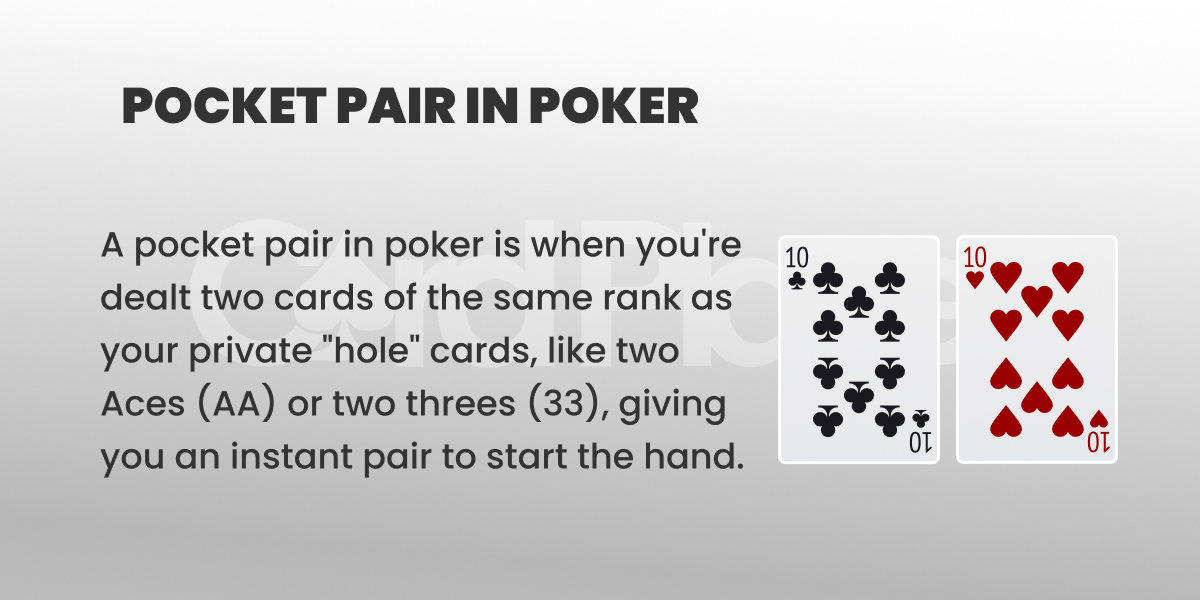
A pocket pair in poker is when a player has two personal hole cards that are equal in ranking. An example of a pocket pair would be when a player is dealt two Jacks, two Fours, or two Aces, regardless of their suits.
It’s simply a pair made before any community cards are dealt.
Pocket Pair in Poker: Key Points
- The term “pocket pair” refers to holding two cards of the same rank.
- Strategy changes depending on whether you hold a premium, medium, or small pair.
- Winning pots with lower pairs requires understanding pocket pair odds, particularly the probability of flopping a set.
Pocket Pair Categories: Premium, Middle, & Small
Pocket pairs are grouped by rank because of their playing characteristics on common boards.
- Best pairs: A-A, K-K, Q-Q. These are the strongest pocket pairs because they’re ahead of most hands preflop and can often win unimproved.
- Middle Pairs: Typically, these range from 7-7 to J-J. Raising preflop with middle pairs is a standard approach; however, they can be tricky to play postflop when overcards hit.
- Small pairs: 2-2 to 6-6. Small pocket pairs rarely win big pots unimproved; their strength lies in flopping sets.
Here’s a simple lesson that works: premium pairs usually value bet across multiple streets, medium pairs usually need pot control based on the board, and small pairs aim for a set.
Pocket Pair Odds and Probabilities
Let’s get the numbers straight since math keeps you grounded.
Odds of Being Dealt a Pocket Pair
There are 1,326 possible starting hand combinations in Texas Hold’em; out of these 1,326 possible combinations, 78 are pocket pairs. This means that, on average, you will be dealt a pocket pair once every 17 hands, or approximately 5.88%.
Odds of Flopping a Set with a Pocket Pair
In poker, a set is when you hold two cards of the same rank in your hand, and a third card of the same rank comes in the community cards (on the flop, turn, or river). For example, you hold 8-8, and the flop comes K-8-3, giving you three of a kind with your pocket pair. This is referred to as a set to distinguish it from trips, which consist of one hole card and a pair of board cards.
The probability of flopping a set with a pocket pair is around 11.8% or once every 8.5 hands.
A quick reality check about “set mining”
New players sometimes learn the odds for flopping a set and then treat every small pair like an automatic call.
However, what they fail to realize is that you need to take into account other factors such as position, the amount of chips that you have to invest to call, and the size of your stack.
When you call a raise with a small pocket pair, you will miss the flop most of the time. If you continue calling every time, hoping to hit a set, you will lose money in the long run in these situations.
A good rule of thumb for pocket pair poker strategy is to avoid calling multiple streets in hopes of hitting a set, but rather focus on the situations where you do hit it on the flop. Getting paid in this situation is extremely important for your long-term profitability with small pocket pairs.
Pocket Pair Strategy for Beginners
When it comes to pocket pair poker strategy, you don’t need fancy moves. You need solid fundamentals. One of the easiest approaches is to divide it into two phases:
- Preflop: You decide whether the hand is playing, and whether you should raise, call, or fold based on position, action, and stack depth.
- Postflop: You decide whether your pair is still likely best, whether it can improve, and whether the board makes it dangerous to keep investing in the hand.
Premium Pairs (AA, KK, QQ)
As pointed out, premium pairs are those that can win big pots even when they don’t improve, potentially making them the best pocket pairs in poker.
With these pairs, raising preflop is the standard approach. Raising builds the pot while you’re likely ahead, and it also reduces the number of opponents. This is important because the value of premium pocket pairs goes down in multiway pots.
On the flop, you will often have an overpair. (your pocket pair will be higher than any of the community cards). Example: you hold Q-Q and the flop is J-6-2.
Still, even when you have an overpair, not every situation will be the same. Boards that are coordinated, such as 9-8-7 with two of the same suit, produce more straights and draws, thereby reducing the value of your overpair.
If multiple opponents continue with aggression on these boards, you should be careful; there is a chance that your overpair might not be ahead.
A clean beginner rule: Preflop premium pairs are usually played aggressively. Postflop, you should pay attention to board texture and opponent action, not just your starting hand.
That’s how to play pocket pairs in poker when you actually want to protect your win rate.
Middle Pairs (7-7 through J-J)
Middle pairs are strong enough to raise and strong enough to win at showdown sometimes, but they can be extremely hard to play since overcards show up frequently on the flop.
Take 9-9 as an example. If the flop is A-K-5, your pair is still a pair, but it’s rarely the best hand against someone who has a strong range. Even a single Ace on the board will make your hand uncomfortable for playing.
This is why position matters so much. In late position, you get more information before acting. You can check back some flops, take free turns, and keep the pot from getting bloated when the board is bad for you. In early position, you don’t have this luxury.
Middle pairs also have set value. The odds of flopping a set with a pocket pair don’t change whether you hold 4-4 or J-J. The difference here is that even an unimproved middle pair can still win a pot when it does not hit a set.
A common beginner-friendly approach is this: raise or call pre-flop depending on position and action, then slow down on flops with multiple overcards or heavy coordination unless you have a strong reason to continue.
That’s a pocket pair poker strategy without pretending every hand is a puzzle.
Small Pairs (2-2 through 6-6)
The following section goes in-depth on small pocket pairs. With a pair of 2s, 3s, 4s, 5s, or 6s, big betting action is not what you look forward to on the flop.
If you didn’t hit your set, your hand is basically just a bluff catcher.
A simple explanation would be that you always come in with a pair of low cards in the hope of completing a set. Trip improvement and winning the larger pot in the presence of possible top pair or overpair hands are the aim.
Whether playing at an online poker site or a live ring game, stack size is extremely important when set mining with small pocket pairs. If the effective stack size is short, even if you hit a set, you won’t be able to charge enough money to justify your call preflop.
Common Mistakes with Pocket Pairs
Pocket pairs are one of those hands that appear relatively strong preflop but can be extremely difficult to play after the community cards are revealed. Here are some of the most common mistakes with these hands.
Mistake #1: Playing All Pocket Pairs the Same Way
If you play 2-2 similar to how you would play Q-Q, you’ll be wasting chips. Your high pairs will frequently get you value on many boards. Your small pairs won’t.
Mistake #2: Not Taking into Account Stack and Bet Sizes
A beginner looks at pocket pairs and considers, “I have to see a flop.” However, in pocket pairs in poker, there’s a point at which the cost is too high. In the situation where you are facing a large raise and your stack is shallow, set mining becomes less profitable. The chance of flopping a set with pocket pairs is not great enough to warrant playing the hand with a large amount of your stack when it misses often.
Mistake #3: Getting Attached to Your Hand When There Is a Lot of Action
This mistake is particularly costly. Imagine raising with K-K, then watching the board develop multiple straight and flush possibilities while a normally tight opponent fires multiple barrels. Yes, premium pairs are strong—but they’re not invincible. The key is remaining flexible: assess both the board texture and your opponent’s betting patterns before deciding whether to continue or fold.
Mistake #4: Confusing Sets with Trips
These terms aren’t interchangeable. A set means you hold a pocket pair and one matching card appears on the board—like holding 7-7 when the flop comes K-7-3. Trips means one of your hole cards matches a paired board—like holding A-7 on a 7-7-3 flop. Why does this matter? Sets are disguised strength. When you flop a set, opponents rarely see it coming, which means they’re more likely to pay you off with their top pairs and overpairs. Trips are more visible since the pair is right there on the board, making opponents naturally more cautious..
Mistake #5: Overvaluing Pocket Pairs as Bluff Catchers
Knowing when your pocket pair can only beat bluffs is crucial. Consider holding 8-8 on an A-Q-9 flop. You’re facing a straightforward opponent who bets the flop and barrels the turn. What hands are you actually beating? Realistically, only bluffs. Any ace, any queen, any nine, or any straight draw that connected has you crushed. Against players who don’t bluff frequently, calling with 8-8 here just burns chips. Your pair isn’t strong—it’s a marginal bluff catcher at best, and often it’s simply a fold.
FAQs
What is a pocket pair in poker?
A pocket pair in poker is a starting hand where your two hole cards are the same rank, like 6-6 or A-A, dealt before any community cards appear.
What are the odds of being dealt a pocket pair?
The odds of being dealt a pocket pair are about 5.88% in Texas Hold’em, which is roughly once every 17 hands. These pocket pair odds in poker come from 78 pocket pair combinations out of 1,326 total starting hand combinations.
What are the odds of flopping a set with a pocket pair?
The odds of flopping a set with a pocket pair are about 11.8%. Many players remember it as around 1 in 8.5. That number is central to small pocket pairs strategy and set mining decisions.
Can pocket pairs be suited in poker?
No. A pocket pair cannot be suited because a standard deck only has one card of each suit for a given rank. If both cards are the same rank, they must be different suits.
What is the best pocket pair in poker?
A-A is the best pocket pair in poker because it’s the highest possible starting pair and is favored against every other starting hand pre-flop in Texas Hold’em.
What is the lowest pocket pair in poker?
The lowest pocket pair in poker is 2-2. It has the least pre-flop strength among pocket pairs and often relies on improving to a set to win larger pots.
Should you always play pocket pairs?
No. Whether you should play pocket pairs depends on position, the cost to enter the pot, the number of players involved, and stack sizes. Knowing how to play pocket pairs in poker includes folding some pocket pairs in tough pre-flop situations.
What is the difference between a pocket pair and a pair on the board?
A pocket pair is formed by your two hole cards matching in rank before the flop. A pair on the board happens when the community cards contain two cards of the same rank, or when one of your hole cards matches a board card to make a pair.