







Open-Ended Straight Draw in Poker: Definition, Equity & How It Works
What is an Open-Ended Straight Draw in Poker?
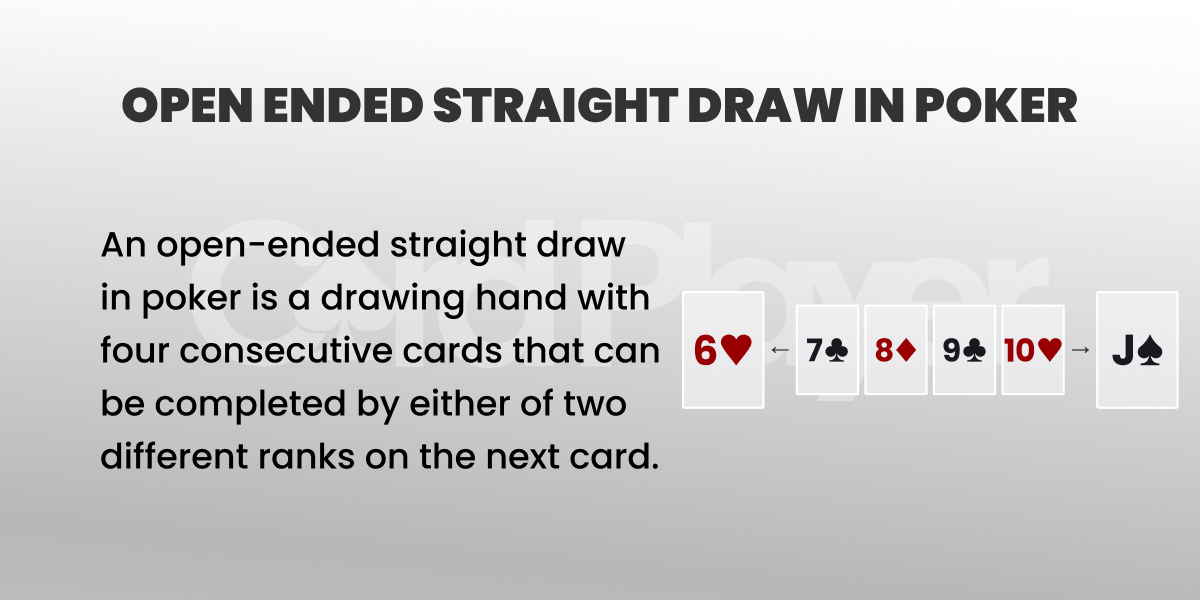
An open-ended straight draw, or OESD, occurs when you have four sequential cards and can form a straight with one additional card on either end of that 4-card run.
For example, if you hold 7♠ 8♠ and the flop comes 9♦ 10♣ 2♠, you can complete a straight with either a 6 or a Jack. That gives you a total of eight outs. Draws in poker refer to hands that need one more card to complete, and the OESD is one of the strongest examples.
Open-Ended Straight Draw in Poker: Key Points
- An open-ended straight draw has eight outs to complete a straight.
- OESDs are stronger than gutshots because they can be completed from both ends.
- They are effective for semi-bluffing and balancing your betting ranges.
- At ~31.5% equity flop to river, OESDs are strong enough to play aggressively.
How an Open-Ended Straight Draw Is Formed
Understanding open-ended straight draw rules is straightforward — four sequential cards, one card needed on either end.
Take a look at these OESD in poker examples:
- Hold’em example: You have 6♦ 7♦, and the flop shows 8♣ 9♠ K♥. You can complete your straight with either a 5 or a 10.
- Omaha example: In Omaha, you have four hole cards, but you must use exactly two of them along with three community cards. For instance, if you have 5♥ 6♥ 9♠ J♦ and the flop comes 7♣ 8♠ Q♦, you can use 5♥ 6♥ plus 7♣ 8♠ 9♠ on the board to make an open-ended straight draw. You can complete your straight with either a 4 or a 10.
It’s not like a gutshot, where you can only complete the straight with a single card rank in the center.
Odds of Completing an Open-Ended Straight Draw
Understanding open-ended straight draw odds starts with the Rule of 2 and 4, which gives you a reliable estimate without needing exact math at the table. Since an open-ended straight draw gives you eight outs, here is how to apply it:
- After the flop (with two cards to come): Multiply your outs (8) by 4. You have roughly a 32% chance of hitting your straight by the river.
- After the turn (with one card to come): Multiply your outs (8) by 2. You have roughly a 16% chance of hitting on the river.
Exact probabilities are altered because of card removal and deck composition, but these quick mental shortcuts are accurate enough for in-game decisions. While the Rule of 2 and 4 works well at the table, you can also use an open-ended straight draw calculator to get exact equity figures away from the felt.
Below is a quick reference table for OESD odds.
| Situation | Chance to Hit |
|---|---|
| Flop to Turn | About 17% |
| Turn to River | About 17% |
| Flop to River | About 31.5% |
Open-Ended Straight Draw vs Gutshot vs Double-Gutter
There are three main types of straight draw in poker — open-ended, gutshot, and double-gutter. Here is how they compare:
| Straight Draw Type | Description | Outs | Strength/Playability |
|---|---|---|---|
| Open-Ended Straight Draw (OESD) | You have four sequential cards, and a card on either end completes the straight. | 8 possible cards | Strongest straight draw. Easy to play aggressively due to many outs. |
| Gutshot (Inside Straight Draw) | You need one specific rank to complete the straight. | 4 possible cards | Weaker than OESD. Fewer outs make aggressive play riskier. |
| Double-Gutter Straight Draw | You have two different inside straight draws at the same time, allowing you to complete the straight from either side. | 8 possible cards | Comparable to OESD in outs, but more complex and harder for beginners to recognize. |
Open ended straight draws are generally more playable and valuable in both cash games and tournaments – whether live or in online poker sites – though the actual impact depends on factors like position, stack size, and game context.
Removing Blocked or Dirty Outs
You should discount your outs when hitting your card does not guarantee you the best hand. This usually happens in two situations:
- Paired boards: If the board is paired, completing your straight may still lose to a full house or four of a kind. For example, if the board pairs and your opponent holds a set, your straight out might not be clean.
- Monotone or flush-heavy boards: When three cards of the same suit are on the board, a card that completes your straight may also complete an opponent’s flush, making your out unreliable.
In these cases, your actual winning chances are lower than the standard OESD odds, and some outs should be discounted.
Open-Ended Straight Draw Equity in Different Situations
Calculating open-ended straight draw equity is straightforward using the Rule of 2 and 4 as your baseline, but the full picture also depends on opponent ranges, board texture, and stack size.
- Against a made hand like top pair: Your OESD retains roughly 31-32% equity with two cards remaining.
- Against an overpair: Equity is in the same range but slightly lower in the scenario if your straight outs intersect with cards that give your opponent a set or full house opportunity.
- In multi-way pots: Equity often decreases, especially if opponents hold blockers to your outs.
Pot Odds & When to Call
Understanding open-ended straight draw odds in relation to pot odds is what separates profitable calls from costly mistakes. Pot odds help you decide if calling a bet is worth it.
Example: There’s $100 in the pot, and your opponent bets $20. You’re risking $20 to win $100, which gives you 5-to-1 pot odds. Those odds mean you need to win the hand about 20% of the time for the call to be profitable.
An open-ended straight draw will hit by the river about 1 in 3 times (roughly 31%), which is much higher than the 20% you need. That’s why calling with an OESD in this situation is usually correct. If your chance to hit (1 in 3) is better than the odds the pot is giving you, the call makes sense.
Implied Odds
Implied odds come into play when the immediate pot odds aren’t favorable, but you expect to win more money later if you hit your hand.
For example, if you have an OESD and the pot doesn’t offer good immediate value, it can still be correct to call if your opponent is likely to pay you off on the next street when you complete your straight.
Implied odds are especially useful in live games or against players who rarely fold strong one-pair hands, allowing you to profit even when the direct odds are not ideal.
Semi-Bluffing with an Open-Ended Straight Draw
Knowing how to play an open-ended straight draw comes down to one core principle — use your equity actively rather than just calling and hoping to hit. Semi-bluffing with an OESD is a viable and often effective strategy. Because you have eight outs to improve, you retain real equity even when called, making a semi-bluff more than just a bluff — it’s a bet with a backup plan.
Common Mistakes with OESDs
A sound open-ended straight draw strategy always begins with confirming your outs are clean and that the pot is offering correct odds. Open-ended straight draws are strong drawing hands, but many players misplay them. Some of the common mistakes include:
- Overestimating outs on dangerous boards: Not every OESD has 8 clean outs, especially when the board is paired or flush-heavy. Always assess whether your outs are actually clean before committing chips.
- Chasing without odds: Calling bets when the pot odds don’t justify it is one of the most common and costly errors with drawing hands. Always check whether the pot is offering you the right price before continuing.
Avoiding these two mistakes alone will save you significant chips over time and keep your OESD play grounded in math rather than hope.
FAQs
What does OESD stand for in poker?
OESD stands for open-ended straight draw. It occurs when you have four sequential cards and can complete a straight on either end.
What are the open-ended straight draw rules?
The rules for an open-ended straight draw are simple: you need four connected cards with an open end on both sides, and one additional card on either end completes your straight.
What are the odds of hitting an OESD?
From flop to river, the odds of completing an OESD are about 31.5%. It’s close to 16.5% from street to street.
What is the difference between an OESD and a gutshot?
An OESD has eight outs and can be made on both ends, but a gutshot (inside straight draw) only has four outs.
Can you semi-bluff with an OESD?
Yes, a semi-bluff with an OESD is a very strong play because you can win outright on your straight or by fold equity.
How do you play an open-ended straight draw?
The core of open-ended straight draw strategy is balancing aggression with pot odds awareness. You can check, bet, or raise depending on the situation — semi-bluff when you have fold equity, and call when the pot is offering the right price.
How many outs does an OESD have in Texas Hold’em?
In Texas Hold’em, an open-ended straight draw (OESD) always has 8 outs.