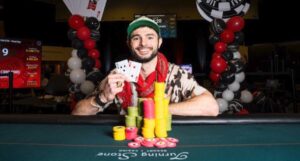



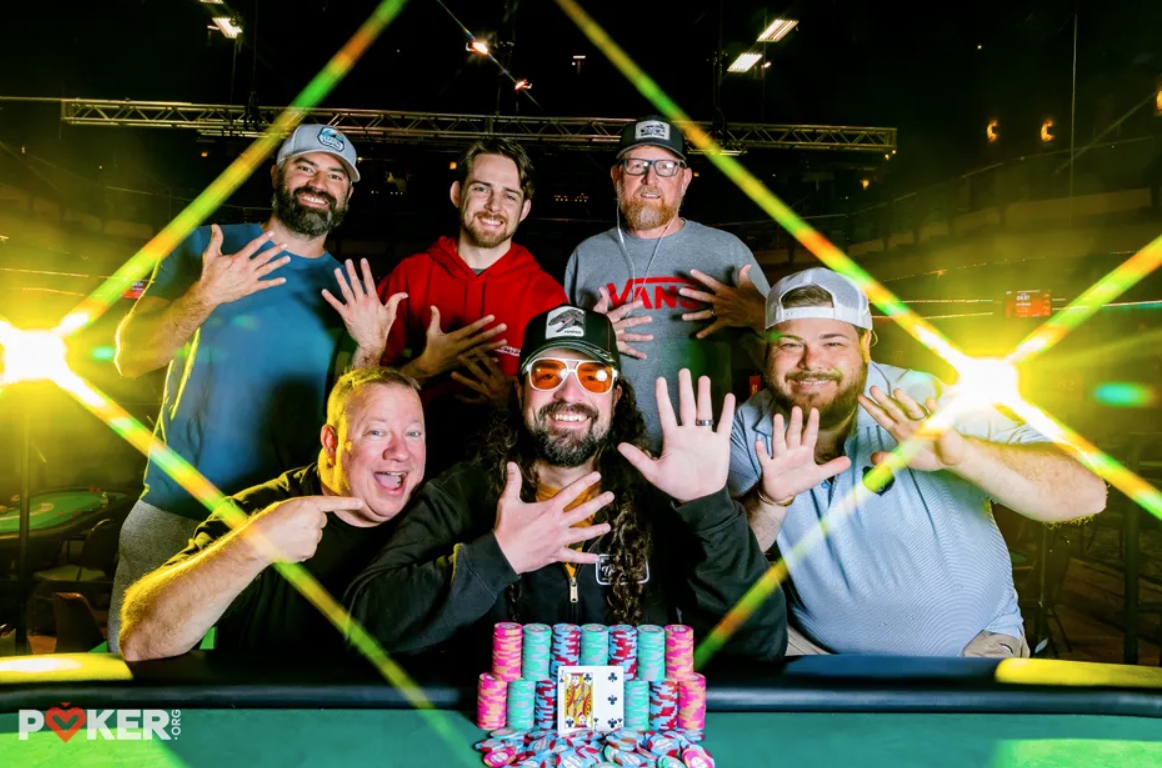
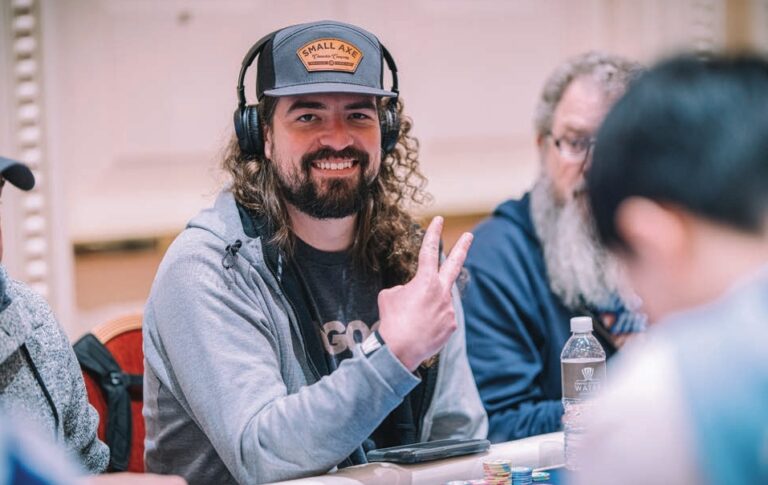
Preston McEwen transitioned from a touring drummer to a full-time poker player in 2018. Since then, he’s won 11 World Series of Poker Circuit events and nine RunGood Poker Tour rings.
McEwen spends about half the year traveling the southeastern poker circuit and the other half at home with his wife and two daughters. He ventures out to Vegas for the WSOP and the WPT World Championship. While he hasn’t scored a bracelet, he’s had exciting deep runs, including a heartbreaking fourth-place finish in last summer’s $2,500 no-limit hold’em event. He now has more than $2.9 million in career cashes.
Card Player caught up with McEwen to talk about one of his latest trips to the winner’s circle.
Event: World Series of Poker Circuit Tunica
Buy-In: $1,700
Entrants: 340
Prize Pool: $515,100
First-Place Prize: $108,853
Craig Tapscott: You’ve been on quite the tear recently. Can you share what part of your game has improved the most over the last year and why?
Preston McEwen: I spent several months studying ICM with a couple super sharp online players. Coming from a more exploitative live background, this helped round out my game, especially at final tables.
I’ve also been working on eliminating distractions and life leaks, elevating my mindset and focus at the table. When I make it a priority to “never take a hand off” whether I’m in the hand or not, I’m able to tap into my highest flow state.
Hand No. 1
Stacks: Preston McEwen – 650,000 (43 BB) David Cook – 920,000 (61 BB)
Blinds: 10,000-15,000 with a 15,000 big blind ante
Players Remaining: 23
CT: Set this hand up for us, Preston. Had day two been good to you?
PM: It was. I started day 2 in the middle of the pack with 355,000 and slowly chipped up to 650,000. I had $4,856 locked up at the time of this hand, and there were minimal pay jumps until the final table.
The action folded to me in the small blind and I looked down at J-10 suited. The big blind was David Cook, a very solid reg who had started the day second in chips. He had me well-covered, and I definitely wanted to take my hand to the flop, so I decided to pot-control with a limp.
McEwen limped in with J♦10♦ from the small blind. Cook raised to 50,000 from the big blind, and McEwen called.
As I expected, he was going to raise a ton of hands after my limp.
FLOP: K♣10♠6♦
McEwen checked. Cook bet 35,000, and McEwen called.
PM: I saw no reason to do anything but call with a fairly strong made-hand with plenty of backdoor equity. I also wanted to continue to pot control, while keeping all of his bluffs in.
TURN: J♠
CT: That’s a good card for you, but you still have to be cautious at the same time.
PM: Yes. I improved to two pair, but the board texture became much more dangerous. This card was also theoretically better for David’s range as he had the nut advantage, so I elected to…
McEwen checked. Cook bet 100,000.
PM: A lot of players in my position would opt to raise here in fear of being drawn out on. But against good players who understand range advantages, and are capable of applying pressure, I prefer to just call and allow them to continue bluffing.
RIVER: 4♦
CT: Pretty much a blank. What now?
PM: This was obviously a great card for me considering all turned draws missed. However, David still had an uncapped value range consisting of all two pairs, sets, and straights.
Leading the river would accomplish little as I fold out his bluffs and can only target a few worse hands for value. In my opinion, my best option with an above average bluff catcher was to check and continue to feed him rope.
CT: From your experience, what sizing did you expect him to throw at you?
PM: Well, we had about a 1.2 SPR (stack-to-pot ratio), so David had a few bet size options, the most polarizing being all in. And that’s exactly what he landed on, and I didn’t exactly love it.
Cook moved all-in.
PM: This sizing did however condense his value range a bit. I’d expect him to jam his best two pairs, sets, and straights, none of which I beat.
He is capable of potentially finding a creative merge with Q-Q, Q-J, and Q-10 at some small frequency, but unlikely. He also has plenty of A-x/Q-x nut blocker bluffs that get to lean on his nutted range advantage. All things considered, it was a pretty tough spot, and I went deep into the tank and weighed my options.
It didn’t help that other players at the table were talking to each other loudly, paying no mind that I was making a huge decision for my tournament life, but I did my best to block out the noise and replay the hand and every bit of history I had with my opponent. I considered the logistics of folding and preserving my remaining 30 big blinds, which is plenty to work with. But… if he was indeed bluffing, and I won this pot, I would be in a great position for a deep run.
CT: Did you have any other observations?
PM: I did. After a minute or so, I noticed David’s carotid artery began to thump, thump, thump. Woah. This is a common tell that translates to either heightened nervousness or excitement, and can’t really be employed consciously. He either has it or nothing.
I could now discount certain value hands that beat me. I also began to notice another physical tell that I’ll refrain from divulging, as I often battle David on the felt. Sorry, David!
McEwen called, and Cook turned over A♠7♥. McEwen won the pot of 1,315,000.
PM: Luckily, I found the call and was happy to watch him table a bluff.
CT: Nice call. Can you share some other physical tells you tend to see recreational players show up with at the tables?
PM: I lean heavily on timing and bet sizing tells. While it helps to have some kind of baseline with your opponents, you can often extrapolate the tendencies of unfamiliar players based on their demeanor, clothing, jewelry, profession, casual conversation at the table, etc.
Some recreationals and even professionals are happy to openly discuss their thought process at the table. Just keep your ears open and absorb all the info you can. But also, beware of those who may intentionally reverse tells or strategies.
I’d love to go into more detail about specific tells I exploit, but this is where I think a large portion of my edge derives from and feel a bit conflicted sharing them publicly with my opponents.
Hand No. 2
Stacks: Preston McEwen – 10,000,000 (125 BB) Dave Alfa – 3,000,000 (37 BB)
Blinds: 40,000-80,000 with a 80,000 big blind ante
Players Remaining: 3
CT: At this point you were getting close to another ring. What were the payouts you three were battling for?
PM: The payouts were $105,000 for first, $70,000 for second, and $47,000 for third.
I was the driver’s seat with 10 million chips. Charles Hopper (an unfamiliar player with zero recorded cashes) has been crippled down to 500,000. Dave Alfa, a very successful, aggressive and skilled player, was second in chips with 3,000,000. This was the epitome of an ICM handcuff situation for Dave, which he and I are both very aware of.
Alfa raised to 165,000 from the button.
PM: Without even looking at my cards I knew that I would almost always be three-betting in this spot from the small blind. I peaked down at 8-2 suited, which was good enough!
McEwen raised to 520,000 with 8♦2♦. Alfa called.
CT: Did you have any sort of range read on Alfa, as you’ve had some experience playing with him.
PM: Well, I didn’t expect him to be opening super wide but also know he ‘should’ be folding a huge portion of his opening range, despite having position. When he called, I knew I needed to proceed with some caution and avoid recklessly doubling him up.
The dealer spread a favorable flop for my hand.
FLOP: A♦10♦2♠
PM: Although I had just bottom pair, my hand had a ton of equity and I could build the pot.
McEwen bet 375,000, and Alfa called.
PM: Dave didn’t take long to make the call. In my mind, he had mostly A-x, 10-x, Broadway draws and flush draws, as well as some random floats, knowing that I could very likely be exploiting the ICM situation. On brick turns things would get pretty interesting.
TURN: 9♦
PM: But thankfully, the flush peeled off instead.
With the SPR now close to 1:1 and not necessarily needing to bet the turn to be able to get stacks in, I elected to check, giving Dave the rope to make a play with his floats and value bet his made hands.
McEwen checked, and Alfa bet 500,000.
PM: As expected, he did oblige me. I could have just called and hoped he barreled the river with his bluffs, but I found it more likely he would find a check-back give up.
I would also hate to see another diamond on the river which would either kill my action or improve his hand to the winner. So doing whatever I could to bust Dave and eliminate my biggest threat was my biggest priority.
McEwen moved all-in, and Alfa called.
PM: Dave called almost immediately. I tabled my flush and before his cards were turned over, I heard, “DAMMIT!” from across the table. I realized I was on the good side of a cooler.
Alfa revealed 7♦4♦, and McEwen won the pot of 6,160,000.
PM: He was drawing dead. I scooped a massive pot to give me an overwhelming chip lead entering heads-up play, which I converted into the win.
Follow McEwen on Twitter/X @flapjack_jebus.
- Photos by Poker.org and World Poker Tour