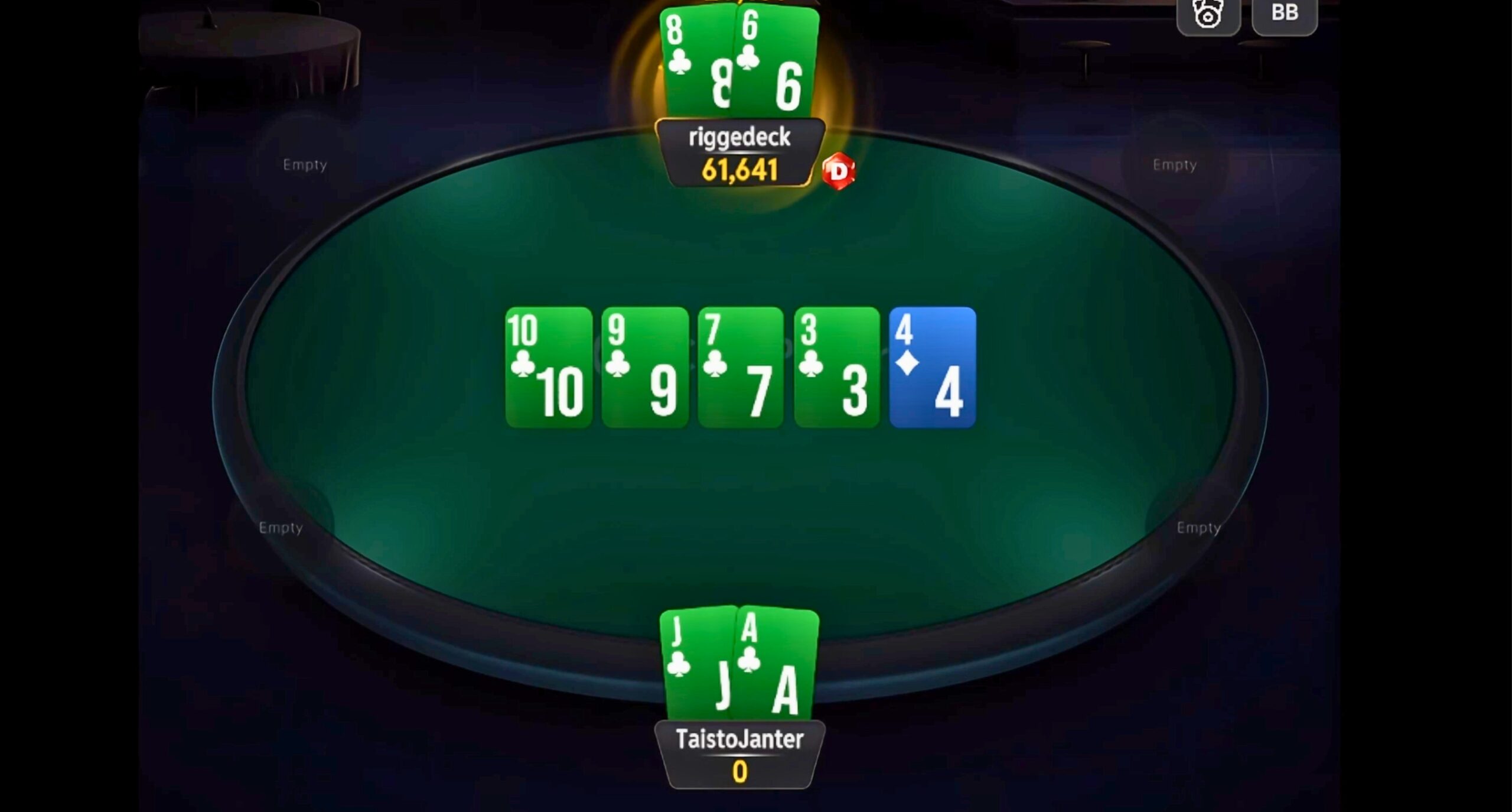
High-stakes no-limit hold’em regulars ‘TaistoJanter‘ and ‘riggedeck‘ went at it on the heads-up $100-$200 with $32 ante tables this week on CoinPoker. They played some ridiculous hand, as riggedeck came out on top for a win of about $100,000.
One hand produced an absurd cooler, the sort that a player might see once every few years. In another, riggedeck caught TaistoJanter trying to get away with a monster bluff, shoving several times the size of the pot on the river.
When Flopping the Nut Flush Goes Wrong
Playing 132 blinds deep, riggedeck raised to $500 on the button and called a three-bet to $2,200.
On the 10♣9♣7♣ flop, TaistoJanter continued for $1,294, and riggedeck called. On the 3♣ turn, TaistoJanter continued for $2,045, and that brought about a 4♦ river. TaistoJanter bet $5,571 and called it off for $20,907 when riggedeck shoved.
TaistoJanter had A♣J♣ for the ace-high flush, but it was no good, as riggedeck had flopped the straight flush with 8♣6♣. Riggedeck won a $52,958 pot.
👀 53k NLH pot pic.twitter.com/Lcnvwv2AyC
— CoinPokerAction (@CoinPokerAction) June 2, 2026
Hand Analysis
This hand opens normally with a raise and a three-bet, as these high suited Broadway hands are premium holdings that should always be reraised in heads-up no-limit.
On the flop, the big blind is supposed to play a heavy dose of checks. The reason is that the flush imbalance strongly favors the small blind. The small blind will raise-call preflop with many suited combos, while the big blind only three-bets a selection of mostly Broadway combos and connectors. So, while the big blind has an overall advantage range versus range, the nut advantage goes to the small blind.
TaistoJanter does bet with their flush, and riggedeck could raise or call. They opt to slow play.
The fourth club on the turn flips the situation on its head. Because the big blind is heavy on Broadway cards in the three-betting line, four clubs gives them the flush advantage, especially in the high cards, which matter the most. At that point, betting becomes the primary play. They can use a block size or a big size, and TaistoJanter chooses the block size.
The situation is much the same on the inconsequential river card. TaistoJanter chooses a small size and faces the surprising jam.
The question for TaistoJanter is what hands would riggedeck jam? Riggedeck is supposed to shove hands like K♣Q♣, K♣J♣, and K♣8♣ at a high or pure frequency for value, since having two clubs makes it hard for the opponent to have a flush. They’re supposed to bluff with some non-intuitive hands like K♠Q♠ and even 10♠9♠.
Against a solver range, TaistoJanter has a clear call. But it doesn’t work out as the sick cooler costs them big.
A Huge Bluff Doesn’t Work for TaistoJanter
Playing stacks just a hair larger than 100 blinds, TaistoJanter raised to $500 and riggedeck called.
The flop came A♥Q♥2♣, and riggedeck check-called $308. They check-called an overbet of $2,521 on the 7♣ turn, bringing a 6♦ river. Riggedeck checked, and TaistoJanter slammed the remaining $17,307 in.
Riggedeck called with A♣6♠ for two pair, and that was way good against K♥J♦ for an unpaired holding. That sent the $41,340 pot to riggedeck.
Hard to bluff aces up. pic.twitter.com/bPy5HOFh2O
— CoinPokerAction (@CoinPokerAction) June 2, 2026
Hand Analysis
Preflop is standard in this hand, as the big blind wants to keep the pot small with their worst A-X hands. The flop is a normal check-call for riggedeck for the same reason.
Things start to get more interesting on the turn, as the double-flush texture comes in. Omaha players will be familiar with the strategy mechanic here that the aggressive player needs to use large sizings, because they don’t really have hands that make sense to bet small. In no-limit, that means plenty of overbetting, and that’s what TaistoJanter does.
However, the solver isn’t really a fan of this play, as K-J is just too in-between. It can win a showdown sometimes, especially when it improves on the river, and the small blind has many worse hands to pick from to use as bluffs. It’s better to bluff with mediocre flush draws that can fold out some king-high hands and weak pairs.
On the seemingly brick river, the small blind uses mostly big non-all-in bets, but there’s a bit of shoving as well. Zero-showdown missed flushes are the main bluffs in that size, so TaistoJanter is out of line with the river jam, as well as the turn blast.
Riggedeck finds the two pair for the easy call to punish them, though they are supposed to mix calls with one-pair hands as well. Against a strategy that includes extra bluffs like this, they could likely call all of their top pairs and show a profit.
Hungry for more high-stakes poker content? Check out the CoinPoker YouTube channel and Bobby James’ YouTube channel for more action.