


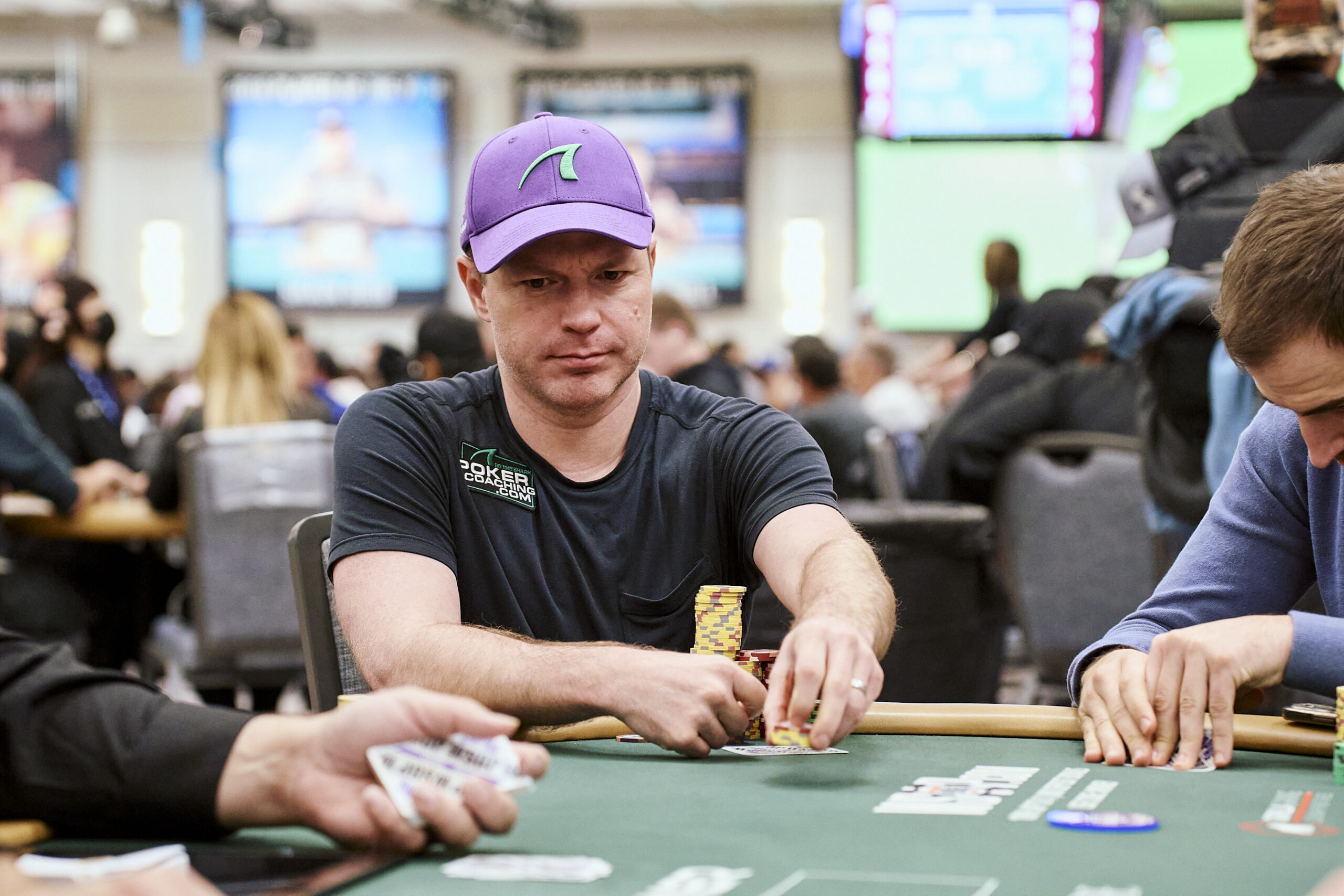
If you want to increase your poker skills and learn to crush games, check out Jonathan Little’s elite training site at PokerCoaching.com.
Preflop
I was recently told about a hand played by a recreational poker player from a $500 buy-in live event. With blinds at 800-1,600 with a 1,600 big blind ante, an aggressive player raised to 3,200 out of his 32,000 effective stack from second position. A tight player called on the button. Our Hero had 7♣7♠ in the small blind and decided to three-bet to 10,000.
Hero should not three-bet to roughly 30% of his stack with any hand in his range because when he faces an all-in, he has to call off due to the excellent pot odds. Also, by three-betting small, he is almost certain to get called by both of his opponents due to their excellent pot odds, which is not what he wants from out of position with a hand that will usually flop poorly.
Instead, he should either go all-in when he expects his opponents to fold most of the time, or call when he expects his opponents to have strong ranges. Both plays are significantly better than three-betting to 10,000. Facing a raise and a call, three-betting small with a 20-big blind stack is almost never a viable option.
The Flop
As expected, the big blind folded and the other two players called. The flop came K♣J♥7♦, giving Hero a set. That is lucky!
The pot was 33,200 with 22,000 remaining stacks. Hero checked.
Hero’s check is fine, although betting a tiny amount like 6,000 or going all-in are perfectly viable options, depending on the opponents’ tendencies.
The benefit of checking is it makes it much more difficult for the opponents to get away from any jack. Of course, if the opponents will check behind with their decent made hands like top or middle pair and never bluff with hands like A♥10♥ or 9♣8♣, Hero should probably go all-in for 67% pot.
The initial raiser thought for a minute before going all-in and the button quickly called.
The Outcome
Hero thought for a while and then folded.
Not like that!!!
Hero told me that he was certain the tight player on the button had exactly K-K or J-J. While anything is possible, those two holdings are extremely unlikely because almost everyone three-bets both of these premium hands before the flop when facing a raise, and if they happened to slowplay them against the initial raiser, once three-bet by Hero and called by the initial raiser, most people would four-bet all-in due to the short stack depths remaining.
Hero was quite disappointed to see the initial raiser turn over K♠Q♣, which beat the button’s J♦8♦. Hero folded a hand that was almost a lock to win in a gigantic pot because he was confident in his reads.
The Lesson
It is vitally important to realize that your reads will often be completely incorrect. This is one of the many reasons why you should work hard to develop a fundamentally strong strategy. You should know what to do when lots of money is on the line in all the common situations you will frequently encounter.
Even if Hero’s reads were correct and both players had hands they thought were strong, those hands could easily be K-J, K-Q, K-10, or A-J.
By folding, Hero is saying that his opponents both play so poorly that he knows without a doubt that at least one of them has specifically K-K or J-J. That makes no sense when you consider the preflop action. Hero lost a huge amount of value by “trusting his reads,” or more likely, being afraid to commit all his chips when there was a small chance he was beaten.
In this situation, letting go of a hand like K-Q would also be a substantial blunder, although again, that should have probably been pushed all-in preflop. When you have the top of your range and you play in a manner that induces bluffs (as was this case in this situation), folding is a significant mistake.
Level Up Your Game
If you want more resources to help you improve your game, I put together a course called Master the Fundamentals. This course covers the basics, preflop, post-flop, multiway, turn and river strategy, and much more. This course is completely free inside Card Player Poker School!
If you want more resources to help you improve your game, I put together a course called Five-Day Preflop Challenge. This course is completely free inside Card Player Poker School!
When you join the Card Player Poker School (it’s free to join), you’ll also get:
- Free Downloadable Preflop Charts
- GTO Preflop Charts
- Video Classes
- Interactive Hand Quizzes
- Free Course: Master The Fundamentals
- Free Course: The 25 Biggest Leaks And How To Fix Them
- Free Training Every Week
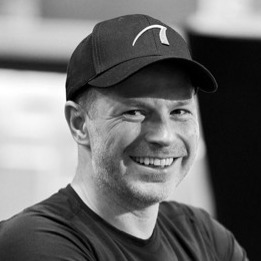 Jonathan Little is a WSOP bracelet winner, two-time WPT winner, and the 2024 PokerGO Cup champion with $9 million million in live tournament earnings. He is a best-selling author of 15 educational poker books, and the 2019 GPI Poker Personality of the Year. If you want to increase your skills and learn to crush games, check out PokerCoaching.com/cardplayer.