







Poker Hand Odds Explained – Your Poker Hands Probability Cheat Sheet
Poker hand odds and probabilities are the numbers behind every decision you make at the table, from whether to call a bet to how likely you are to hit your draw on the river. Whether you’re new to Texas Hold’em or you’ve been grinding for years, this page breaks down exactly how likely you are to be dealt certain hands, how often common draws come in, and how to use those numbers.
What Are Poker Hand Odds?
Poker hand odds tell you how likely a specific outcome is compared to how unlikely it is. When you hear something like “4 to 1,” it means the outcome you want happens once for every four times it doesn’t. Odds are typically written as ratios, while probability is usually written as percentages, but they describe the same underlying math.
Every hand you’re dealt, every card that comes on the flop, turn, or river, and every decision your opponent makes can be measured against known odds. Over thousands of hands, players who consistently make decisions based on the math come out ahead of players who rely on gut feeling alone.
That’s why you’ll find a lot of benefit in understanding basic odds. You don’t need to memorize every number on this page, but knowing roughly how often your draws hit and how rare your hand really is will help you avoid costly mistakes and recognize good spots to push an edge.

Poker Hands Probability
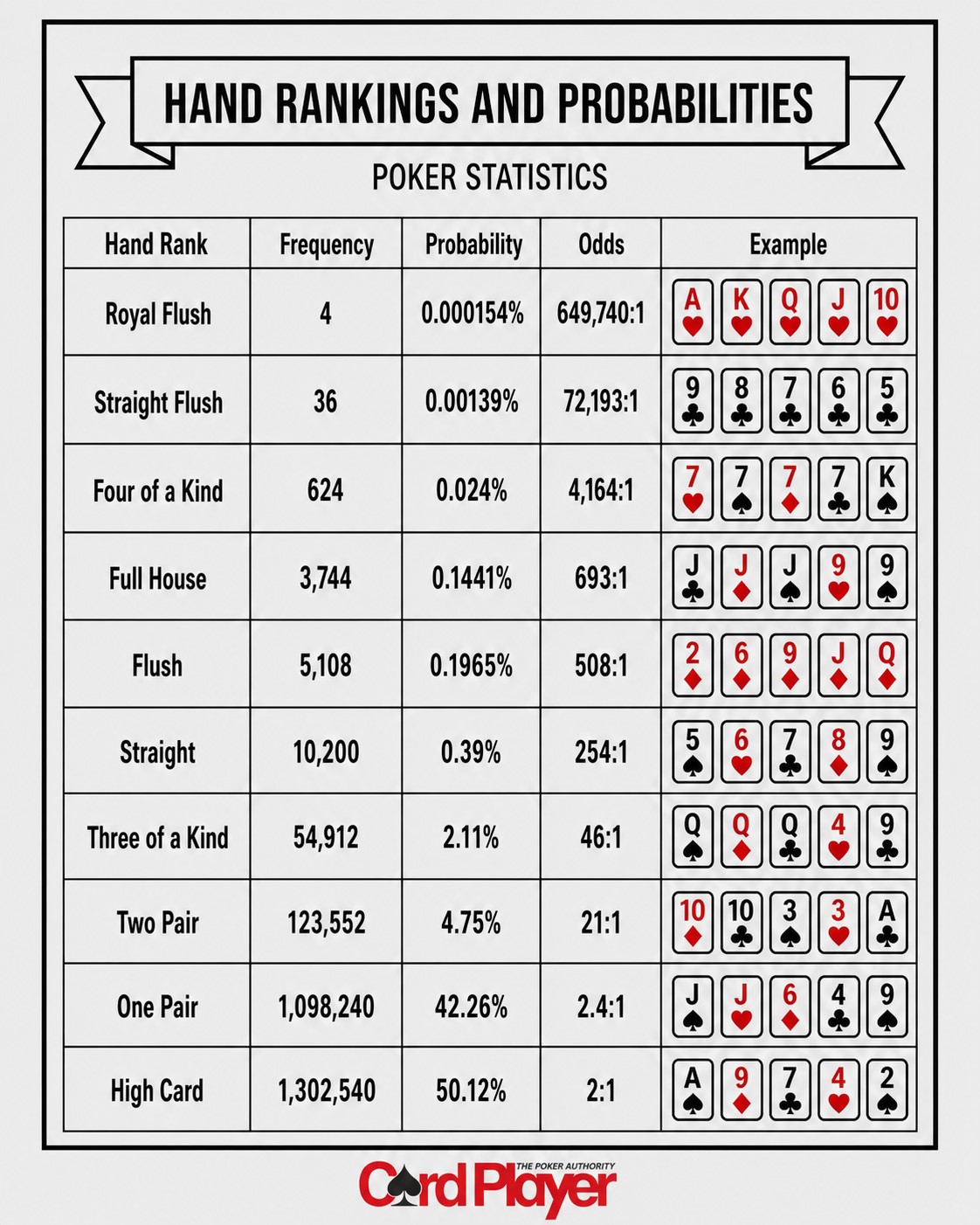
There are 2.6 million different five-card combinations in poker, but only ten different hand ranks, from a lowly high card up to that elusive royal flush. Your odds of getting dealt each of those types of hands go down as you move up the ranking chart. Roughly half of all possible hands don’t even contain a pair, while only four out of those 2.6 million are a royal flush.
Understanding these poker hand probabilities will be the foundation of strategic decision-making, and every player should ensure they have a solid grasp of the fundamentals before playing online poker for real money.
Poker Hand Probability Chart
Here’s a quick reference chart showing the probability and odds of being dealt each type of poker hand in a random five-card hand. These figures reflect the odds for exactly five cards, not the best five of seven, so for Texas Hold’em, they represent your chances by the flop. By the river, with two more cards to come, your odds of landing the stronger hands improve.
Understanding Poker Probability vs Poker Odds
Probability and odds describe the same event, but they’re not interchangeable, and mixing them up can lead to bad math at the table. Probability tells you how often something happens out of all possible outcomes, expressed as a percentage. Odds compare how often something happens to how often it doesn’t, expressed as a ratio. Here’s a simple breakdown of the two.
Hole Cards Probability
Your hole cards are the two cards you’re dealt at the start of a Texas Hold’em hand. They’re the only information you have when you reach your first decision point, so these hand probabilities will have the most impact on your game.
The strength of your hole cards is crucial to deciding how you’ll play your hand and, more importantly, whether to play it at all. Knowing the odds that you’ll pick up certain premium hands should therefore drastically influence your strategy as to which hands are worth playing in which positions.
Here’s a quick breakdown of the probabilities of some common hole card combinations. There are 1,326 hole card combinations in the deck, but only 139 if you don’t care about specific suits, only whether they match or not.
| Hand | Total Hand Combinations | Probability (%) | Odds |
| Any two cards | 1,326 | 100% | Always |
| AK (or any specific unpaired hand) | 16 | 1.2% | 1 in 82.8 |
| AK suited (or any specific suited hand) | 4 | 0.3% | 1 in 331.5 |
| AK off-suit (or any specific off-suit hand) | 12 | 0.9% | 1 in 110.5 |
| AA (or any other specific pair) | 6 | 0.45% | 1 in 221 |
| KK+ (i.e., KK or a higher pair) | 12 | 0.9% | 1 in 110.5 |
| QQ+ | 18 | 1.4% | 1 in 73.7 |
| JJ+ | 24 | 1.8% | 1 in 55.3 |
| TT+ | 30 | 2.3% | 1 in 44.2 |
| QQ+ or AK (premium hands) | 34 | 2.5% | 1 in 39 |
| JJ+, AK | 40 | 3% | 1 in 33.2 |
| TT+, AK | 46 | 3.4% | 1 in 28.8 |
| Any suited hand | 312 | 23.5% | 1 in 4.3 |
| Any unpaired, unsuited hand | 936 | 70.6% | 1 in 1.4 |
| Any pocket pair | 78 | 5.9% | 1 in 17 |
| Any suited connector (e.g., 76 suited) | 52 | 3.9% | 1 in 25.5 |
Odds of Flopping Made Hands
The flop is generally the most crucial stage in a Texas Hold’em hand. At this point, players have a fairly good idea of how strong their hand is going to be, and need to make decisions about how much money to commit to it.
The flop consists of three community cards that all players can use in combination with their hole cards to make the best hand. Here, the odds of flopping specific hands can be better or worse based on your hole cards. For instance, you’re more likely to make a three-of-a-kind if you start with a pocket pair.
There isn’t enough space here to list the probabilities of every hand type for every set of hole cards, but here are a few examples.
| Your Hole Cards | Flop (Your Hand) | Probability (%) | Odds |
| Unpaired Cards | A Pair | 32.40% | 1 in 3.1 |
| Pocket Pair | A Set | 11.80% | 1 in 8.5 |
| Connected Cards (JT through 54) | A Straight | 1.30% | 1 in 77 |
| Suited Connectors | A Flush | 0.80% | 1 in 119 |
Common Texas Hold’em Poker Hand Odds
In Texas Hold’em, you’ll often encounter situations where you have four out of five cards for a strong hand and are hoping to improve with the next community card. The cards that will help you improve are called “outs.”
Knowing the odds of hitting your outs for certain draws can give you the edge over your opponents. A closer look at pot odds is worth studying separately to really sharpen your post-flop game, but here are the odds to improve your drawing hand on the next card dealt.
Flush Draw – 4.1:1
If you’re holding two suited cards, and two more of that suit hit the board, you have a flush draw and need one more card of the same suit to complete a flush. The odds of hitting your flush on the turn are about 4.1-to-1.
From the flop to the river, you’re getting two cards, so your odds are almost twice as good. You have a 35% chance of completing a flopped flush draw by the river, or once every 2.86 times. However, you may have to call two bets to see both cards if you’re chasing the draw passively. Sometimes it’s better to turn your draws into a “semibluff” by doing the betting yourself. Then you might win by making the opponent fold, but can still catch a lucky card if they don’t.
Open-Ended Straight Draw – 4.8:1
An open-ended straight draw occurs when you have four consecutive cards, giving two possible ways to complete a straight — top and bottom. For instance, 5678 is an open-ended straight draw, hitting on a 4 or 9.
The odds of completing your straight on the turn are about 4.8-to-1. You have a 31.5% chance of making your straight by the river, or about once every 3.17 times. Again, you may have to put more money in the pot to realize this equity, however.
Pairing an Overcard – 6.8:1
If you hold two cards that are higher than any of the cards on the flop, you have a weak hand but might be tempted to continue and try to make top pair on the next street. The odds of hitting one of your overcards on the turn this way are about 6.8-to-1. You have a 24.1% chance of hitting one of your six available overcards by the river, about once every 4.15 times.
Note that although these odds are only slightly worse than hitting a flush or straight, the hand you’re drawing to is considerably weaker. The risk of drawing to top pair is that you could still lose to an opponent with two pair or better.
Improving One Pair Hands – 8.4:1
If you have unpaired hole cards and pair the board, you’re hoping to improve to two pair or three of a kind. Your odds of doing that in a way that doesn’t also improve your opponent are 8.4:1. That is, you’re looking to improve by matching one of your hole cards, not a board card that isn’t in your hand. With two cards, your odds of having improved by the river are 20.4%.
If we include pairing a board card, the odds of having two pair or better on the turn are about 4.9-to-1. You have a 30.6% chance of improving by the river, about once every 3.3 times. However, if it’s a board card being paired, keep in mind that’s also giving a pair to your opponent, which is unlikely to change who is winning the hand.
Gutshot Straight Draw – 10.5:1
A gutshot straight draw happens when you need one specific card in the middle of your hand to complete a straight. For instance, 5689 is a gutshot straight, as only a 7 will help.
Note that A234 and JQKA are also gutshots. Even though the cards are consecutive, they’re only open at one end, since “around the corner” straights like JQKA2 don’t count in most forms of poker.
The odds of hitting this specific card are about 10.5-to-1. Your odds of hitting it on either turn or river are about once every six times, or 16.5%.
Improving to a Set – 22:1
If you’re holding a pocket pair, the odds of improving to three of a kind (a set) on the turn are about 22-to-1. Your chance to hit it by the river is around 8.4%. Understanding the draws, possibilities, and odds associated with each of the decision points listed above will make the difference between a winning and losing player.
Common Heads-Up Poker Odds
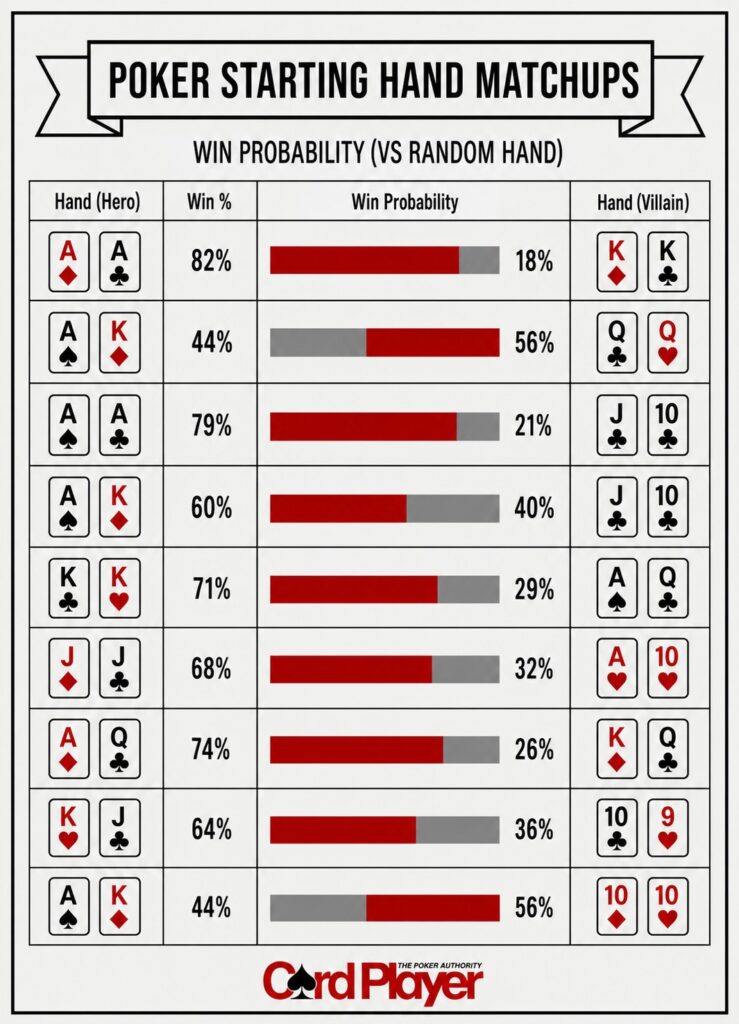
When you’re playing tournaments or heads-up Hold’em, it is essential to understand how specific hole cards perform against other particular holdings. Knowing the chance of one hole card combination beating another when you’re all-in is crucial to making preflop push-or-fold decisions.
You can use the Card Player poker hand probability calculator to calculate specific matchups. However, here are some common matchups between premium hands that you’ll encounter frequently, since these holdings are strong enough that all-in is a common outcome.
Beginner Mistakes When Using Poker Odds
Even players who understand the math on this page tend to fall into a few common traps when applying it at the table. These are some of the common ones to avoid.
- Ignoring pot odds. Knowing your odds of hitting a draw doesn’t mean much if you’re not comparing it to the price you’re being asked to pay. A good draw can still be a bad call if the pot odds don’t line up.
- Overvaluing suited hands. Suited cards slightly improve your odds, but the difference between a suited and an off-suit hand is smaller than many new players assume. Don’t let two matching suits talk you into a call you’d otherwise fold.
- Forgetting implied odds. Some calls are only correct if you expect to win more money on later streets when you hit. New players often calculate pure pot odds without factoring in what they can win afterward.
- Chasing gutshots too often. A gutshot straight draw is one of the weaker draws in Hold’em. Calling large bets to chase it without good implied odds is a common leak.
- Treating a strong preflop hand as a guaranteed winner. Even pocket aces lose a meaningful percentage of the time against a random hand, and far more often against a range of hands.
Tips for Learning Poker Odds Faster
Poker odds can feel overwhelming at first, but a few habits can make them easier to pick up.
- Start with the outs-based shortcuts, like the 4/2 rule, before trying to memorize exact percentages. Close estimates are usually good enough at the table.
- Study one section of this cheat sheet at a time. Trying to memorize every table at once tends to backfire.
- Review hands after you play them, and check whether your read on the odds matched reality.
- Use a hand odds calculator to check your math against real numbers until the common scenarios start to feel automatic.
- Practice pot odds calculations with round numbers first, then work up to messier bet sizes.
Why Knowing the Odds Will Improve Your Game
Understanding poker hand probabilities is a fundamentally useful part of the study required to enhance your poker game. Whether you are just starting out or have been playing the game for years, it’s never too late to brush up on some basic poker hand probability decisions that come up extremely often.
But more importantly, it’s about pot odds. Pot odds are the price the pot is laying you to make the call. For example, if there is $10 in the pot and your opponent bets $10, the pot pays you 2:1. You have to call $10 to win the $20 already in the pot. As a result, you need to win about 33% of the time to call the bet.
Knowing the odds will help you make better decisions on the fly and improve your overall strategy.
There’s plenty more poker strategy content to further hone your game. Just be sure to keep studying.
Remember that any kind of gambling is risky and can lead to addiction. Gamble responsibly, and never bet more than you can afford to lose.