







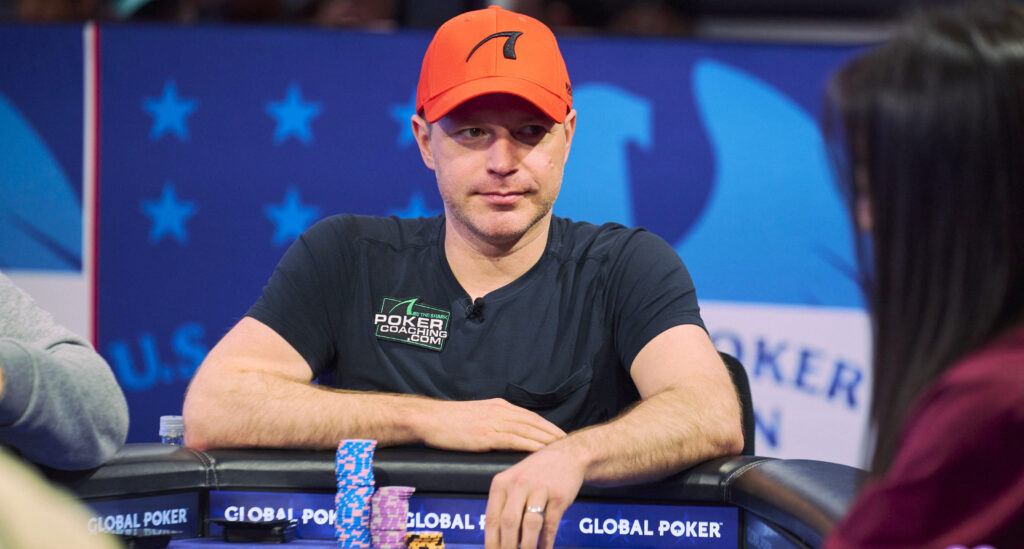
 If you want to increase your poker skills and learn to crush the games, check out Jonathan Little’s elite training site at PokerCoaching.com/CardPlayer.
In a $2-$5 no-limit hold’em cash game, everyone folded around to a presumably decent player on the button who raised to $20 out of his $500 effective stack. The small blind folded and our Hero decided to call from the big blind with 8 6.
6.
While almost everyone calls in this situation, when facing a large four-big blind raise, Hero should be less inclined to call and more inclined to either fold or three-bet, especially with suited gappers.
I realize that a four-big blind raise may be “standard” in your game, but that does not mean you can call as wide as if the button instead raised to 2.5 big blinds. As the raise size gets larger, you must adjust by defending tighter and potentially three-betting more often. Calling is still reasonable with 8-6 suited, but three-betting will likely lead to better results.
Calling large raises from out of position is one of the main reasons many $2-$5 players never move up to higher buy-in games. I would have three-bet to $70 some portion of the time (depending on my opponent’s preflop strategy) and called the rest. If Hero’s hand was a bit weaker, like 8-5 suited, he should just fold to a four-big blind raise and move on to the next one.
The flop came K 9 7, giving Hero a flush and straight draw. Hero checked, the button bet $25 into the $42 pot, and Hero called.
While Hero is certainly getting the right price to draw to his multitude of outs, check-raising to $80 is the best option, especially if the opponent tends to continuation bet the flop too often (as many players do).
Check-raising will win the pot immediately some portion of the time and when it doesn’t, Hero will be able to continue betting the turn essentially every time.
Hero should also make this check-raise with many of his best made hands, including sets, two pairs, and perhaps some top pairs. This strategy will make him difficult to play against because sometimes he will be value betting and other times he will be semi-bluffing.
Another reason to check-raise is that if Hero instead calls and improves on the turn, the opponent will likely check behind with most of his non-premium hands, and if Hero decides to lead the turn when he improves, he takes away his opponent’s opportunity to bluff.
For the most part, check-raising your high equity draws that have no showdown value is the best play.
The turn was the K. Hero checked, the button bet $40 into the $92 pot, and Hero called.
The king is certainly a bad card for Hero since the button should have essentially all kings in his range and would usually bet them on the flop and turn. The opponent may also continue value betting with some nines.
While folding is still out of the question due to Hero’s excellent pot odds, calling is a viable option. However, as on the flop, if Hero improves on the river, he will have a difficult time getting paid. For this reason, plus the fact that Hero would like to also check-raise some of his own kings, he should again check-raise, this time to about $130.
It is always rough when you are against trips, but when you aren’t, you will put your opponent in a difficult spot where even if he decides to make a big turn call, he may fold to a river bet, or you may improve.
Of course, if Hero knew the opponent would only bet the turn with trips and better made hands, he should instead call because he is behind and his opponent will not fold to a raise.
The river was the K .
.
This is a tough spot, but Hero should at least consider leading, given he has no showdown value and would strongly consider betting if he had quads (although there may be no quads in his range because he would have raised his kings on the flop or turn).
A small river bet of $55 into the $172 pot is quite nice because the opponent will almost certainly fold all of his hands worse than a full house, many of which may still be in his range if he bets the flop and turn with all his possible draws (Notice all the draws that missed).
A reason not to lead this particular hand is because knowing the 8 and 6 cannot be in the opponent’s hand makes it a bit less likely that he has a busted flush draw (one of the hands Hero wants to make fold). That said, since Hero should realistically have no quads, he cannot justify leading without some sort of a read on the opponent that justifies making the exploitative play.
Both players checked and Hero lost to Q J.
If you want to apply more pressure to your opponents, one of the ways you can accomplish this is by bluffing. I created a simple flowchart to help you bluff like a pro. This flowchart has 11 questions you should always ask yourself when deciding if you should bluff. I also recorded a short video that shows you how to use this flowchart by going through two hand examples! ♠
When you join the Card Player Poker School (it’s free to join), you’ll also get:
- Free Downloadable Preflop Charts
- GTO Preflop Charts
- Video Classes
- Interactive Hand Quizzes
- Free Course: Master The Fundamentals
- Free Course: The 25 Biggest Leaks And How To Fix Them
- Free Training Every Week
 Jonathan Little is a two-time WPT winner and the 2024 PokerGO Cup champion with nearly $9 million million in live tournament earnings, best-selling author of 15 educational poker books, and 2019 GPI Poker Personality of the Year. If you want to increase your poker skills and learn to crush the games, check out his training site at PokerCoaching.com/cardplayer.