







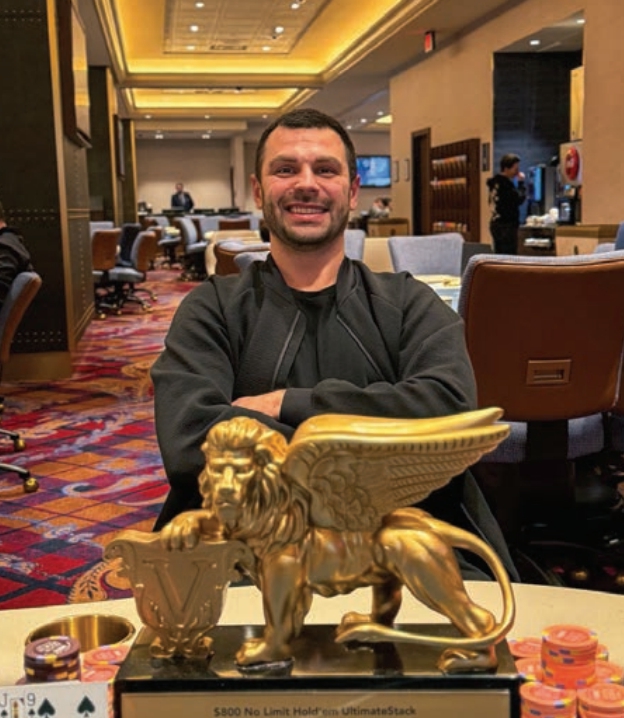
 Francis Anderson was born in upstate New York and attended the University of Albany. He started playing poker for low stakes with friends in college and then quickly jumped into online poker. He eventually dropped out of school to pursue a career in the game.
Anderson moved to Costa Rica for five years after Black Friday in 2012 to play online poker full time. There he met the likes of Chris Hunichen, Chris Oliver, and David Peters who were great mentors along the way.
In 2018, Anderson moved to Las Vegas and started playing full-time live poker again. The following year he would break out with final tables at the World Series of Poker and on the World Poker Tour, continuing to score deep finishes as he followed the live circuit.
During the 2024 World Series of Poker, Anderson nabbed his first gold bracelet and $510,000 in the $800 Independence Day Celebration event. He continued his run good with a fifth-place finish at the WPT Rock ‘n’ Roll Poker Open and an eighth-place showing at the WPT bestbet Bounty Scramble.
Most recently, Anderson took down the last tournament of 2024, scoring $61,551 for topping a field of 515 in the Venetian News Years Deepstack Extravaganza. The 37-year-old now has more than $3,600,000 in career earnings.
Card Player caught up with Anderson to break down a few key hands from his latest win.
Craig Tapscott: You had a great run last year in a number of live events. Can you share what part of your game you focused on to improve over the last year?
Francis Anderson: I talk poker strategy and send hands almost every day with some great American poker players including Brock Wilson, Stephen Song, Shannon Shorr, Michael Rossito, and Justin Saliba. This really helps me to stay very sharp and on top of my game by receiving honest feedback from my peers.
This year in particular I have really notched up my aggression deep in poker tournaments. I am applying more and more pressure on my opponents and trying to find under-bluffed spots. I also watch a lot of poker streams to see what some of the top poker players in the game are doing that I am not incorporating into my game.
Craig Tapscott: What are some of the most egregious leaks players in the mid-stakes buy-ins tend to have?
Francis Anderson: I think the two biggest things I see are people overplaying medium-strength hands by putting too much money in the pot. The second mistake is they give up on their tournament when they’re short-stacked. Really good players still take 10 big blinds seriously and sometimes spin it up, but it’s really common for people to be tilted that they got so short and just punt it off.
Event: New Years Deepstack Extravaganza
Buy-In: $800
Entrants: 515
Prize Pool: $355,350
First-Place Prize: $61,551
Stacks: Francis Anderson– 900,000 (90 BB) Jessica Vierling – 550,000 (55 BB)
Blinds: 5,000-10,000 with a 10,000 big blind ante
Players: 9
Players Remaining: 25
CT: What was your read on Jessica to start the hand? She has the reputation of being a strong and smart player.
FA: Yes. Jessica is a very aggressive opponent that likes to make moves on her opponents when she senses weakness.
Anderson raised to 22,000 holding K Q from under the gun. Vierling called in the big blind.
Flop: 7 6 2
2
CT: It was a pretty good flop for you. What were all your options here?
FA: The Villain is a solid aggressive player, as we established. And this is generally a board versus the big blind that I am going to bet big or check, since the board is connected and has a lot of straight draws. So, I decided to bet about 60% of the pot.
Anderson bet 35,000, and Vierling called.
Turn: 4
 FA: The turn completes one straight and gives her more equity if she has a pair and straight draw. But I think it’s a good spot where I am going to triple barrel on most runouts and represent an overpair since I opened from UTG.
Anderson bet 100,000. Vierling tanked briefly and called.
CT: What’s your read on her holding at this point?
FA: I was putting her on a hand that has a 7 or a hand that has a pair plus straight like a 4-5, 6-8, 5-6 type hand, etc. My plan was to bet big on the river as long as an 8, 7, 6, 5, or 3 didn’t fall.
River: J
CT: Did you like this river card?
FA: This is a very good river. It’s an overcard to the board and it’s going to be more difficult for her to call if she only has one pair. I also have some J X combinations, too. She had a little over the pot behind.
Anderson moved all-in.
FA: It’s very important to understand your image when playing with opponents on a regular basis. Jessica views me on the tighter side overall, so I think this will help me generate more folds as well. She started to tank and eventually…
Vierling folded, and Anderson won the pot of 329,000.
FA: It was after this hand I became one of the chip leaders.
CT: Can you go into a little more detail of understanding your image at the table?
FA: It’s very important. When my opponents view me on the tighter side, I’m a lot more likely to go for a big bluff against them. When my image is crazy and I make a hand, I will tend to get very greedy and go for max value with a bigger raise.
Stacks: Francis Anderson – 2,500,000 (100 BB) Villain 1 – 875,000 (35 BB) Villain 2 – 1,500,000 (60 BB)
Blinds: 15,000-25,000 with a 25,000 big blind ante
Players: 9
Players Remaining: 18
Villain 1 raised to 60,000 from UTG+1, and Villain 2 called from middle position. Anderson called from the big blind holding Q 9.
Flop: K 9 8
Villain 1 bet 50,000 and Villain 2 folded. Anderson called.
FA: Villain 1 was an older gentleman. I hadn’t played too much yet with him and he was on the tighter side from what I can tell. I put him on a tighter range preflop due to his bigger preflop sizing open. I didn’t think he’d continuation bet too wide three ways, but he still could have some bluffs here.
Turn: 3
Both players checked.
FA: Villain 1 snap checked, and the turn completed a flush draw. Let’s see what the river brings.
River: 5
FA: I think this is a pretty scary runout for the preflop raiser. His smaller flop sizing for under 25 percent pot gave me the feel he could have pocket tens, jacks, queens, and maybe an A-9 suited type hand.
CT: What was the plan to take the pot away from Villain 1?
 FA: This is a spot where people take their showdown value and try to win the hand. They are hoping the river goes check-check.
The past year I’ve been working on trying to find creative bluff spots that people generally under bluff. With this runout completing the front door flush and 6-7 for a straight, I really thought that I could get him off a hand like K-Q, K-J, and tens, jacks, queens, and A-9.
Anderson bet 210,000, and Villain folded. Anderson won the 320,000 pot.
FA: Villian 1 used all three of his remaining timebank chips and folded pocket queens faceup in the last second.
CT: What are some other spots that people tend to under bluff in?
FA: A lot of times recreational players are a little bit too scared to pull the trigger in a big spot deep in a tournament with the fear of getting called. There are also times when we get to the river with ace high or fourth pair and people will check back.
They think they have slim showdown value when in reality if they check they will lose the hand the vast majority of the time in that spot. It’s important sometimes to turn fourth pair or ace high into a bluff, especially when a lot of the draws got there. From where our opponent sits, it’s hard for us to have many bluffs. This approach will get a better hand to fold fairly often.
Stacks: Anderson – 3,500,000 (70 BB) Villain – 2,500,000 (50 BB)
Blinds: 25,000-50,000 with a 50,000 big blind ante
Players: 9
Players Remaining: 9
CT: What was your take on the Villain?
FA: Villain was a young, solid player with limited playing experience. He started the hand in the middle of the pack at the final table. I started the hand as the second biggest stack.
Villain raised to 100,000 from UTG+2, and Anderson called from the big blind holding A 6.
Flop: K 3 2
Anderson checked, and Villain bet 65,000.
FA: The Villain was someone that was continuation betting and opening way too wide. I thought that he was someone that I could put pressure on due to his stack size being an average stack and there being two short stacks at the final table.
Anderson raised to 190,000.
CT: What were you putting him on at this point?
FA: This is a spot where he would have folded twos or threes preflop. I can have hands like K-2 suited, K-3 suited, pocket twos and threes preflop. Whereas he can’t. I also have an overcard and a backdoor flush draw and straight draw. I can put some pressure on him with some good turn cards.
Villain called.
FA: Right now, I am putting him on pocket sevens through pocket queens, or a king.
Turn: 5
CT: Was this a good card for your perceived hand? Clearly it was a great card for your exact hand.
FA: This is a great card for my range and now it’s hard for me to have bluffs. If I continued with A-4 and 6-4 they got there too.
Anderson bet 400,000.
FA: He took about 45 seconds and…
Villain called.
FA: Now I think I can pretty much put him on a king. And with a king he definitely wasn’t liking the situation.
River: 9x
Anderson bet 1,000,000. Villain tanked and then folded. Anderson won the pot of 1,450,000.
CT: After you raked in the pot what was your take on his range? He tanked for a bit. Could he have had a really big hand?
FA: I really think I got him to fold aces or A-K. After this hand I was able to regain the chip lead.
When I’m the chip leader, I want to apply pressure on everyone, but mainly on the middling stacks. That’s because they are facing the most pressure when there are a couple of short stacks out there. They have the most to lose in this moment and don’t want their stacks to fall down to where the other short stacks sit at the table.
Follow Anderson on Twitter @FrancisPoker123. ♠
*Photos by Venetian Poker, World Poker Tour