




Oct 16th—Raise folding turn donk lead can be a solid line when you are the preflop raiser Most incapable of bet 3 betting draws COMBO OCT 20th—Raising the turn to see a free showdown can definitely be a useful tool if you plan on calling down
One of the most awkward spots you can find yourself in in today’s no-limit games is an opponent who check/calls your continuation bet on the flop and then donk leads the turn when something scary appears. There are many ways to interpret this line and there is no right answer as to exactly what it means. However, especially at the lower levels, players who check/call then lead are usually not capable of bet/three-betting a draw. Therefore, by raising, not only do you freeze your opponent, but you actually get extra value from their draws as well as getting to a free showdown at the river some of the time.
Let’s look at an example. We are under-the-gun (UTG) and raise to $20 in a $5-$5 no limit game with K K
K . Two players, both in the blinds, call with $800 effective stacks. The board runs out 10 7
 2. It gets checked to us and we bet $40. The small blind calls and the big blind folds. The turn is the 9 and now our opponent leads out at us for $80. What is our play here? This can really be a tough spot when playing deep. We only have one pair and there are certainly straights and two pair combinations that beat us. However, there are a lot of draws and we still very well may have the best hand. We decide to just call. The river comes a 2
 and our opponent checks. We think that we definitely have the best hand and bet $140 to try and get paid off by a ten. Our opponent hems and haws and talks about how lucky we are that he did not get there and folds 9 6 face up. Obviously, he had an absolute monster on the turn — flush draw, gutshot and a pair. In fact, with one card to come against our red kings he had 17 outs. He would probably call any raise amount. So did we lose value?
That is not an easy question to answer. When playing deep-stacked no-limit it is important to concentrate on protecting your stack rather than protecting your hand. And that is why you will see many players just call when their opponent shows strength — so that they do not expose their stack. However, if your opponents are not big semibluffers, you can counter this donk turn line by raise/folding some of your medium strength hands. So let us say that we raise his $80 bet to $250. If he three-bet ships I would be fairly comfortable folding since his range for getting it all-in here has us killed even getting 3-to-1 on a call. In fact 9 6 is one of the worst hands that we can be up against here. Normally we are going to be shown two pair, a set or a straight. If we just call and our opponent does not bluff the river, like he did not here, we actually have allowed him to name his price on the turn and sort of give him a reverse free card.
Obviously you open yourself up to a world of hurt, however, if you start raise folding the best hand in these spots. However, it is so rare that anyone is going to raise the turn in position and then fold that I do not expect my opponent to ship back light after leading the turn because they don’t expect me to fold.
Another time you can implement this raise turn line is when someone leads at you and the nuts are in your range. Let us say for example we raise with J J to $20 in late position in a $5-$5 game with $1500 stacks. The small blind, an aggressive, good player, calls. The board comes out Q 10 3 and he checks. We think we have the best hand here a lot of the time because of the late position blind dynamic and we bet $30. Our opponent check raises us to $110. We think there is a very good chance that our opponent may be making a play at the pot and that it is unlikely that he would merely check-raise with a queen so we call. Turn is 8. He now bets $200. We raise to $550. Now usually you are not putting this type of money in with second pair to the board but I think that this is a good case where we can raise to take a free showdown at the river if unimproved. Our hand is an easy fold to a ship but we have blockers to the nuts and even if our opponent has a hand as strong as 3-3 he may just call. We also get a ton of value from draws and if we were planning on calling a blank river we have actually made it cheaper for ourselves.
Oct 25th—Allowing a good player to value own themselves can be a very useful line. Especially if they would fold to pressure
Occasionally bad players accidentally play in an optimal way. One of the things I have noticed over the past few years is the propensity for some weak competition to allow their good opponents to value own themselves. When I talk about value owning I am referring to betting with the worst hand for value. I have discussed many times in previous articles about how important thin value betting is to increase your winrate. Simply put a value bet is plus expected value on the river if when called you are good more than 50 percent of the time. The better the player, the thinner the value bettor. So how do we counter this type of thin value betting? We allow our opponents to value bet weaker hands.
This advice is only applicable in hands against good, capable players. Taking a value own line does not usually work against average or bad competition because those types of opponents do not value bet enough. I saw this interesting hand go down a few months ago in a $10-$25 game. A good, solid pro raised under the gun to $100 and a fishy, recreational businessman called heads up in the big blind. The board ran out K-5-4 rainbow. The businessman check/called a $175 bet on the flop. The turn was a 9, completing the rainbow. The businessman again check/called, this time a $375 bet. A deuce fell on the river. The businessman paused for a moment and checked once again. The young player thought for a while and finally bet $1000. The businessman snap called. The pro tabled K-J and the businessman proudly turned over 9 5 for two pair.
Was this a good value bet by the young player? Of course. In reality, this businessman had shown that he would call down any amount with top pair and sometimes made big calls with lesser holdings. If I were the preflop raiser I would expect him to usually have a weaker king here, figuring that I would have heard from two pair or a set earlier. Most of the time I would expect to be good when called. However, if the businessman, who had shown that he was not all that aggressive but more of a calling station, had check-raised the turn, I would have almost immediately folded as would have the young pro. However, the businessman accidently took the most optimal line. He did not announce any strength and because he was up against a thin value bettor ended up making the maximum amount from his hand. If you are a tighter player or you are up against competition constantly going for thin value you can see that allowing people to bet weaker hands for value can be a good game plan.
Otherwise, if you ever put pressure on the pot good competition will fold. Again it is very, very important to realize that this only applies to good players and for the most part you should play your hands rather straightforward at the lower levels. A detailed explanation of this concept can be found in my new podcast “The Seat Open Podcast” Hands from A Cash Game Volumes 1 and 2 at www.seatopenpoker.net. ♠
Want Card Player and Bart to provide analysis on a cash game hand you played? Send full hand details (blinds, stacks, street-by-street action) to @CardPlayerMedia. If we choose your hand, we’ll send you a Card Player subscription.
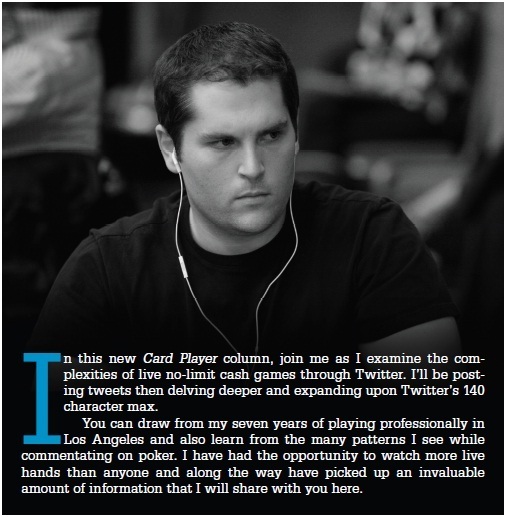
Follow Bart for daily strategy tips on twitter @barthanson. Check out his podcast “The Seat Open Podcast” on seatopenpoker.net and his video training site specifically for live No Limit players —CrushLivePoker.com. He also hosts Live at the Bike every Tuesday and Friday at 10:30 pm ET at LivettheBike.com