







It was the kind of game you write home to mother about – as in, "Mom, please send more money!"
My $30-$60 limit hold'em game at Wynn Las Vegas was full of action. Several passive novice players played almost every hand. The aggressive players fired in raises, vainly trying to isolate the limpers, or at least make them pay for their weak hand selection. If you made some big hands in a game like this, you'd feel like a champ; if you ran cold, you'd head home feeling like a chump.
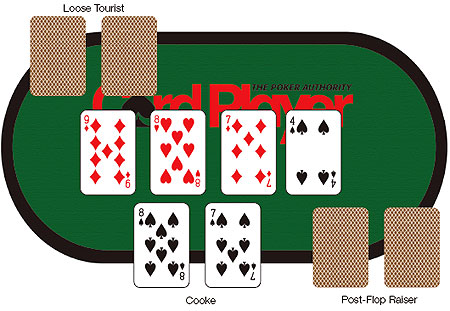
One of the aggressive players raised from up front and four players called the two bets cold. Just to the right of the button, I held the 8 7.
7.
I am somewhat less impressed with the potential of low and medium suited connectors than most players. Part of my reasoning for this is that if you are getting the volume from weak players that's necessary to play the hand in the first place, that action oftentimes is from people playing suited hands – two- and three-gappers, and any suited king, queen, or even jack. Therefore, your flush draw has a higher likelihood of being in a position of drawing dead to a higher flush, and the value of the bets lost when drawing to dead flushes is great.
I play weak hands against weak players if I think I can read the situation well and get away from losing hands, and my opponents will tend to pay off my winning hands, thus giving me good value. on the hand. But with weak flush draws and volume fields, those situations are very difficult to read, and if you lay down flush draws that you think might be dead, you unfortunately end up laying down some live flush draws.
That said, while I do not attach the value to suited connectors that some other poker pros do, that doesn't mean that I always throw them away. I merely require the situation to be a little richer than most. And this situation was pretty rich – as all three players yet to act behind me were loose in regard to hand selection and likely to call. Several of the players in the pot already were not the type to play their hands well, and I was getting more than 5-1 current odds even without any additional callers. I tossed $60 into the pot, calling the opener's raise. The button folded, the small blind reraised, the big blind called the three bets, and so did all of the initial callers. We took the flop off eighthanded with $720 in the pot, which is a huge preflop pot for a $30-60 game!
The good news was that I flopped two pair. The bad news was that it was about as bad a flop for two pair as I could get. That's another problem with connectors: When you make two pair in a very loose game, a straight draw is invariably among your opponents' possible holdings, leaving you very vulnerable. The flop came 9 8
8 7, producing multiple straight draws as well as a diamond draw. Plus, my hand might not be the best as it stood, as I could be up against a better two pair or a set. While the flop had value for me, it was also a very perilous one.
The small blind led into the field, and everyone called to the guy on my immediate right, who raised. My situation was a tough one, and required some thought. I pondered my next move.
I really wanted to win the pot right there. Unfortunately, that was the stuff dreams are made of – unrealistic dreams, in this case. The players in this field were not the type to make many laydowns on the flop. Pretty much everyone was taking any draw all the way. And given this huge pot, they couldn't be terribly incorrect in doing so.
If I three-bet, I did not think I would eliminate much of the field, if any. I thought the small blind had an overpair, and knew he wouldn't lay it down. I doubted he would four-bet if I raised, but I wasn't sure if he would three-bet with that board if I flat-called. I also did not have much of a read on what the post-flop raiser held. He played a lot of hands, and raised with both pairs and draws, but he also could have me beat.
I decided to flat-call. My reasoning was that if I caught a card I liked on the turn, I might be able to raise the player on my immediate right and put some significant pressure on those players who held weak draws but could outdraw my holding, giving me an increased percentage chance of winning. In large pots, increasing your percentage chance of winning has high value. Flat-calling also kept my contribution to my opponents' price down a little, although in a pot of this size, that didn't matter much. Everyone called behind me.
The turn card was a positive one for me, the 4. It didn't make any straights or flushes, and would not help many possible holdings. The field checked to the post-flop raiser, who once again fired into the pot. I stroked a raise in right after him. The player in the small blind thought for a long period of time and then threw his hand away. One player, a loose tourist, called the $120 cold, and the rest of the field folded to the post-flop raiser, who just called my raise.
We were down to three players, which was good news for my hand. My positive thoughts didn't last too long however. The dealer turned the 6 on the river, putting a four-straight on the board, crippling my hand. The tourist led into the pot and was raised by the post-flop raiser. I tossed my two pair into the muck. The tourist called and turned over the 10 2 to split the pot with the post-flop raiser, who turned over the K 10, having flopped an open-ender and a flush draw.
Although it might not seem so from the results, my turn raise had worked to perfection. I had created a situation in which my hand was up against two drawing hands and would win the pot if they missed. I had eliminated hands to which I may have lost the pot if a card had come that improved one of them.
If the small blind folded an overpair, it increased my likelihood of winning because if a 4, a 9, or his set card hit, I would have lost the pot. The same was true against anyone who held a 9 -as they might have hit their kicker or caught a 9. If someone folded a jack, I had eliminated the winner if a 10 had hit. Other combinations were possible, also. The way I played my hand gave me the best shot to win the pot and lowered my possible cost if I caught a bad card on the turn. Yes, I caught a bad card on the river, but that doesn't make the play incorrect. In poker, you can only make the best decisions you can and let the cards take care of themselves, while understanding that the cards do not always take care of you.
This hand demonstrates the problem of playing suited connectors in high-volume pots. The tourist had the 10 2, killing any flush I might have made. I am not saying that you should always fold suited connectors in volume pots, but you must include the possibility that you are drawing dead into the equation, and extend your price. How you quantify that is difficult, and it's based on your opponents' propensity to play suited cards. So, keep track of opponents who play suited hands and extend the odds if you are drawing to weak flushes against them. When I play suited connectors, the hand I prefer to make is the nut straight.
I put $270 into that pot – and I didn't even have to write home to Mom for more cash. Despite the result, it was money well-invested, and if I had it to do again, I'd do it exactly the same way.
Roy Cooke has played winning professional poker since 1972, and his Card Player column is the poker world's longest continuously running feature. He is a successful real estate broker/salesperson in Las Vegas. His books are available at www.conjelco.com. His longtime collaborator, John Bond, is a freelance writer in South Florida.