



I recently came across a hand online that was somewhat compelling as it contained a series of close and interrelated decisions. It’s also a good example of why you need to be aware of how your range is perceived, and its implications on your winning percentage and the river betting round.
The hero opened with 2-5-5-5-8 from the lojack. The small blind put in a three-bet, and the big blind folded. The original raiser called.
Whether to play this holding to begin with is the first close decision. My own personal standards dictate that 2-4-8 from the lojack position is an open, but 2-5-8 is a fold. While no one can say for certain that the one hand is profitable and the other isn’t, we should have a set of default opens and have to draw the line somewhere.
However, the pairs are valuable in that they block your opponents from making hands while also reducing your probability of pairing on the final draw. Having three fives likely makes this hand a profitable play.
The small blind drew one, and the hero took two. The small blind bet and her called with 2-2-5-8-Q .
Despite bricking, due to the size of the pot, this street was completely standard. While it wasn’t required to proceed on, pairing the deuce has some value for our hero because some of the small blind’s reraising range is “duck hunting” with hands like 3-4-6-7 or 3-4-6-8.
On the second draw, the small blind again took one and bet. The hero drew two and looked down at J-8-6-5-2.
The hero continuing in this hand is mandatory as his opponent had an automatic turn bet since he was a card ahead going into the draw. The villain is still going to draw around 60% of the time (increased by the likelihood he’s searching for a five that’s in short supply) and across his entire range the hero probably has a little more than 40% equity.
However, before sliding in the chips to call there are a few things to consider, and this is where it gets interesting.
When our opponent is still drawing, is it best to pat the jack or draw to an 8-6 low? Hero’s equities against various incomplete holdings that Villain may have are as follows:
| Villain’s Holding | Hero Pats Jack | Hero Draws 1 | Equity Difference |
| 7-4-3-2 | 56% | 50% | 6% |
| 8-7-3-2 | 61% | 57% | 4% |
| 8-7-5-2 | 54% | 54% | 0% |
| 7-5-4-2 | 49% | 46% | 3% |
| 6-4-3-2 | 56% | 51% | 5% |
| 8-4-3-2 | 54% | 50% | 4% |
As you can see, unless the opponent has both an inferior draw and the case five, our hero’s win percentage is increased by patting. But the odds are in our favor that needs the five. Should hero choose to call, there would be 6.5 big bets in the middle, and gains say an additional 5% equity it would be worth around .325 (5% * 6.5) of a big bet.
However, the hand doesn’t end on the turn, so we must also consider the play on the river and its impact on our overall expectation. In theory, on the last round of betting the made jack low will lose some small fraction of a bet as it needs to pick off bluffs. Drawing to 2-5-6-8 in position might be making a little money.
Therefore, when you choose to call and pat, some or possibly all of that .325 of a big bet (or other similar amount) that was gained by patting is evaporated when reflecting river play.
Is there any merit to leveraging our positional advantage by raising and overplaying our jack low?
Let’s first assume that our opponent had specifically 2-3-4-7 heading into the second draw and we chose to simply to call, planning to pat the jack when he’s still drawing. That situation could be represented as follows:


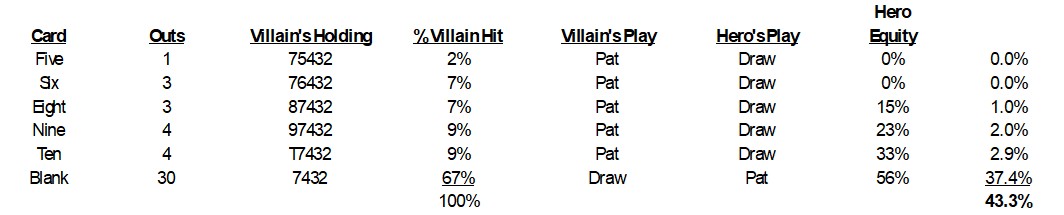
When just getting called on the turn will our opponent pat 10-7-4-3-2 or continue drawing? This will vary, but some players will do so under the rationale that a pat ten is a nice favorite when their opponent doesn’t yet have a made hand, which will frequently be the case when their opponent took two on the second draw. And as shown above when making this assumption, Hero has around 43% overall equity.
But when facing a raise, they are certainly going to break 10-7-4-3-2, and it also puts 9-7-4-3-2 into a predicament. Assuming we instead choose to raise and get both pat nine and ten lows to break, the win percentage increases to over 48%.
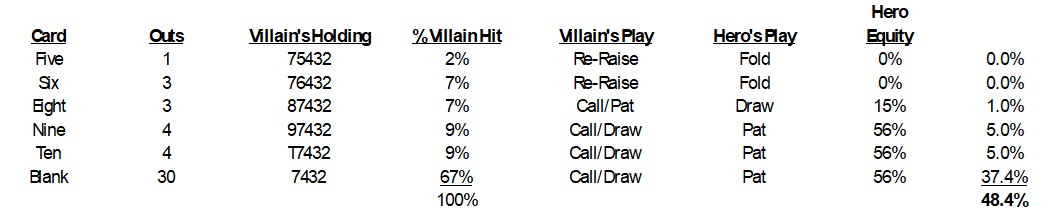
If the above charts accurately depict how the action would go down, Hero can possibly increase his overall win percentage when raising by another 5% or so. And with a win percentage of around 48.4%, the extra bet required to do this has a minimal cost.
We should pause here to state that a raise should really only be considered versus an opponent whose reraise indicates that we are drawing dead and can safely fold to a three-bet. Ideally, we want to avoid the situation where our opponent three-bets 8-7-4-3-2 and we fold, relinquishing 15% equity, but this would be an aggressive play most would not make. Thus, for this scenario, we assumed our opponent would just call and pat and we would respond by drawing.
While raising the turn can sometimes cause us to lose an extra bet, it also allows for the possibility for some very good things to happen. For example, with the right image there are some scenarios where rough nines and tens, or subpar draws just fold the turn, which are huge wins.
What if the villain is looking at a hand such as 9-8-7-4-2? In a lower or middle limit game where straightforward play dominates, it’s conceivable that hand or weak draws such as 2-6-7-8 or 3-4-6-7 simply hit the muck.
However, this type of magic happening is a bonus and not a necessity as most of the time our opponent will still be drawing where the money is going in as a slight favorite. And against the entirety of our opponent’s range, when having overall equity north of 40% just simply securing a small amount of breaks is sufficient.
Had hero chosen to just call and pat the jack low, the hand is often what it appears to be, a mediocre holding just hoping to hang on. This allows the opponent to value bet the river aggressively while also forcing hero to call with at least some frequency in order to pick off potential bluffs, which lowers overall expectation.
However, the aggressive turn action represents a stronger range where it’s conceivable that your opponent won’t often lead the river at all, assuming he goes for a check-raise when drawing a premium hand.
Against a cautious and plain sailing player whose reraise always means you are drawing dead and is also capable of making tight folds, raising and patting the jack probably offers the highest expectation. However, when that’s not case we usually just want to call, break, and hope to win some money on the river. As is often the case in poker, your best course of action depends on your opponent.