
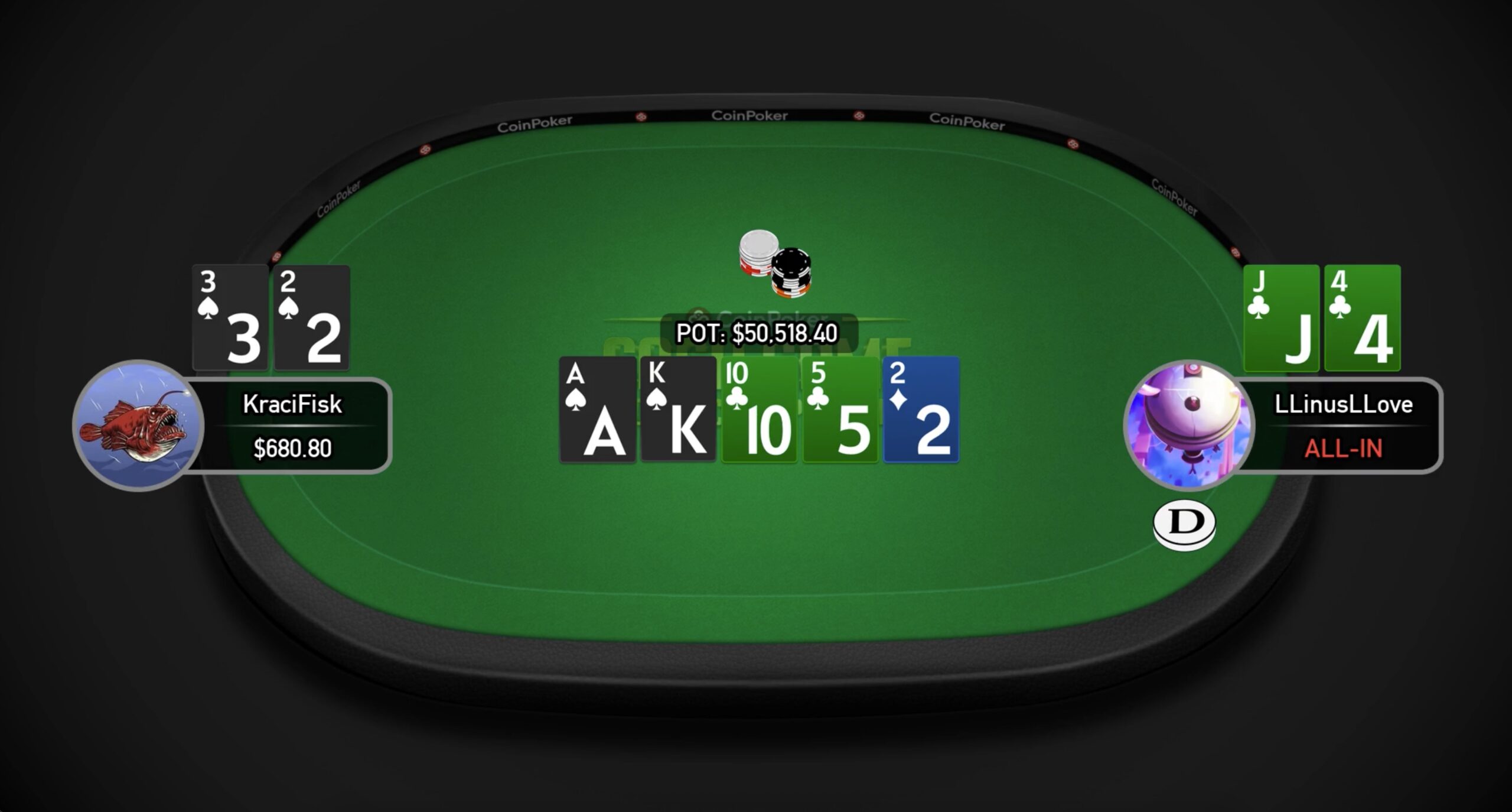
Linus ‘LLinusLLove’ Loeliger continues to take on all comers in the high-stakes no-limit hold’em games on CoinPoker. Loeliger’s latest tilt came against fellow high-stakes regular ‘KraciFisk,’ as the two played $100-$200 the old-school way, with no antes.
KraciFisk got the better of the Swiss legend, winning about $80,000. The two played some wild hands, featuring crazy hero-calls and brazen bluffs.
KraciFisk Bluffs Then Hero-Calls River
At 125 big blinds deep, Loeliger opened to $500, and KraciFisk made it $2,100. Loeliger called.
The flop came A♠K♠10♣. KraciFisk continued for $2,740, and Loeliger called. KraciFisk then potted the 5♣ turn for $9,680. Loeliger called. On the 2♦ river, KraciFisk checked. Loeliger shoved for the remaining $10,739, and KraciFisk called.
Loeliger showed J♣4♣ for a whiffed backdoor draw, and KraciFisk took it down with just 3♠2♠ for bottom pair.
Two missed flush draws square off on the river. pic.twitter.com/Zbkld9lVI7
— CoinPokerAction (@CoinPokerAction) February 17, 2026
Hand Analysis
Preflop, KraciFisk’s three-bet is on the adventurous side, but almost every suited hand is supposed to three-bet at some frequency in heads-up no-limit hold’em. So, this combo is actually fine as long as KraciFisk isn’t doing it too often.
Loeliger’s call is also thin. The jack-high suited hands are indifferent, with the weak 10-high ones folding and the weak queen-high ones mostly calling.
Much like in tournament poker, the ace-king flops are usually played as big bet or check. KraciFisk correctly bets big with the weak flush draw, and Loeliger opts to continue with a borderline hand. If he suspects that KraciFisk is too wide, then this call is going to win money in theory.
Things go off the rails a bit on the turn, as the solver actually favors overbet shoving with KraciFisk’s combo draw. It doesn’t have any showdown value and can garner folds from hands as strong as A-J. That might be optimistic. But certainly, weak, unpaired peels like the one Loeliger actually had would fold.
As played, Loeliger does correctly call, but he misses on the river and faces a check. It’s actually pretty hard for Loeliger to be unpaired on the river, so the bluffs are going to come from a lot of missed draws, even though these generally have bad blockers to be used as such. He does go for the bluff, which is correct despite the fantastic odds KraciFisk is getting on a call.
Interestingly enough, KraciFisk’s call is fine in the solver as well. Their combo is indifferent, so if Loeliger is bluffing too often, it will become a call, and if he’s not bluffing enough, it will become a fold.
Loeliger Goes for Crazy Turn Shove
Playing just a tad more than normal 100-blind stacks, KraciFisk raised to $460, and Loeliger reraised to $2,000. KraciFisk four-bet to $5,200, and Loeliger called.
On the Q♠Q♣2♣ flop, Loeliger checked and called $2,080. He came out with a jam for just under pot, $13,342, on the 10♠ turn.
KraciFisk quickly called with Q♦J♥ for trips. Loeliger had a combo draw with 9♠8♠, though KraciFisk had a couple of the outs killed with their J. They ran it twice, and the 9♣ and 4♥ were both safe for KraciFisk.
More KraciFisk vs. LLinusLLove action. pic.twitter.com/DMG7FDa9Qm
— CoinPokerAction (@CoinPokerAction) February 17, 2026
Hand Analysis
KraciFisk raises, and Loeliger has a normal three-bet with a good suited connector. However, he faces a four-bet, and KraciFisk does choose a good combo to attack with here. Four-betting Q-J forces folds from some dominating holdings as strong as A-J. Even if that particular hand might not always fold, K-J and some slightly better hands like offsuit K-X and A-X probably will.
Loeliger’s hand is actually indifferent against the four-bet because of the somewhat shallow stacks (by cash game standards), but he decides to take a flop.
KraciFisk hits the dream flop and bets very small. Loeliger is supposed to only continue with his 9♣8♣ and fold the backdoor draw. However, he sticks around.
Once again, the hand goes to the streets on the turn. Loeliger’s turn shove is definitely a non-standard play. He’s supposed to check his entire range despite having a slight equity advantage — it’s important to remember that the out-of-position player eliminates most of their air by check-calling the flop. The in-position player, meanwhile, can still have many bluffs.
Still, Loeliger is out of position against a range that includes plenty of good and great hands, and the small blind has a big advantage in trips-or-better holdings. It also makes little sense for Loeliger to play a Q this way.
The out-of-line bluff gets snapped off and punished.
Hungry for more high-stakes poker content? Check out the CoinPoker YouTube channel and Bobby James’ YouTube channel for more action.