







Draw in Poker: Definition, Types & Strategy
What Is a Draw in Poker?
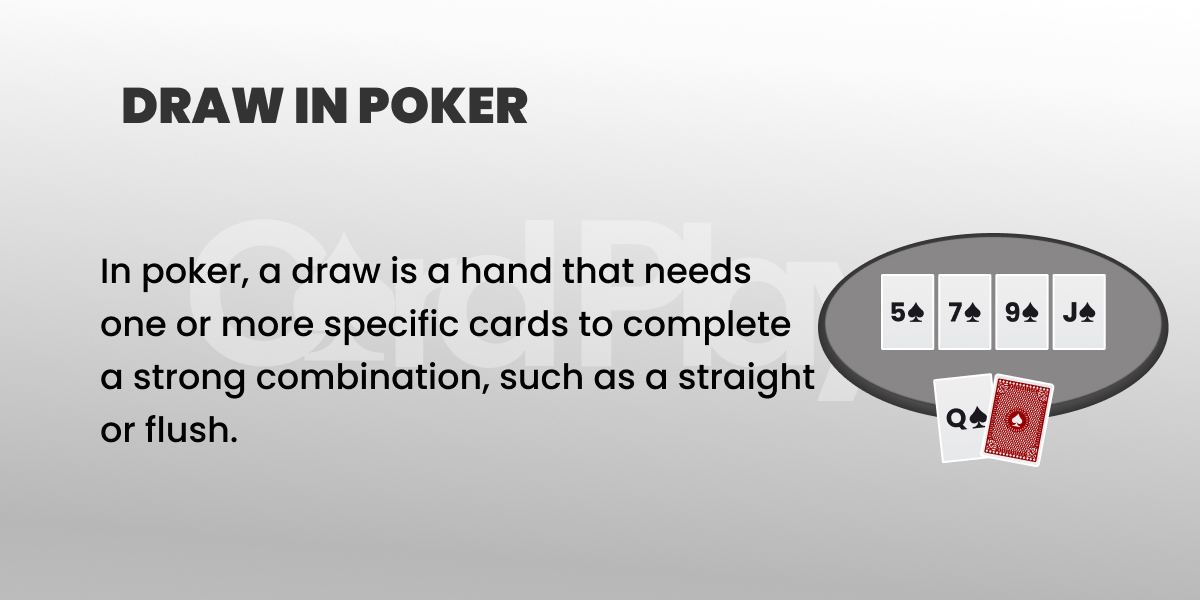
A draw in poker is an incomplete hand that needs one or more specific cards to improve it into a strong hand.
Terms like open-ended straight draw, gutshot, and the combo draw will come up a number of times, and the art lies in the assessment of how likely the drawn hand is to improve and if it’s worth chasing.
In addition to these terms, a flush draw in poker occurs when a player has four cards of the same suit, requiring one more to complete the flush. A straight draw in poker is when the player needs a card of a specific rank to complete a straight.
Draw in Poker: Key Points
- A draw in poker is a hand that needs one or more cards to create a strong combination
- Straight draws and flush draws in poker both fall under this umbrella, along with gutshots, backdoor draws, and combo draws.
- A good draw strategy depends on counting outs, estimating equity, and comparing the cost of risk and reward.
Types of Poker Draws
There are several draw types that emerge frequently enough that players can recognize them without much thought. The straight draw is the easiest place to start.
Open-Ended Straight Draw
An open-ended straight draw will happen when a player holds four cards that are sequential, with two possible ranks that can make the straight.
When you have 8-9 with the board showing 6-7-K, you’re one card away from a straight on both ends. Any 5 completes the low end (6-5-6-7-8-9), and any 10 completes the high end (6-7-8-9-10).
Since there are four 5s and four 10s remaining in the deck, you have a total of eight outs.
Gutshot Draw
With a gutshot draw, also known as an inside straight draw, only a card of a specific rank turns that draw into a straight.
This results in there being only four outs. For new players seeking a definition of a gutshot draw in poker, the simplest one is that the specific rank of a particular card must come up.
Flush Draw
Flush draws are not very different.
When playing poker, either at online poker sites or a local card room, a flush draw gives you nine outs. A flush draw typically provides nine outs. Players with Ace-high flush draws are more confident betting because their flush will be the nuts, eliminating the risk of losing to a higher flush.
Backdoor Draw
Backdoor draws are a bit different.
What is a backdoor draw in poker exactly can only be explained by pointing out that for a successful completion of the hand, you need two perfect cards, one on the turn and one on the river.
They’re long shots, but they can add equity when semi-bluffing or when you have other reasons to continue in the hand.
Combo Draw
Lastly, combo draws are where a given hand can improve in more than one way.
Combo draws occur when a player has multiple ways to improve their hand. For example, holding both a flush draw and a straight draw at the same time creates a combo draw with numerous outs, placing these hands at the top of the draw strength scale.
Draw Odds and Probabilities
Learning how to count outs makes draw decisions much easier. Outs represent the cards in the deck that can improve your hand. The table below summarizes common draw types:
| Draw Type | Outs | Simple Example |
|---|---|---|
| Flush draw | 9 | A♣ J♣ on 7♣ 2♣ Q♥ |
| Open-ended straight draw | 8 | 8-9 on 6-7-K |
| Gutshot draw | 4 | 9-J on 8-Q-2 needing a 10 |
| Backdoor flush draw | 1-2 immediate outs (requires perfect runouts) | A♠ 9♠ on Qd 4♥ 2♠ |
| Combo draw | 12-15 (varies) | J♣ T♣ on 9♣ 8♣ 2♥ |
Once you have your outs, converting them to equity uses a quick approximation known as the Rule of 2 and 4. Multiply your outs by 2 to estimate your chance of hitting on the next card, or by 4 to estimate your chance of hitting by the river if you see two more cards.
A small reference table helps put things into perspective:
| Outs | Chance to Hit by River | Chance to Hit on Next Card |
|---|---|---|
| 4 | about 17% | about 8% |
| 8 | about 32% | about 17% |
| 9 | about 35% | about 19% |
| 12 | about 45% | about 24% |
| 15 | about 54% | about 32% |
After you calculate your equity, you also need to calculate pot odds. Pot odds express the expense of the call in comparison with the pot.
Once the pot provides a better price than the chance of getting your draw, the call becomes mathematically optimal. It’s a natural transition for players to learn about the price of the chase after they have a grasp on what a flush draw is.
Draw Strategy for Beginners
Even if you understand the math behind the calculations, you still need insight regarding situations where the drawing in poker is optimal.
To keep drawing, players usually require large pots, high implied odds, or sufficient draws that allow them to take aggressive play. An ideal situation could be when playing heads-up in the pot with the nut flush draw and the opponent betting a decent number of chips.
Drawing hands fold when:
- The price is too high.
- The draw is not very good.
- There are reverse implied odds.
Having a gutshot draw with a large bet on a paired board is usually the time to fold.
Learning when to chase draws takes practice and discipline. New players often discover that in poker, a straight draw or backdoor draw can shape their strategy differently depending on how many ways the hand can win.
Understanding Draw Hand Strength
It’s helpful to break down the draws into elementary layers, allowing new players to categorize them.
- Weak Draws (Avoid unless very cheap): Backdoor draws, and gutshot draws fall here. These draws rarely hit and don’t win big pots. Only continue if the call costs almost nothing.
- Marginal Draws (Play cautiously): A gutshot straight draw on a paired board, or a low flush draw when facing heavy action. These draws have some potential, but not enough to commit many chips. Call small bets, fold to big pressure.
- Strong Draws (Profitable in most spots): Flush draws and open-ended straight draws fit here. They hit often enough to call comfortably and can support semi-bluffs.
- Monster Draws (Play aggressively): Combo draws with 12+ outs belong in this tier. They have so much equity that betting or raising is usually the best approach.
Common Mistakes with Draws
Many players misplay draws by calling too often without considering the pot odds or implied odds.
- Chasing a hand simply because it has potential: This leads to long-term losses. Strong players take time to confirm whether the cost of continuing is warranted based on the likelihood they’ll complete the draw vs the pot odds they are getting.
- Another frequent error is playing draws passively: By only calling, players surrender fold equity and allow opponents to dictate the pace of the hand. Semi-bluffing with the right combination of equity and position can win the pot immediately or set up a profitable river decision.
- A third mistake is overvaluing dominated draws: This is especially true on paired or heavily coordinated boards. Not all draws are worth the same, and ignoring reverse implied odds can turn a semi-strong hand into an expensive trap. Good players stay selective, choosing draws that interact well with the board and can win big pots when they hit.
Real Examples of Draw Hands in Poker
Imagine you hold A♣ 9♣ on a flop of Q♣ 7♣ 2♥. Your opponent bets half the pot. The pot is 60, and the bet is 30, giving you 2-to-1 pot odds. Your flush draw has 9 outs and roughly 35% equity by the river.
Since 35% is higher than the 33% required by your pot odds, calling is justified.
Draws shape a huge part of poker decision-making. Recognizing good and bad spots takes practice, but the basic tools of counting outs, estimating equity, and weighing pot odds make everything much clearer. Once you get comfortable with what a draw is in poker, the rest of your strategy starts to fall into place.
FAQs
What is a draw in poker?
A draw is an incomplete hand that improves to a strong hand if certain cards appear.
What are the odds of hitting a flush draw?
A flush draw has 9 outs, giving it about a 35% chance to complete by the river.
What is the difference between a straight draw and a flush draw?
A straight draw needs cards of certain ranks to come in order to be completed, while a flush draw needs cards of a certain suit to come in order to be completed.
How many outs does an open-ended straight draw have?
An open-ended straight draw has 8 outs.
Should you chase a draw in poker?
To decide whether to chase a draw in poker, you need to take into account pot odds and implied odds, as well as the strength of the draw.
What is the difference between a draw and a made hand?
A made hand is already complete, while a draw needs certain cards to come to improve.
What is a combo draw in poker?
A combo draw has multiple ways to improve, such as a straight draw plus a flush draw.
What is a gutshot draw in poker?
A gutshot is an inside straight draw that needs one specific rank to complete.