







Heads-Up in Poker: Rules, Strategy & Dynamics
What is Heads Up in Poker?
Heads-up poker is exactly what it sounds like: you versus one opponent. The blinds rotate every hand, your playable ranges get much wider, and aggression becomes your best friend. These dynamics apply whether you’re playing cash games or tournaments.
Heads-Up in Poker: Key Points
- The game structure in heads-up poker is the same, but with only two players. The blinds are changed each deal, and more pots are created.
- The ranges expand in both directions. Players raise, defend, and fold up considerably fewer times than they would in multiway pots.
- Balanced aggression is excellent heads-up play, as playing back out of position leaks easy money.
How Heads-Up Works in Texas Hold’em
Heads-up poker fundamentally differs from multi-way games – you face a single opponent at the table. Every game is one-on-one, and if you are accustomed to playing six-handed and full ring, you may find heads-up action quick and, in places, naked.
You get to see more flops, defend your position, and make moves. Heads-up poker centers on one-on-one competition where each hand presents unique strategic challenges based on position, stack sizes, and opponent tendencies.
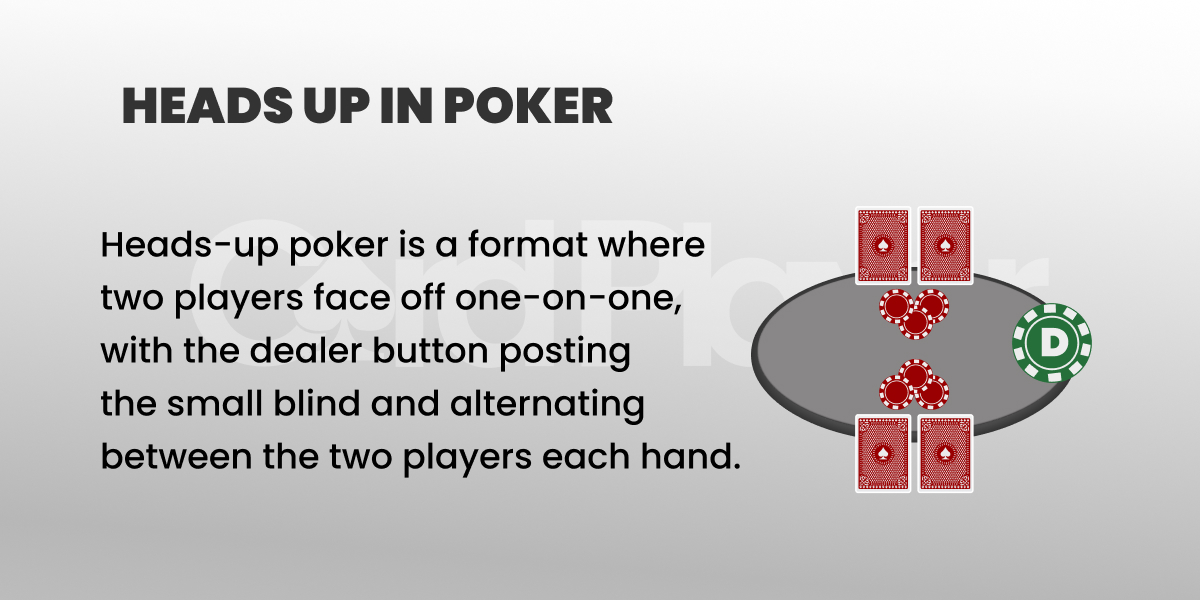
When beginners hear about heads-up in poker, the first confusion usually involves who posts which blind and who acts first. In full-ring games, the order feels natural. With two players, however, the rules shift slightly. The dealer posts the small blind, and the other player posts the big blind.
Per heads-up Texas Hold’em rules, the dealer button posts the small blind, and the other player posts the big blind. Action begins with the small blind whenever cards are dealt. After the flop is placed, the big blind acts first, giving the button last action on all later streets.
This pattern repeats with each new hand and is consistent across both online poker sites and live action. Since all blinds are rotated after each hand and occur at a considerably faster pace than in full-ring games, each player finds themselves assuming each position continuously.
Both players need to learn to open from the small blind and protect the big blind with a wide range of hands. This is one of the first fundamentals you must learn in heads-up poker.
Pots tend to grow quickly. With only one player to contend with, the small blind can raise a significant portion of hands. Many new players struggle with the sudden flood of marginal holdings – that’s normal.
The crucial part is understanding that hands appearing weak in full-ring games become significantly stronger heads-up. Q4 suited, K3 offsuit, and any ace become a standard raising hands due to the changed dynamics. This is part of that intuitive leap all new poker players must make.
Heads-up appears in Texas Hold’em cash games, final tables, or even home games when playing heads-up at the table. Wherever it appears, one thing is constant, and that is that ranges expand, and decision-making improves.
And if you lose focus even for an instant, your opponent seizes the initiative. This is why understanding how to play heads-up poker with structure, patience, and controlled aggression matters so much for beginners.
Understanding Position & Blinds in Heads-Up
To grasp position and blinds in heads-up Hold’em, you must understand a few key concepts.
In poker, position is paramount, and its effect is amplified in heads-up games. The player at the table with the button has a heads-up position advantage over their opponent on all streets, apart from the pre-flop street.
The last word in a pot with one opponent at your table gives you all the latitude to control your game’s tempo – increase, slow down, trap, and pressure your opponent. The big blind has no choice but to react.
This is due to this edge, and playing small blind raises an enormous amount of hands. The majority of modern ranges entail calling with 70-85% of all available heads-up poker hands in Texas Hold’em. This figure may come as a shock to new players, but it is ideal for this format. Since you have a positional advantage after the flop, you automatically possess leverage.
On the other hand, it’s essential that the big blind be aggressive in defending its position. Folding out too often creates leaks. Every time you fold, you’re giving the small blind free money.
This is why you find high-level big blind players calling with chips they wouldn’t consider playing with in an open game with nine players at the table. Hands like J5, 86, or even Q2 suited become defensible from the big blind – holdings you’d fold without hesitation in full-ring games.
Optimal Preflop Ranges for Heads-Up Play
A good player has his heads-up game plan revolving around these two starting concepts: raise nearly anything on the button, and defend a wide range of hands in the big blind. And then, based on playing habits, stack size, and comfort level post-flop, ranges are more diversified.
For new users, it can be helpful to keep things simple:
- Button: Raise with most hands, fold worst off-suited combinations, and mix in limps selectively if necessary.
- Big blind: Call quite frequently, 3-bet many suited Aces, suited broadways, strong pocket pairs, and some suited connectors.
The most crucial aspect in heads-up poker is being unpredictable. If you only play a narrow range of hands, your opponent will quickly notice and exploit this pattern.
For example, if you only defend your big bling with premium hands, opponents that pay attention will simply raise every button and force you to fold constantly, stealing blinds at will.
Balanced play keeps opponents guessing and prevents them from running you over.
Common Mistakes in Heads-up Poker
All players new to this format typically make the same mistakes. The first one is overfolding. The second one is calling with too wide a range at incorrect times. The third mistake is underestimating the number of winning pots that can be gained through aggressive actions.
Here are some mistakes that show up most:
- Playing passive: This scenario occurs when you check and call frequently. The opponent will be controlling all your pots.
- Overshooting with matched pairs: A 44 or 66 is quite tempting, but sometimes it is better to fold. New players tend to overplay.
- Ignoring board texture: Board texture is huge in heads-up Play. An A-7-2 dry flop permits all kinds of continuation bets (c-bets). An 8-10-J wet board calls for caution.
- Not recognizing patterns: One opponent, one rhythm, one set of habits. You’ve got to pay attention.
Adjusting Strategy Against Different Opponents
Not all heads-up opponents are created equal. Some are tight and nervous, while others can’t stop putting pressure. But first, you need to make an observation. Like, how often they fold their hand to a raised bet, and how they react when they get checked.
Against tight players, bet even more from the button and make more c-bets. They will tend to overfold these spots. So pay attention and keep putting pressure when you notice it.
Against loose and aggressive players, you fold fewer times, trap them more, and allow them to push money into the pot with worse hands. These games require patience; the tactic of fighting wild play with more wild play is what gets many new players into trouble.
Such an adjustment marks true heads-up, or one-on-one, poker strategy. This is not about memorizing charts – it’s about recognizing patterns and reacting with controlled movements.
Heads-up in Cash Games vs Tournaments
In both cash games and tournaments, the same set of rules applies, but the situations will dictate how you play them. The stacks in cash games are deep and constant. You can reload your stack if needed. The course of your hands extends over more streets and more maneuvers.
In WSOP and WPT tournaments, as well as others, heads-up action typically appears at the end, when only the last two players are left. The stacks are generally shallow. Pressures from ICM are not present, as the payouts are fixed.
Psychological Factors & Reading Opponents
The mental game has far more influence over heads-up play than any other format. There is no hiding. Every pot is a battle. You find out what your opponent bets when they hit the flop, what they do when they miss, and how they handle pressure.
To read your opponents is not to guess but to compile small amounts of information. If someone bets quickly every time they miss a flop but pauses when they hold a strong hand, that is a readable pattern. These patterns emerge because the same two players play dozens of hands against each other.
The mental aspect will also influence your performance. Frustration, impatience, and pride can ruin your moves and decisions. When learning what heads-up in poker is, this aspect is underrated by beginning players. Maintaining your calm and keeping the process smooth is not easy.
Creating a Long-Term Heads-Up Poker Strategy
The game plan in heads-up poker involves structure first, followed by creativity. This is achieved by creating sound ranges, sound c-bets, and sound defensive lines, and then waiting to see what the other player does. After you understand your opponent’s pattern, you can then react.
Good heads-up players don’t get nervous at crucial points. They understand what’s mathematically right at each table and how to transition from aggressive to controlling without becoming passive.
This is what playing with a smart heads-up poker strategy is all about. You are not aggressive or passive; you adjust, step by step, until all your moves are tailored to your opponent.
FAQs
What is heads-up poker?
Heads-up poker is a format where exactly two players compete in each hand. This occurs at tournament final tables, in specialized cash games, or when only two players remain at any poker table.
How do blinds work in heads-up play?
Blinds are used in many table games to raise initial bets. The dealer makes the small blind and leads off, then plays last after the flop, while his opponent posts the big blind.
What hands should you raise heads-up?
Raise against most hands on the button, including all suited aces, broadways, suited connectors, and many offsuit holdings.
How aggressive should you be in heads-up poker?
Compared to multiway games, it’s even more aggressive here. You’re raising quite often, and also c-betting widely.
What are the best strategies for heads-up tournaments?
Employ push-fold ranges, limp and attack, defend wide, and accelerate due to shallow stacks.
Does position matter in heads-up Texas Hold’em?
The positional advantage that the player on the button has after the flop is one of the biggest edges available in this format.
What makes a strong heads-up player?
Stability in aggression, good three-range game, emotional control, and ability to adapt to an opponent’s habits.