







Cooler in Poker: Definition, Examples & How to Handle Them
What Is a Cooler?
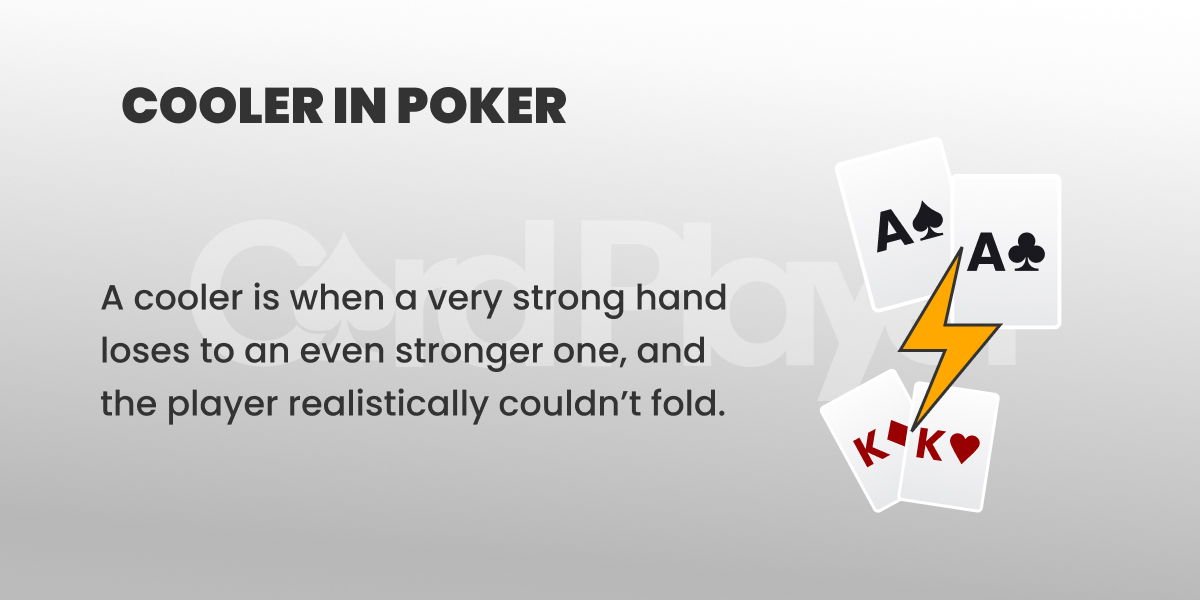
A cooler is a term that’s used to describe a situation where a player loses with an excellent hand to an even better hand. The word usually gets mentioned when a player is irritated, usually when they thought they had “the nuts” or a hand that couldn’t be beat.
Cooler in Poker: Key Points
- Cooler in poker means a situation when two players have strong hands, sufficient to make poker bets and raises, resulting in an inevitable confrontation.
- In coolers, the big difference from bad beats is that the winning hand is not an unlikely occurrence, it’s just an advantage.
- Cooler in poker play aims to minimize the amount lost and staying mentally disciplined once the round has concluded.
The Difference Between a Cooler & a Bad Beat
The terms “cooler” and “bad beat” are often confused, as they refer to similar concepts. In a bad beat, a disadvantaged hand gets a lucky break by obtaining an unlikely card. Examples of bad beat scenarios include losing with the top set after the opponent hits a runner-runner straight draw.
On the other hand, in the case of a cooler, there are two strong hands that go against each other. Raising Kings against Aces pre-flop and eventually losing, for example, does not fall under the definition of a bad beat. This situation demonstrates the cooler in poker meaning perfectly – both players have such strong hands that they’re expected to commit all their chips.
This distinction is important because of how you should evaluate your play. In the bad beat situation, the right play was made, and the bad break came when you lost to an unexpected outcome. In a case of a cooler, you made the right play, but you still lost.
Common Cooler Situations & Examples
In general, the average cooler usually occurs where each player’s hand sets up an adequate range that gives the hand overwhelming strength. In a pre-flop scenario, a typical cooler may be Aces vs Kings. These hands are not typical because a player would be dealt pocket Kings or Aces only about once in every 221 hands.
There’s another typical scenario on paired boards. Let’s assume you’re playing on an online poker site. In this poker cooler example, you raise with J-7, and the board shows J-7-7. You flopped a full house, and it’s an incredibly powerful hand. Another player could have raised with pocket J-J and hit quads. In both cases, the players involved usually build the pot because there’s nothing on the board calling for slow play.
Straights compared to higher straights, also flushes beaten by larger flushes, represent the same situation. When you have the King-high flush and your opponent has the Ace-high flush, there isn’t much chance that you’ll be able to fold. Even the pros can lose these pots.
Although there are no hard and fast rules for what counts as the term cooler in poker, a big hand against another big hand isn’t always a cooler situation. Some strong hands, like when you have top pair with a medium kicker, don’t fit the definition. That type of hand has sufficient play value to stay in the contest, yet it isn’t strong enough to commit stacks. This type of recognition, in general, will significantly improve the decision-making process.
How to Minimize Losses in Cooler Spots
While most real coolers cannot be avoided, a well-founded cooler poker strategy can help minimize the damage. The basic concept here is to manage the pot when your hand is strong, even though it may not be the best.
This is particularly challenging for beginners, who often believe that any strong hand requires maximum protection. The fact is, there are degrees of strength. Picking up a set on the flop means you have an incredibly strong hand. Having top two pair when you’re looking at a board with a possible straight draw for your opponent means you have a powerful hand, but a slightly vulnerable one.
Position goes a long way when it comes to the prevention of coolers. When you play last, you can ease up on turns and rivers where there has been a texture change. This could occur when the board pairs in a manner where someone else may have a full house. You have the chance to check back without risking a lot of chips. Players who are out of position do not have an opportunity like this.
There is also the issue of stack depth. In deep stacked cash games, there is the ability to fold strong, yet non-premium hands when there is a lot of action.
In tournaments, the presence of short stacks may eliminate this choice because the action becomes required. The knowledge of stack-to-pot ratios enables you to make an educated decision on whether the hand you hold qualifies for continuation.
Managing Tilt After a Cooler
Tilt can be one of the most hurtful reactions when playing poker, and coolers are particularly quick triggers. Even the most seasoned poker player gets their adrenaline pumping when they’re dealt a bad break with a strong hand. The big difference between an amateur and an expert, however, isn’t in the lack of emotion, but in recognizing it early.
The first step in dealing with the tilt situation would be to recognize that the emotional peak has occurred and should not be ignored. Some poker players may choose to take a break after a cooler, and others might simply fold a few hands and try to calm down.
There’s also the strategy of reminding yourself that coolers are part of the math in the game. The ultimate truth in poker, and in all things, is that you’re eventually bound to experience the winning and losing side of coolers numerous times.
Discussing the hand with a friend, either in the moment or reflecting on it later, can also be helpful. The purpose here isn’t necessarily to explain the bad beat, since it’s beyond defense anyway, but to assess whether there was anything about the bet you placed that could have been adjusted. When it is concluded that nothing can, the cooler becomes much easier to accept.
Coolers in Cash Games vs Tournaments
Coolers come in various forms, whether you’re playing at a live game or online casinos. The effect could be slightly different, whether you’re in a cash game situation or in a tournament. In cash games, the effect only affects the cash on the table. All you need to do in coolers is rebuy and play. From a mathematical perspective, the effect of coolers isn’t traumatic.
In a tournament, you can be completely knocked out by a cooler. Losing Queens to Kings with 25 big blinds hurts much worse in a tournament, since you are playing for the whole prize. A cooler in a tournament has much bigger psychological connotations, and that’s why poker mental toughness becomes even more essential.
However, the definition of a poker cooler stays the same. The real variable is how being involved in a cooler impacts your tournament life or cash game session.
Learning from Coolers to Improve Decision-Making
While coolers are inevitable, they still offer some learning points. The post-hand review enables you to evaluate whether there was a misinterpretation of the stack sizes, whether there was an available stronger hand, and whether there was over-aggression on the threatening card.
In most cases, you’ll see the hand was played correctly, and in other cases, you will recognize that you could save some chips in similar situations. The changes, though small, add up over thousands of played hands. Just cutting back on your losses, even a single big blind, can make you profitable in the long run.
Coolers also teach the importance of patience. Players are reminded that things are not always as they seem. The effect of one bad deal does not necessarily reflect the quality of your play.
Emotional Control and Long-Term Perspective
Handling coolers requires much more than just a proper poker strategy – it demands emotional control. Players who can effectively manage their emotions tend to experience long-term success much sooner.
The poker term ‘cooler’ can refer to an agonizing experience, but over the course of a season or an entire year, it becomes just one hand among others. When you put things into perspective, the anger fades, and you are able to keep playing your best even after suffering a bad loss.
FAQs
What is the difference between a cooler and a bad beat?
A bad beat involves a weaker hand catching up through luck. A cooler occurs when two strong hands collide, and the weaker one loses in a standard way.
Why is it called a cooler in poker?
The term refers to a hand that freezes a player in shock or surprise because the loss feels unavoidable.
Can you avoid coolers in poker?
Most of the time, no. True coolers are situations where folding would be unrealistic. You can reduce losses only in borderline spots.
What are common examples of a poker cooler?
Kings versus Aces, a lower flush losing to the nut flush, or a full house losing to a higher full house.
Why do coolers matter in poker strategy?
They teach players about variance, discipline, and long-term thinking. They also guide decisions about pot control.
How should a player respond after suffering a cooler?
Take a moment to settle your nerves, review the hand later, and continue making solid decisions.
Does losing a lot of chips mean you got cooler?
Sometimes, large losses come from overplaying mediocre hands. A true cooler involves strong hands on both sides.
How do you handle a poker cooler?
Stay calm, avoid impulsive decisions, review the situation later, and trust that good play wins over time.