





At the World Series of Poker, can a player be penalized for actions that do not violate a specific rule?
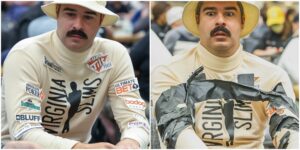
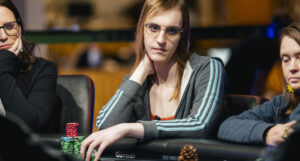
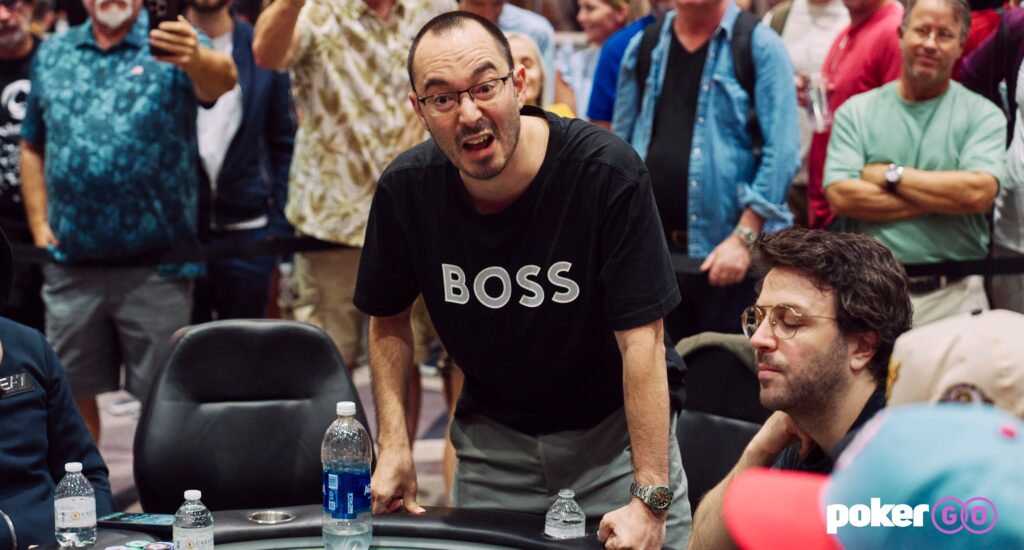
We are talking, of course, about Will Kassouf and perhaps to a lesser extent, about Martin Kabrhel. The behavior of both can be fairly described as generally obnoxious, but it can be argued that the rules don’t forbid being obnoxious. Furthermore, there is an anti-authoritarian streak in poker players that tends to give players the benefit of the doubt when the powers that be come down on their behavior.
The Making Of A Rule
It therefore seems only fair for the authorities to tread carefully and to give players advance warning that some particular act will be penalized. Over the years, the WSOP has been reactive, crafting rules to address particular problems that have arisen.
For example, a number of years ago a player thought he would keep his lucky streak alive if he did not bathe or use deodorant. He was escorted from the tournament shouting, “Show me in the rules where it says you have to take a shower!”
The next year, you could show him Rules 40c and d:
- All Participants are entitled to expect civility and courtesy from one another at every table and throughout the WSOP area …. This rule shall include, but is not limited to, any Participant whose personal hygiene has become disruptive to the other Participants seated at their table. The determination as to whether an individual’s personal hygiene is disruptive to other Participants shall be determined by WSOP Personnel which may, in its discretion, implement sanctions upon any such Participant who refuses to remedy the situation in a manner satisfactory to Host Properties.
After Jamie Gold disclosed the contents of his hands, Rule 116 followed, stating in part that…
- Participants may not… Disclose contents of live or folded hands.
And do you remember Hevad Khan and his over-the-top celebrations after winning hands during the 2007 main event? The following rule was fashioned in 2008:
- Excessive celebration through extended theatrics, inappropriate behavior, or physical actions, gestures, or conduct may be subject to penalty. Any player that engages a member of the tournament staff during the celebration or utilizes any property of Harrah’s will be penalized in accordance with Rules No. 31 and/or 51. Harrah’s property includes but is not limited to chairs, tournament tables, and stanchions.
Curiously, this rule does not seem to appear in the 2025 version of the rules.
Note, however, that in many of these cases, a penalty was imposed when the act occurred and before the specific rule was adopted. As has been frequently pointed out in this column, there is no doubt that the WSOP can take action, even when a rule does not address the particular conduct at issue.
The Best Interests Of The Game
In Major League Baseball, the Commissioner has the power to act in the “best interests of baseball.” At the Horseshoe, the rules state many times that the organizers have the power to act “in the best interests of the WSOP.” Rule 51 puts in succinctly:
- Where a situation arises that is not covered by these rules, Host Properties shall have the sole authority to render a judgment, including the imposition of a penalty, in accordance with the best interests of the Tournament and the maintenance of its integrity and public confidence.
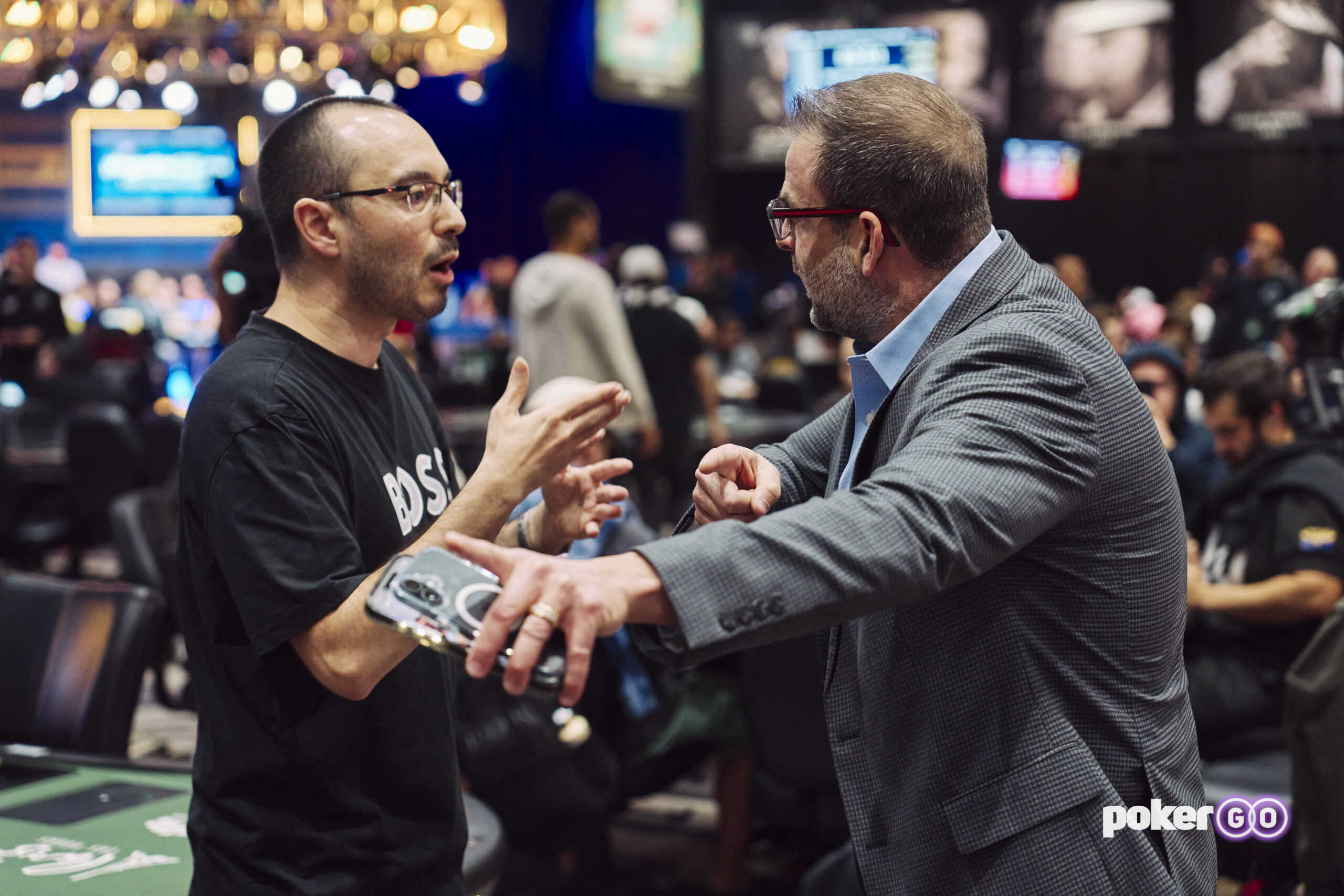
Will Kassouf Argues With Tournament Director Jack Effel
When no specific rule is violated, it seems incumbent upon tournament staff to advise the player of what behavior needs to stop and to impose an escalating series of penalties for violations. I thought Jack Effel and his staff did an excellent job of doing this in the case of Kassouf, and any problem communicating the issue to him was due to his constant arguing over their explanations.
Indeed, the penalties escalated to a ban on participation in future events. This is clearly permitted by Rule 41, which provides:
- In addition to the penalties authorized in Rule 40, Host Properties may impose penalties of any kind or nature upon any person who gives, makes, issues, authorizes, or endorses any statement or action having, or designed to have, an effect prejudicial or detrimental to the best interest of the WSOP as determined by Host Properties, acting in its sole and absolute discretion. This may include, but shall not be limited to, expulsion from the Event and property, forfeiture of a Participant’s entry fee(s) and/or loss of the right to participate in this and/or any other tournament conducted by Host Properties or its affiliates.
In any event, even though the WSOP clearly had the power to take action under these general rules, it seems to me that Kassouf’s behavior violated specific existing rules. For example, Rule 119 prohibits “delay of the game” and “excessive chatter:”
- Etiquette Violations: Repeated etiquette violations will result in the imposition of penalties assessed by WSOP Personnel. Examples include, but are not limited to, unnecessarily touching other Participants’ cards or chips, body, or clothing, delay of the game, repeatedly acting out of turn, betting out of reach of the dealer, or excessive chatter. Excessive chatter includes, but is not limited to, talking or conversation that causes a disruption of Participants who are in a hand.
Crossing The Line
Did he delay the game? The commentators reported that Kassouf’s table played half as many hands as were played at other tables, and it seemed he was the only player with excessive decisions.
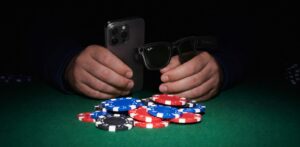
Was his chatter excessive? It was amusing to see the extent to which recent Poker Hall of Fame inductee and PokerGO commentator Nick Schulman made an effort to ignore him, even when he could be heard over the action being shown at other tables. His tablemates could not ignore him, however. I thought I heard the commentators say that players were forbidden from wearing noise-reduction headsets, even though new rule 64.b prohibits their use only at the final three tables.
Did this cause disruption? Kassouf has acknowledged that his “speech play” is intended to put other players on tilt. When the compulsion seemed to get out of his control and he himself went on tilt, it may have made for entertaining television, but it also distracted from the play of hands that should have been the focus of attention.
One can argue that imposing silence at the table kills much of the pleasure of playing, but it is a logical fallacy to suggest that anyone is trying to prohibit all table talk. You can argue about how much chatter is “excessive,” but when the stream of verbal diarrhea it is literally nonstop, any argument is pointless.
The fact is that restraining behavior like Kassouf’s falls within “the best interests of the game” and the WSOP does not need to enact a “Kassouf Rule” to serve those interests.
 Scott J. Burnham is Professor Emeritus at Gonzaga University School of Law in Spokane, Washington. He can be reached at profburnham@yahoo.com.
*Photos courtesy of PokerGO / Enrique Malfavon